Department of Health Services Administration, China Medical University, No. 91, Xueshi Rd., North Dist, Taichung City, 40402, Taiwan.
Department of Psychiatry, Changhua Christian Hospital, 135 Nanxiao St., Changhua City, Changhua County, 50006, Taiwan.
BMC Health Serv Res. 2020 Mar 18;20(1):230. doi: 10.1186/s12913-020-05089-6.
The decreased life expectancy and care costs of mental disorders could be enormous. However, research that compares mortality and utilization concurrently across the major category of mental disorders is absent. This study investigated all-cause mortality and medical utilization among patients with and without mental disorders, with an emphasis on identifying the psychiatric category of high mortality and low medical utilization.
A total of 570,250 individuals identified from the 2002-2013 Taiwan National Health Insurance Reearch Database consistuted 285,125 psychiatric patients and 285,125 non-psychiatric peers through 1:1 dual propensity score matching (PSM). The expenditure survival ratio (ESR) was proposed to indicate potential utilization shortage. The category of mental disorders and 13 covariates were analyzed using the Cox proportional hazard model and general linear model (GLM) through SAS 9.4.
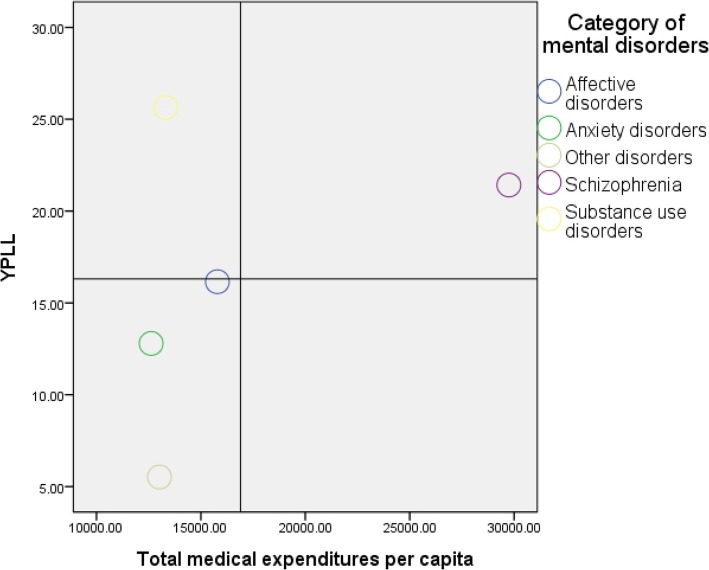
PSM analyses indicated that mortality and total medical expenditures per capita were both significantly higher in psychiatric patients than those in non-psychiatric patients (all P <.0.0001). Patients with substance use disorders were reported having the youngest ages at diagnosis and at death, with the highest 25.64 of potential years of life loss (YPLL) and relevant 2904.89 of ESR. Adjusted Cox model and GLM results indicated that, compared with anxiety disorders, affective disorders and substance use disorders were significantly associated with higher mortality (HR = 1.246 and 1.064, respectively; all P < 0.05); schizophrenia was significantly associated with higher total medical expenditures per capita (P < 0.0001). Thirteen additional factors were significantly associated with mortality or utilization (all P < 0.05).
Substance use disorders are the category of highest YPLL but notably in insufficient utilization. Health care utilization in patients with substance use disorders should be augmented timely after the diagnosis, especially toward home and community care. The factors related to mortality and utilization identified by this study merit clinical attention.
精神障碍患者的预期寿命和医疗费用可能会大幅减少。然而,目前还没有研究同时比较精神障碍主要类别中的死亡率和利用率。本研究调查了有和没有精神障碍的患者的全因死亡率和医疗利用率,重点是确定高死亡率和低医疗利用率的精神障碍类别。
通过 1:1 双重倾向评分匹配(PSM),从 2002 年至 2013 年的台湾全民健康保险研究数据库中确定了 570250 名参与者,其中 285125 名是精神科患者,285125 名是非精神科患者。提出支出生存比(ESR)来表示潜在的利用不足。使用 SAS 9.4 中的 Cox 比例风险模型和广义线性模型(GLM)分析精神障碍类别和 13 个协变量。
PSM 分析表明,精神科患者的死亡率和人均总医疗支出均显著高于非精神科患者(均 P <.0001)。物质使用障碍患者的诊断年龄和死亡年龄最小,潜在寿命损失(YPLL)为 25.64 年,相关 ESR 为 2904.89 年。调整后的 Cox 模型和 GLM 结果表明,与焦虑障碍相比,情感障碍和物质使用障碍与更高的死亡率显著相关(HR=1.246 和 1.064,均 P <.05);精神分裂症与人均总医疗支出显著相关(P <.0001)。另外 13 个因素与死亡率或利用率显著相关(均 P <.05)。
物质使用障碍是 YPLL 最高的类别,但利用率明显不足。物质使用障碍患者的医疗保健利用率应在诊断后及时增加,特别是家庭和社区护理。本研究确定的与死亡率和利用率相关的因素值得临床关注。