Domínguez-Contreras José F, Munguia-Vega Adrian, Ceballos-Vázquez Bertha P, Arellano-Martínez Marcial, García-Rodríguez Francisco J, Culver Melanie, Reyes-Bonilla Hector
Departamento Académico de Ciencias Marinas y Costeras, Universidad Autónoma de Baja California Sur, La Paz, Baja California Sur, Mexico.
Instituto Politécnico Nacional, Centro Interdisciplinario de Ciencias Marinas, La Paz, Baja California Sur, Mexico.
PeerJ. 2018 Feb 15;6:e4295. doi: 10.7717/peerj.4295. eCollection 2018.
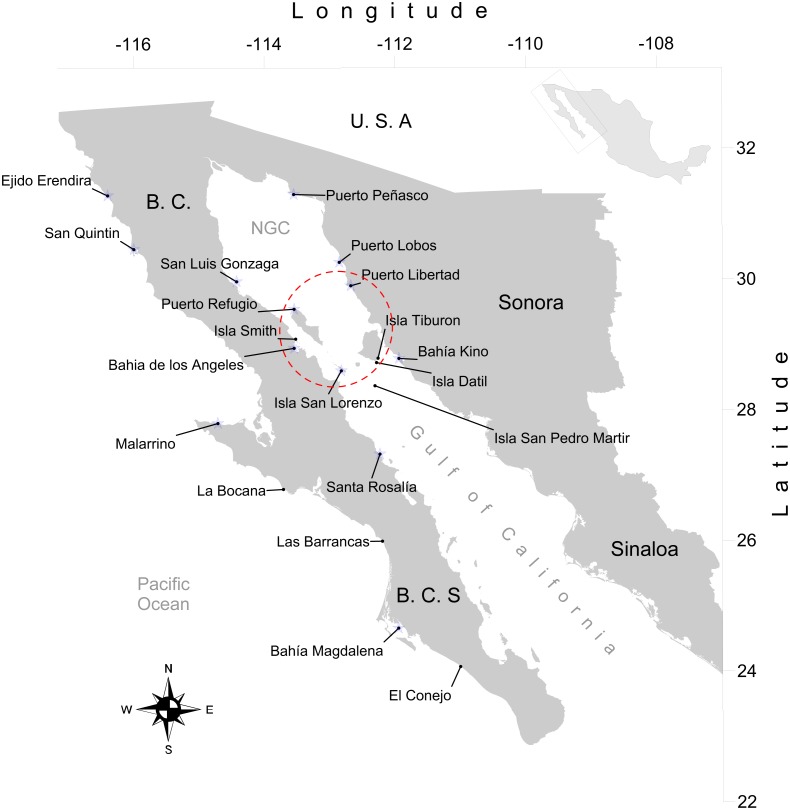
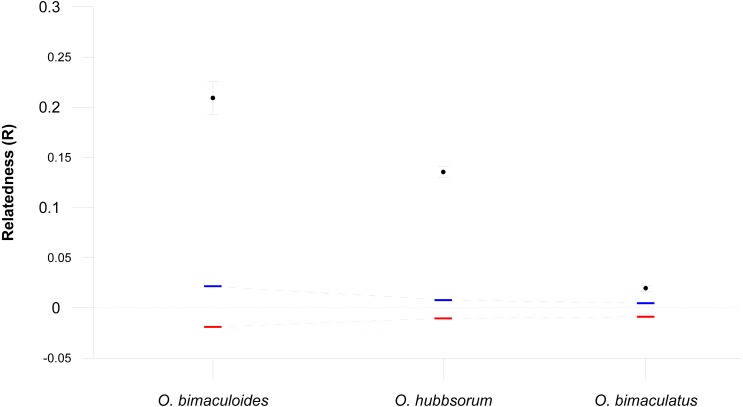
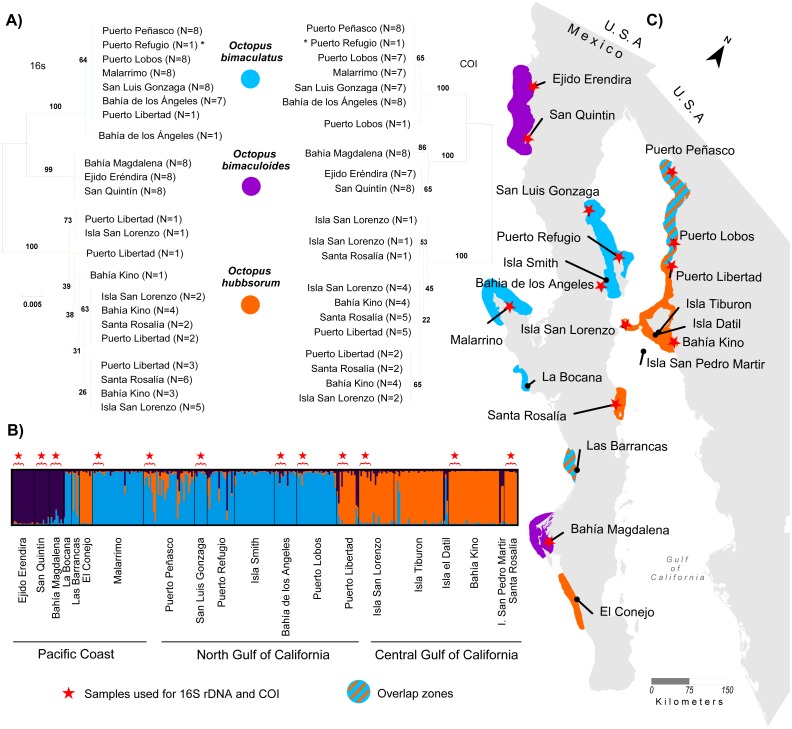
The fishery for octopus in Northwest Mexico has increased to over 2,000 tons annually, but to date the specific composition of the catch has been ignored. With at least three main species targeted by artisanal fisheries in the region with distinct life histories, the lack of basic biological information about the distribution, metapopulation size and structure of each species could impede effective fisheries management to avoid overexploitation. We tested if different life histories of three species of octopus could help predict observed patterns of genetic diversity, population dynamics, structure and connectivity and how this information could be relevant to the sustainable management of the fishery. We sequenced two mitochondrial genes and genotyped seven nuclear microsatellite loci to identify the distribution of each species in 20 locations from the Gulf of California and the west coast of the Baja California peninsula. We tested five hypotheses derived from population genetic theory based on differences in the fecundity and dispersal potential for each species. We discovered that with low fecundity and direct development (without a planktonic phase) had lower average effective population size and genetic diversity, but higher levels of kinship, population structure, and richness of private alleles, than the other two species. These features indicated limited dispersal and high local recruitment. In contrast, and with higher fecundity and planktonic phase as paralarvae had higher effective population size and genetic diversity, and overall lower kinship and population structure than . These observations supported higher levels of gene flow over a larger geographical scale. with the longest planktonic paralarval duration and therefore larger dispersal potential had differences in the calculated parameters possibly associated with increased connectivity. We propose is more susceptible to over exploitation of small, isolated populations and could have longer recovery times than the other two species. This species may benefit from distinct fishery management within each local population. and may benefit from fishery management that takes into account metapopulation structure over larger geographic scales and the directionality and magnitude of larval dispersal driven by ocean currents and population connectivity among individuals of each locality. The distribution of each species and variations in their reproductive phenology is also important to consider when establishing marine reserves or seasonal fishing closures.
墨西哥西北部的章鱼渔业产量已增至每年2000多吨,但迄今为止,渔获物的具体构成一直被忽视。该地区的个体渔业至少针对三种具有不同生活史的主要物种,而缺乏关于每种物种的分布、集合种群大小和结构的基本生物学信息,可能会阻碍有效的渔业管理,从而无法避免过度捕捞。我们测试了三种章鱼不同的生活史是否有助于预测观察到的遗传多样性、种群动态、结构和连通性模式,以及这些信息如何与渔业的可持续管理相关。我们对两个线粒体基因进行了测序,并对七个核微卫星位点进行了基因分型,以确定这三种章鱼在加利福尼亚湾和下加利福尼亚半岛西海岸的20个地点的分布情况。我们基于每种物种的繁殖力和扩散潜力的差异,测试了从种群遗传理论得出的五个假设。我们发现,与其他两个物种相比,繁殖力低且直接发育(无浮游阶段)的物种平均有效种群大小和遗传多样性较低,但亲缘关系、种群结构和私有等位基因丰富度较高。这些特征表明扩散有限且本地补充率高。相比之下,繁殖力较高且有浮游幼体阶段的物种和 具有更高的有效种群大小和遗传多样性,总体亲缘关系和种群结构低于 。这些观察结果支持了在更大地理尺度上更高水平的基因流动。 具有最长的浮游幼体持续时间,因此扩散潜力更大,其计算参数存在差异,可能与连通性增加有关。我们提出, 比其他两个物种更容易受到小的孤立种群过度捕捞的影响,恢复时间可能更长。该物种可能受益于每个当地种群内不同的渔业管理。 和 可能受益于考虑更大地理尺度上集合种群结构以及洋流驱动的幼体扩散方向和规模以及每个地点个体之间种群连通性的渔业管理。在建立海洋保护区或季节性禁渔时,考虑每种物种的分布及其繁殖物候的变化也很重要。