Department of Surgery, Healthcare Research Institute, Seoul National University Hospital Healthcare System Gangnam Center, Seoul, South Korea.
Department of Internal Medicine, Healthcare Research Institute, Seoul National University Hospital Healthcare System Gangnam Center, Seoul, South Korea.
PLoS One. 2018 Feb 23;13(2):e0193516. doi: 10.1371/journal.pone.0193516. eCollection 2018.
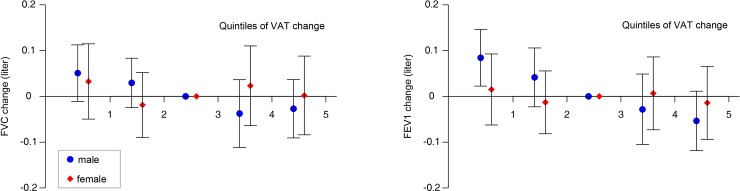
Obesity, particularly abdominal obesity, might be related to decreased lung function. We aimed to investigate whether obesity indices are associated with forced expiratory volume in one second (FEV1) and forced vital capacity (FVC) in asymptomatic non-smokers through a longitudinal cohort study. The clinical records of 1,145 subjects (428 males, mean age 52.3 years) who underwent a comprehensive health evaluation, including spirometry and abdominal fat computed tomography, at least twice between 2007 and 2014 were retrospectively reviewed and analysed. The mean follow-up period was 1,105 days (over 3.0 years). The baseline total adipose tissue (TAT) and visceral adipose tissue (VAT) were inversely associated with both FEV1 and FVC (P < 0.05). The longitudinal study found that increasing TAT and VAT were significantly related to decreasing FEV1 and FVC, whereas decreasing TAT and VAT were related to increasing FEV1 and FVC in both males and females (P < 0.05). The strength and consistency of these associations were clearer in males than in females. However, no significant relationship was found between changes in subcutaneous adipose tissue and changes in lung function. In Korean non-smokers, longitudinal changes in abdominal visceral fat were found to be inversely related to changes in lung function over a mean period of three years. These results suggest that decreasing abdominal visceral obesity could increase lung function despite ageing.
肥胖,尤其是腹部肥胖,可能与肺功能下降有关。我们旨在通过一项纵向队列研究,调查肥胖指数是否与无症状不吸烟者的一秒用力呼气量(FEV1)和用力肺活量(FVC)有关。回顾性分析了 2007 年至 2014 年间至少两次接受全面健康评估(包括肺活量测定和腹部脂肪计算机断层扫描)的 1145 名受试者(428 名男性,平均年龄 52.3 岁)的临床记录。平均随访时间为 1105 天(超过 3.0 年)。基线总脂肪组织(TAT)和内脏脂肪组织(VAT)与 FEV1 和 FVC 呈负相关(P<0.05)。纵向研究发现,TAT 和 VAT 的增加与 FEV1 和 FVC 的降低显著相关,而 TAT 和 VAT 的减少与男性和女性 FEV1 和 FVC 的增加相关(P<0.05)。这些关联在男性中的强度和一致性比女性更明显。然而,皮下脂肪组织变化与肺功能变化之间没有发现显著关系。在韩国非吸烟者中,发现腹部内脏脂肪的纵向变化与三年平均时间内肺功能的变化呈负相关。这些结果表明,尽管随着年龄的增长,腹部内脏肥胖的减少可以增加肺功能。