Department of Pharmacy, Evidence-based Pharmacy Center, West China second hospital, Sichuan University, Chengdu, China.
Key Laboratory of Birth Defects and Related Diseases of Women and Children (Sichuan University), Ministry of Education, Chengdu, China.
BMC Psychiatry. 2018 Feb 23;18(1):50. doi: 10.1186/s12888-018-1610-5.
The risk of relapse in major depressive disorder (MDD) is associated with high worldwide disease burden. Cognitive behavioral therapy (CBT) and its modifications might be effective in relapse prevention. The aim of this review was to evaluate the efficacy of these treatments for reducing relapse of MDD.
The retrieval was performed in the databases of MEDLINE via Pubmed, EMBASE and PsycINFO via OVID, The Cochrane Library and four Chinese databases. Clinical trials registry platforms and references of relevant articles were retrieved as well. Hazard ratio (HR) and corresponding 95% confidence interval (CI) were used to pool evidences.
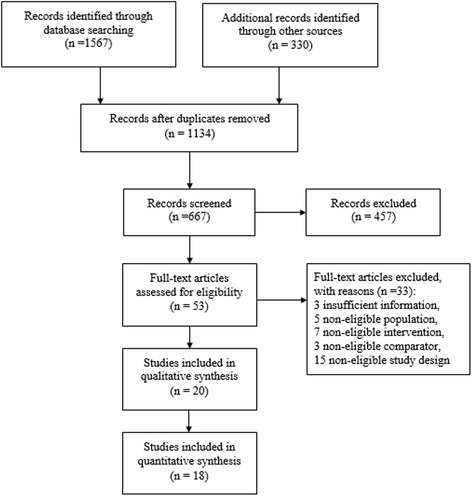
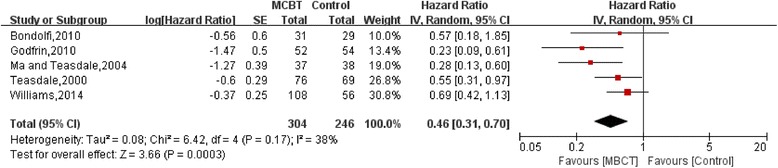
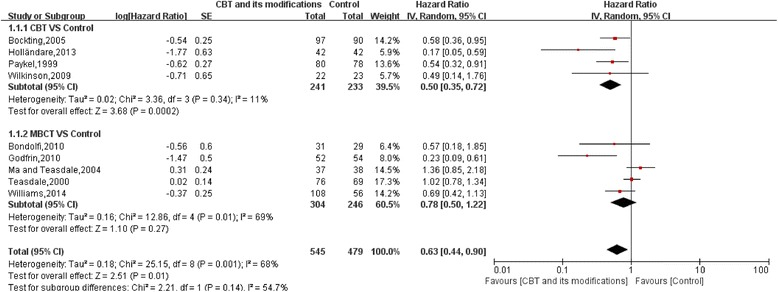
A total of 16 eligible trials involving 1945 participants were included. In the first 12 months, CBT was more efficacious than control in reducing the risk of developing a new episode of depression for MDD patients in remission (HR:0.50, 95%CI:0.35-0.72, I = 11%). Mindfulness-based cognitive therapy (MBCT) was more efficacious than control only among patients with 3 or more previous depressive episodes (HR:0.46, 95%CI:0.31-0.70, I = 38%). Besides, compared with maintenance antidepressant medication (m-ADM), MBCT was a more effective intervention (HR:0.76, 95%CI:0.58-0.98, I = 0%). These positive effects might be only maintained at two and nearly 6 years follow up for CBT.
The use of CBT for MDD patients in remission might reduce risk of relapse. Besides, the effect of MBCT was moderated by number of prior episodes and MBCT might only be effective for MDD patients with 3 or more previous episodes. Further exploration for the influence of previous psychological intervention is required.
重度抑郁症(MDD)的复发风险与全球范围内的高疾病负担有关。认知行为疗法(CBT)及其改良可能对预防复发有效。本综述的目的是评估这些治疗方法在降低 MDD 复发方面的疗效。
通过 Pubmed 检索 MEDLINE 数据库、通过 OVID 检索 EMBASE 和 PsycINFO 数据库、Cochrane 图书馆和四个中文数据库。还检索了临床试验注册平台和相关文章的参考文献。使用风险比(HR)和相应的 95%置信区间(CI)来汇总证据。
共纳入 16 项符合条件的试验,涉及 1945 名参与者。在前 12 个月,CBT 比对照组更能降低缓解期 MDD 患者新发抑郁的风险(HR:0.50,95%CI:0.35-0.72,I²=11%)。正念认知疗法(MBCT)仅在有 3 次或更多先前抑郁发作的患者中比对照组更有效(HR:0.46,95%CI:0.31-0.70,I²=38%)。此外,与维持抗抑郁药物治疗(m-ADM)相比,MBCT 是一种更有效的干预措施(HR:0.76,95%CI:0.58-0.98,I²=0%)。这些积极的效果可能仅在 CBT 随访 2 年和近 6 年时保持。
在缓解期 MDD 患者中使用 CBT 可能降低复发风险。此外,MBCT 的效果受到既往发作次数的影响,MBCT 可能仅对有 3 次或更多先前发作的 MDD 患者有效。需要进一步探索先前心理干预的影响。