From the Turku PET Centre (L.L.E., J.J., S.H., J.O.R.) and Department of Geriatrics (M.V., H.L.), Turku City Hospital (M.V., H.L.), University of Turku, Finland; Department of Radiation Sciences (J.J.), Umeå University; Clinical Geriatrics (M.V.), Karolinska Institutet, Karolinska University Hospital, Huddinge, Sweden; Department of Medicine, University of Turku (H.L.), and Division of Clinical Neurosciences (J.O.R.), Turku University Hospital; and National Institute for Health and Welfare (P.P., A.J.), Turku, Finland.
Neurology. 2018 Mar 27;90(13):e1150-e1157. doi: 10.1212/WNL.0000000000005214. Epub 2018 Feb 23.
To examine whether midlife insulin resistance is an independent risk factor for brain amyloid accumulation in vivo after 15 years, and whether this risk is modulated by ε4 genotype.
This observational study examined 60 elderly volunteers without dementia (mean age at baseline 55.4 and at follow-up 70.9 years, 55.5% women) from the Finnish population-based, nationwide Health2000 study with [C]Pittsburgh compound B-PET imaging in 2014-2016. The participants were recruited according to their homeostatic model assessment of insulin resistance (HOMA-IR) values in the year 2000, and their ε4 genotype. The exposure group (IR+, n = 30) consisted of individuals with HOMA-IR >2.17 at baseline (highest tertile of the Health2000 study population), and the control group (IR-, n = 30) consisted of individuals with HOMA-IR <1.25 at baseline (lowest tertile). The groups were enriched for ε4 carriers, resulting in 50% (n = 15) ε4 carriers in both groups. Analyses were performed with multivariate logistic and linear regression.
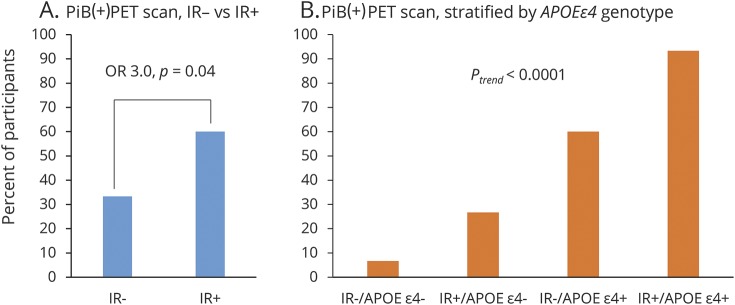
An amyloid-positive PET scan was found in 33.3% of the IR- group and 60.0% of the IR+ group (odds ratio 3.0, 95% confidence interval 1.1-8.9, = 0.04). The increased risk was seen in carriers and noncarriers of ε4 genotype. Higher midlife, but not late-life continuous HOMA-IR was associated with a greater brain amyloid burden at follow-up after multivariate adjustments for other cognitive and metabolic risk factors (β = 0.11, 95% confidence interval 0.002-0.22, = 0.04).
These results indicate that midlife insulin resistance is an independent risk factor for brain amyloid accumulation in elderly individuals without dementia.
研究中年胰岛素抵抗是否是 15 年后体内脑淀粉样蛋白蓄积的独立危险因素,以及这种风险是否受 ε4 基因型的调节。
本观察性研究纳入了来自芬兰全国性人群健康 2000 研究的 60 名无痴呆的老年志愿者(基线时平均年龄为 55.4 岁,随访时平均年龄为 70.9 岁,55.5%为女性),并于 2014 年至 2016 年期间进行了[C]匹兹堡化合物 B-PET 成像。根据 2000 年的稳态模型评估胰岛素抵抗(HOMA-IR)值及其 ε4 基因型招募参与者。暴露组(IR+,n=30)由基线时 HOMA-IR>2.17(健康 2000 研究人群的最高三分位数)的个体组成,对照组(IR-,n=30)由基线时 HOMA-IR<1.25(最低三分位数)的个体组成。两组均富集 ε4 携带者,导致两组各有 50%(n=15)为 ε4 携带者。采用多元逻辑回归和线性回归进行分析。
IR-组的淀粉样 PET 扫描阳性率为 33.3%,IR+组为 60.0%(优势比 3.0,95%置信区间 1.1-8.9,=0.04)。这种风险增加见于 ε4 基因型的携带者和非携带者。经其他认知和代谢危险因素的多变量调整后,较高的中年但非晚年连续 HOMA-IR 与随访时的大脑淀粉样蛋白负荷增加相关(β=0.11,95%置信区间 0.002-0.22,=0.04)。
这些结果表明,中年胰岛素抵抗是无痴呆老年个体脑淀粉样蛋白蓄积的独立危险因素。