Department of Medical Epidemiology and Biostatistics, Karolinska Institutet, Solna, Sweden.
School of Medical Sciences, Örebro University, Örebro, Sweden.
Diabetologia. 2021 Apr;64(4):767-777. doi: 10.1007/s00125-020-05372-5. Epub 2021 Jan 16.
AIMS/HYPOTHESIS: The aim of this study was to investigate the effect of childhood-onset type 1 diabetes on the risk of subsequent neurodevelopmental disorders, and the role of glycaemic control in this association. We hypothesised that individuals with poor glycaemic control may be at a higher risk of neurodevelopmental disorders compared with the general population, as well as compared with individuals with type 1 diabetes with adequate glycaemic control.
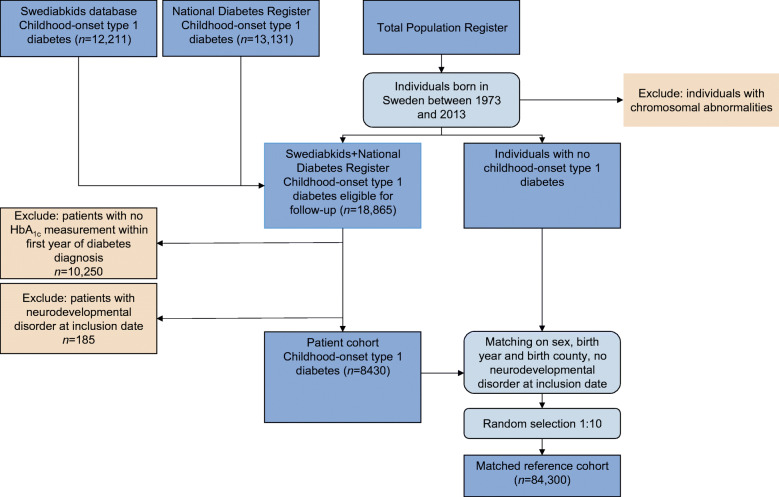
This Swedish population-based cohort study was conducted using data from health registers from 1973 to 2013. We identified 8430 patients with childhood-onset type 1 diabetes (diagnosed before age 18 years) with a median age of diabetes onset of 9.6 (IQR 5.9-12.9) and 84,300 reference individuals from the general population, matched for sex, birth year and birth county. Cox models were used to estimate the effect of HbA on the risk of subsequent neurodevelopmental disorders, including attention-deficit/hyperactivity disorder (ADHD), autism spectrum disorders (ASD) and intellectual disability.
During a median follow-up period of 5.6 years, 398 (4.7%) individuals with type 1 diabetes received a diagnosis of any neurodevelopmental disorder compared with 3066 (3.6%) in the general population, corresponding to an adjusted HR (HR) of 1.31 (95% CI 1.18, 1.46) after additionally adjusting for other psychiatric morbidity prior to inclusion, parental psychiatric morbidity and parental highest education level. The risk of any neurodevelopmental disorder increased with HbA levels and the highest risk was observed in patients with mean HbA >8.6% (>70 mmol/mol) (HR 1.90 [95% CI 1.51, 2.37]) compared with reference individuals without type 1 diabetes. In addition, when compared with patients with diabetes with HbA <7.5% (<58 mmol/mol), patients with HbA >8.6% (>70 mmol/mol) had the highest risk of any neurodevelopmental disorder (HR 3.71 [95% CI 2.75, 5.02]) and of specific neurodevelopmental disorders including ADHD (HR 4.16 [95% CI 2.92, 5.94]), ASD (HR 2.84 [95% CI 1.52, 5.28]) and intellectual disability (HR 3.93 [95% CI 1.38, 11.22]).
CONCLUSIONS/INTERPRETATION: Childhood-onset type 1 diabetes is associated with an increased risk of neurodevelopmental disorders, with the highest risk seen in individuals with poor glycaemic control. Routine neurodevelopmental follow-up visits should be considered in type 1 diabetes, especially in patients with poor glycaemic control.
目的/假设:本研究旨在探讨儿童期发病的 1 型糖尿病对随后发生神经发育障碍的风险的影响,以及血糖控制在这种关联中的作用。我们假设,与一般人群相比,血糖控制不佳的个体可能面临更高的神经发育障碍风险,与血糖控制良好的 1 型糖尿病患者相比也是如此。
这是一项基于人群的瑞典队列研究,使用了 1973 年至 2013 年健康登记处的数据。我们确定了 8430 名儿童期发病的 1 型糖尿病患者(发病年龄<18 岁),其糖尿病发病的中位年龄为 9.6(IQR 5.9-12.9),并从一般人群中匹配了 84300 名参考个体,这些个体在性别、出生年份和出生县方面匹配。Cox 模型用于估计 HbA 对随后发生神经发育障碍(包括注意力缺陷/多动障碍[ADHD]、自闭症谱系障碍[ASD]和智力残疾)风险的影响。
在中位随访 5.6 年期间,与一般人群中的 3066 人(3.6%)相比,有 398 人(4.7%)被诊断为任何神经发育障碍,在校正了纳入前其他精神疾病、父母精神疾病和父母最高教育水平等因素后,相应的调整后 HR(HR)为 1.31(95%CI 1.18,1.46)。任何神经发育障碍的风险随 HbA 水平而增加,最高风险见于平均 HbA >8.6%(>70mmol/mol)的患者(HR 1.90 [95%CI 1.51,2.37]),与无 1 型糖尿病的参考个体相比。此外,与 HbA <7.5%(<58mmol/mol)的糖尿病患者相比,HbA >8.6%(>70mmol/mol)的患者发生任何神经发育障碍(HR 3.71 [95%CI 2.75,5.02])和特定神经发育障碍(包括 ADHD[HR 4.16 [95%CI 2.92,5.94])、ASD(HR 2.84 [95%CI 1.52,5.28])和智力残疾(HR 3.93 [95%CI 1.38,11.22])的风险最高。
结论/解释:儿童期发病的 1 型糖尿病与神经发育障碍的风险增加相关,血糖控制不佳的个体风险最高。在 1 型糖尿病中,应考虑进行常规神经发育随访,尤其是在血糖控制不佳的患者中。