Chen Taoyang, Qian Gengsun, Fan Chunsun, Sun Yan, Wang Jinbing, Lu Peixin, Xue Xuefeng, Wu Yan, Zhang Qinan, Jin Yan, Wu Yiqian, Gan Yu, Lu Jianquan, Kensler Thomas W, Groopman John D, Tu Hong
Department of Etiology, Qidong Liver Cancer Institute, Qidong People's Hospital, Qidong, 226200, Jiangsu, China.
State Key Laboratory of Oncogenes and Related Genes, Shanghai Cancer Institute, Renji Hospital, Shanghai Jiao Tong University School of Medicine, Shanghai, 200032, China.
Hepatoma Res. 2018;4. doi: 10.20517/2394-5079.2017.50. Epub 2018 Jan 26.
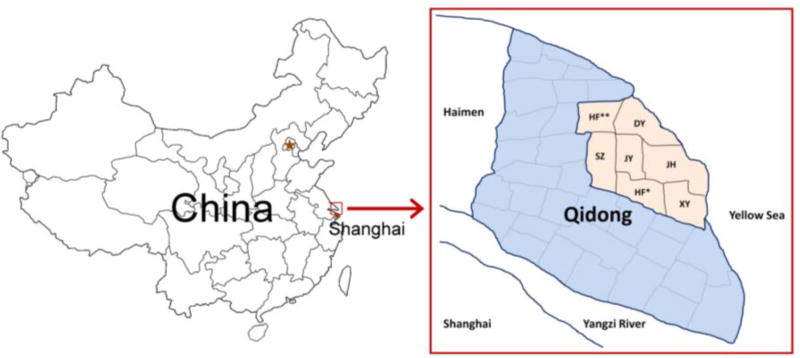
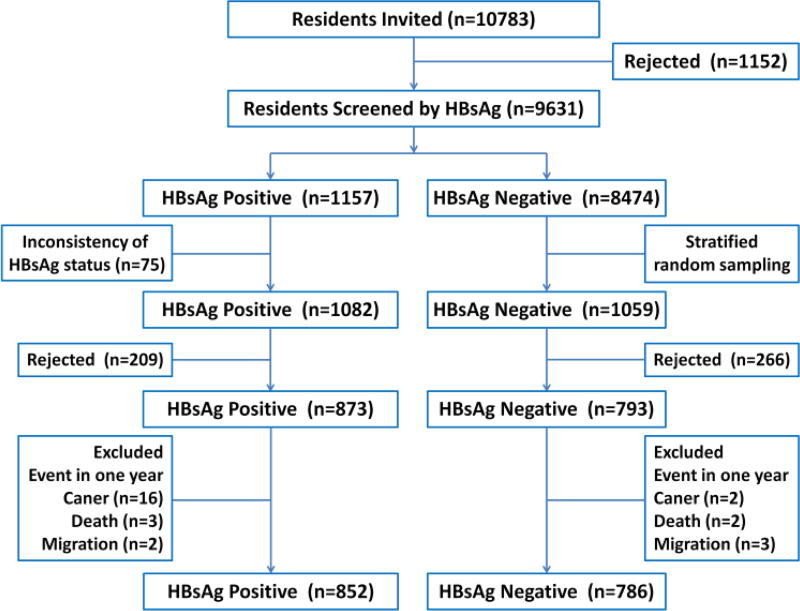
Qidong hepatitis B virus (HBV) infection cohort (QBC) is a prospective community-based study designed to investigate causative factors of primary liver cancer (PLC) in Qidong, China, where both PLC and HBV infection are highly endemic. Residents aged 20-65 years, living in seven townships of Qidong, were surveyed using hepatitis B surface antigen (HBsAg) serum test and invited to participate in QBC from June 1991 to December 1991. A total of 852 and 786 participants were enrolled in HBsAg-positive and HBsAg-negative sub-cohorts in May 1992, respectively. All participants were actively followed up in person, received HBsAg, alanine aminotransferase (ALT), alpha-fetoprotein (AFP) tests and upper abdominal ultrasonic examination, and donated blood and urine samples once or twice a year. The total response rate was 99.6%, and the number of incident PLC was 201 till the end of February 2017. The ratio of incidence rates was 12.32 (95% confidence interval[CI]=7.16-21.21, < 0.0001) in HBsAg-positive arm compared with HBsAg-negative arm. The relative risk of PLC was 13.25 (95% CI=6.67-26.33, < 0.0001) and 28.05 (95% CI=13.87-56.73, < 0.0001) in the HBsAg+/HBeAg- group and the HBsAg+/HBeAg+ group, respectively, as compared to the HBsAg-/HBeAg- group. A series of novel PLC-related mutations including A2159G, A2189C and G2203W at the C gene, A799G, A987G and T1055A at the P gene of HBV genome were identified by using samples from the cohort. The mutation in hepatitis B virus (HBV) basal core promoter region of HBV genome has an accumulative effect on the occurrence of PLC. In addition, the tripartite relationship of aflatoxin exposure, P53 mutation and PLC was also investigated. Dynamic prediction model for PLC risk by using its long-term follow-up information and serial blood samples for QBC was developed. This model is expected to improve the efficiency of PLC screening in HBV infection individuals.
启东乙肝病毒(HBV)感染队列研究(QBC)是一项基于社区的前瞻性研究,旨在调查中国启东原发性肝癌(PLC)的致病因素,启东是原发性肝癌和乙肝病毒感染的高流行地区。1991年6月至1991年12月,对居住在启东七个乡镇、年龄在20 - 65岁的居民进行了乙肝表面抗原(HBsAg)血清检测,并邀请他们参加QBC研究。1992年5月,分别有852名和786名参与者被纳入HBsAg阳性和HBsAg阴性子队列。所有参与者均接受主动的亲自随访,进行HBsAg、丙氨酸转氨酶(ALT)、甲胎蛋白(AFP)检测及上腹部超声检查,并且每年捐献一到两次血液和尿液样本。总应答率为99.6%,截至2017年2月底,原发性肝癌发病例数为201例。与HBsAg阴性组相比,HBsAg阳性组的发病率之比为12.32(95%置信区间[CI]=7.16 - 21.21,P < 0.0001)。与HBsAg - /HBeAg - 组相比,HBsAg + /HBeAg - 组和HBsAg + /HBeAg + 组原发性肝癌的相对风险分别为13.25(95% CI = 6.67 - 26.33,P < 0.0001)和28.05(95% CI = 13.87 - 56.73,P < 0.0001)。利用该队列的样本,鉴定出了一系列与原发性肝癌相关的新突变,包括乙肝病毒基因组C基因的A2159G、A2189C和G2203W,以及P基因的A799G、A987G和T1055A。乙肝病毒(HBV)基因组乙肝病毒基础核心启动子区域的突变对原发性肝癌的发生具有累积效应。此外,还研究了黄曲霉毒素暴露、P53突变与原发性肝癌的三方关系。利用QBC的长期随访信息和系列血样建立了原发性肝癌风险的动态预测模型。该模型有望提高乙肝病毒感染个体中原发性肝癌筛查的效率。