Department of Management, Kingston University Business School, Kingston-upon-Thames, KT2 7LB, UK.
Department of Psychology, Kingston University, Kingston-upon-Thames, KT1 2EE, UK.
Psychol Res. 2020 Feb;84(1):128-139. doi: 10.1007/s00426-018-0992-9. Epub 2018 Feb 26.
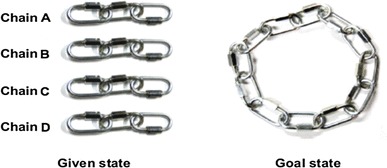
Insight is commonly viewed as originating from the restructuring of a mental representation. Distributed cognition frameworks such as the Systemic Thinking Model (SysTM, Vallée-Tourangeau and Vallée-Tourangeau, Cognition beyond the brain: interactivity and human thinking, pp 133-154, 2017), however, assumes that information processing can be transformed when it is distributed across mental and material resources. The experiments reported here investigated whether interactivity enhanced incubation effects with the cheap necklace problem. Participants attempted to solve the problem in a low-interactivity condition with pen and paper or in a high-interactivity condition with a set of metal chains. Performance was substantially better in a task environment that fostered a higher degree of interactivity at Time 1. There was evidence of an incubation effect as participants significantly improved in performance after a 2-week gap, particularly in the high-interactivity condition. Experiment 2 showed that the context within which people can enact their thinking following incubation is key to improve problem-solving performance. When the problem presentation changed after a 2-week gap (low interactivity to high interactivity or high interactivity to low interactivity), performance only improved for those who worked on a highly interactive task at Time 2. Taken together, these findings underscore the importance of adopting a systemic perspective when investigating incubation effects in problem solving.
洞察力通常被认为源自心理表征的重构。然而,分布式认知框架(如系统思维模型(SysTM,Vallée-Tourangeau 和 Vallée-Tourangeau,超越大脑的认知:交互性和人类思维,第 133-154 页,2017))假设当信息分布在心理和物质资源中时,信息处理可以被转化。这里报告的实验研究了互动性是否可以增强在廉价项链问题上的潜伏期效应。参与者在纸笔低互动条件下或在一套金属链高互动条件下尝试解决问题。在促进更高互动性的任务环境中,表现明显更好。有证据表明存在潜伏期效应,因为参与者在两周的间隔后在表现上显著提高,尤其是在高互动条件下。实验 2 表明,人们在潜伏期后进行思维表现的情境对于提高解决问题的表现至关重要。当问题呈现在两周的间隔后发生变化(低互动到高互动或高互动到低互动)时,只有那些在第二次尝试时进行高度互动任务的人才能提高表现。总之,这些发现强调了在研究解决问题的潜伏期效应时采用系统观点的重要性。