Adeniyi Oladele Vincent, Ajayi Anthony Idowu, Moyaki Mayowa Gabriel, Goon Daniel Ter, Avramovic Gordana, Lambert John
Department of Family Medicine and Rural Health, Walter Sisulu University, Cecilia Makiwane Hospital/East London Hospital Complex, East London, South Africa.
Department of Sociology, University of Fort Hare, 50, Church Street, East London, South Africa.
BMC Health Serv Res. 2018 Feb 27;18(1):140. doi: 10.1186/s12913-018-2942-z.
Integration of family planning services into HIV care was implemented in South Africa as a core strategy aimed at reducing unintended pregnancies among childbearing women living with HIV. However, it is unclear whether this strategy has made any significant impact at the population level. This paper describes the prevalence and correlates of self-reported unplanned pregnancy among HIV-infected parturient women attending three large maternity centres in the Eastern Cape, South Africa. We also compare unplanned pregnancy rates between HIV-infected parturient women already in care (who have benefitted from services' integration) and newly diagnosed parturient women (who have not benefitted from services' integration).
Drawing from the baseline data of the East London Prospective Cohort Study (ELPCS), data of 594 parturient women living with HIV in the Eastern Cape were included. Chi-square statistics and binary logistics regression were employed to determine the correlates of unplanned pregnancy among the cohort.
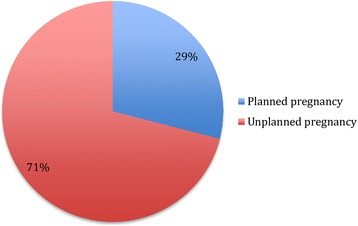
The prevalence of unplanned pregnancy was 71% (n = 422) with a higher rate among parturient women newly diagnosed during the index pregnancy (87%). Unplanned pregnancy was significantly associated with younger age, single status, HIV diagnosis at booking, high parity and previous abortion. Women who reported unplanned pregnancy were more likely to book late and have lower CD4 counts. After adjusting for confounding variables, having one child and five to seven children (AOR = 2.2; CI = 1.3-3.1), age less than 21 years (AOR = 3.3; CI = 1.1-9.8), late booking after 27 weeks (AOR = 2.7; CI = 1.5-5.0), not married (AOR = 4.3; CI = 2.7-6.8) and HIV diagnosis at booking (AOR = 3.0; CI = 1.6-5.8) were the significant correlates of unplanned pregnancy in the cohort.
Unplanned pregnancy remains high overall among parturient women living with HIV in the region, however, with significant reduction among those who were exposed to integrated services. The study confirms that integration of HIV care and family planning services is an important strategy to reduce unplanned pregnancy among women living with HIV. The study's findings have significant implications for the elimination of mother-to-child transmission of HIV in South Africa. Innovative interventions are needed to further consolidate and maximise the benefit of the integration of family planning services with HIV care.
在南非,将计划生育服务纳入艾滋病护理工作作为一项核心战略加以实施,旨在减少感染艾滋病毒的育龄妇女意外怀孕的情况。然而,尚不清楚这一战略是否在人群层面产生了显著影响。本文描述了在南非东开普省三家大型产科中心就诊的感染艾滋病毒的产妇中自我报告的意外怀孕的患病率及其相关因素。我们还比较了已接受护理的感染艾滋病毒的产妇(已从服务整合中受益)和新诊断的产妇(未从服务整合中受益)的意外怀孕率。
利用东伦敦前瞻性队列研究(ELPCS)的基线数据,纳入了东开普省594名感染艾滋病毒产妇的数据。采用卡方统计和二元逻辑回归来确定队列中意外怀孕的相关因素。
意外怀孕的患病率为71%(n = 422),在本次指数孕期新诊断的产妇中比例更高(87%)。意外怀孕与年龄较小、单身状态、孕期首次检查时确诊感染艾滋病毒、多胎妊娠和既往流产显著相关。报告意外怀孕的女性更有可能产检晚且CD4细胞计数较低。在对混杂变量进行调整后,有1个孩子和5至7个孩子(调整后比值比[AOR]=2.2;可信区间[CI]=1.3 - 3.1)、年龄小于21岁(AOR = 3.3;CI = 1.1 - 9.8)、27周后才进行产检(AOR = 2.7;CI = 1.5 - 5.0)、未婚(AOR = 4.3;CI = 2.7 - 6.8)以及孕期首次检查时确诊感染艾滋病毒(AOR = 3.0;CI = 1.6 - 5.8)是该队列中意外怀孕的显著相关因素。
该地区感染艾滋病毒的产妇中,意外怀孕总体发生率仍然很高,不过,那些接受了综合服务的产妇意外怀孕率显著降低。该研究证实,将艾滋病护理与计划生育服务相结合是减少感染艾滋病毒女性意外怀孕的一项重要战略。该研究结果对南非消除艾滋病毒母婴传播具有重要意义。需要采取创新干预措施,以进一步巩固并最大化计划生育服务与艾滋病护理相结合所带来的益处。