• 文献检索
  • 文档翻译
  • 深度研究
  • 学术资讯
  • Suppr Zotero 插件Zotero 插件
  • 邀请有礼
  • 套餐&价格
  • 历史记录
应用&插件
Suppr Zotero 插件Zotero 插件浏览器插件Mac 客户端Windows 客户端微信小程序
定价
高级版会员购买积分包购买API积分包
服务
文献检索文档翻译深度研究API 文档MCP 服务
关于我们
关于 Suppr公司介绍联系我们用户协议隐私条款
关注我们

Suppr 超能文献

核心技术专利:CN118964589B侵权必究
粤ICP备2023148730 号-1Suppr @ 2026

文献检索

告别复杂PubMed语法,用中文像聊天一样搜索,搜遍4000万医学文献。AI智能推荐,让科研检索更轻松。

立即免费搜索

文件翻译

保留排版,准确专业,支持PDF/Word/PPT等文件格式,支持 12+语言互译。

免费翻译文档

深度研究

AI帮你快速写综述,25分钟生成高质量综述,智能提取关键信息,辅助科研写作。

立即免费体验

在脸书上寻求帮助与更传统的求助途径:退伍军人的横断面调查

Help-Seeking on Facebook Versus More Traditional Sources of Help: Cross-Sectional Survey of Military Veterans.

作者信息

Teo Alan R, Marsh Heather E, Liebow Samuel B L, Chen Jason I, Forsberg Christopher W, Nicolaidis Christina, Saha Somnath, Dobscha Steven K

机构信息

Health Services Research and Development Center to Improve Veteran Involvement in Care, Department of Veterans Affairs Portland Health Care System, Portland, OR, United States.

Department of Psychiatry, Oregon Health & Science University, Portland, OR, United States.

出版信息

J Med Internet Res. 2018 Feb 26;20(2):e62. doi: 10.2196/jmir.9007.

DOI:10.2196/jmir.9007
PMID:29483064
原文链接:https://pmc.ncbi.nlm.nih.gov/articles/PMC5847817/
Abstract

BACKGROUND

The media has devoted significant attention to anecdotes of individuals who post messages on Facebook prior to suicide. However, it is unclear to what extent social media is perceived as a source of help or how it compares to other sources of potential support for mental health problems.

OBJECTIVE

This study aimed to evaluate the degree to which military veterans with depression use social media for help-seeking in comparison to other more traditional sources of help.

METHODS

Cross-sectional self-report survey of 270 adult military veterans with probable major depression. Help-seeking intentions were measured with a modified General Help-Seeking Questionnaire. Facebook users and nonusers were compared via t tests, Chi-square, and mixed effects regression models. Associations between types of help-seeking were examined using mixed effects models.

RESULTS

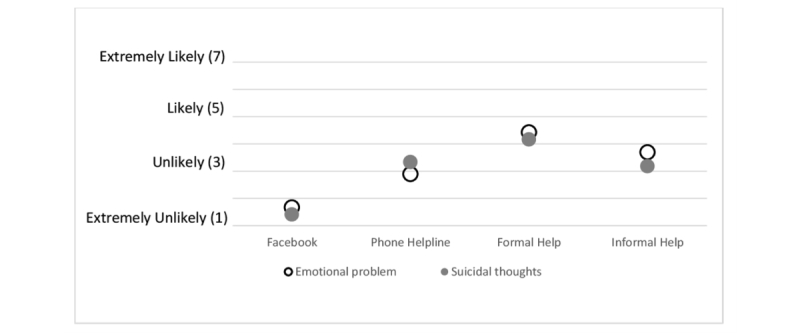
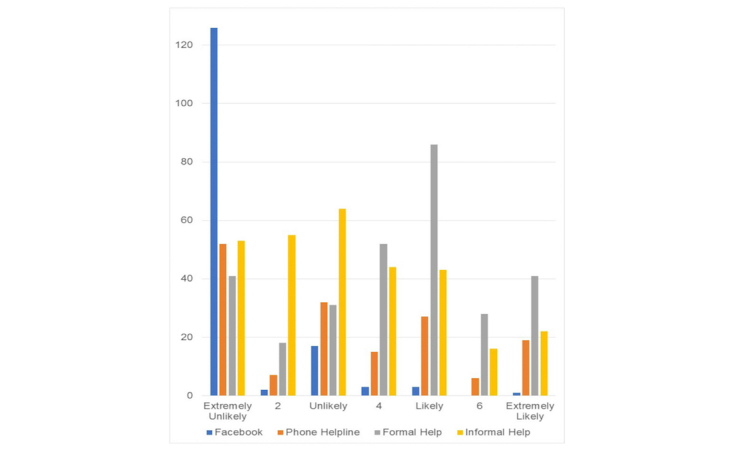
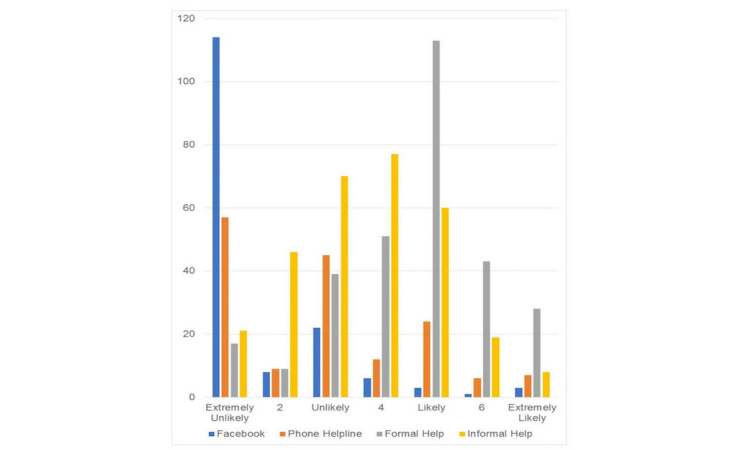
The majority of participants were users of social media, primarily Facebook (n=162). Mean overall help-seeking intentions were similar between Facebook users and nonusers, even after adjustment for potential confounders. Facebook users were very unlikely to turn to Facebook as a venue for support when experiencing either emotional problems or suicidal thoughts. Compared to help-seeking intentions for Facebook, help-seeking intentions for formal (eg, psychologists), informal (eg, friends), or phone helpline sources of support were significantly higher. Results did not substantially change when examining users of other social media, women, or younger adults.

CONCLUSIONS

In its current form, the social media platform Facebook is not seen as a venue to seek help for emotional problems or suicidality among veterans with major depression in the United States.

摘要

背景

媒体大量关注了那些在自杀前在脸书上发布信息的个人轶事。然而,目前尚不清楚社交媒体在多大程度上被视为一种求助来源,或者它与其他潜在的心理健康问题支持来源相比如何。

目的

本研究旨在评估与其他更传统的求助来源相比,患有抑郁症的退伍军人使用社交媒体寻求帮助的程度。

方法

对270名可能患有重度抑郁症的成年退伍军人进行横断面自我报告调查。使用改良的一般求助问卷测量求助意向。通过t检验、卡方检验和混合效应回归模型对脸书用户和非用户进行比较。使用混合效应模型检查不同求助类型之间的关联。

结果

大多数参与者是社交媒体用户,主要是脸书用户(n = 162)。即使在对潜在混杂因素进行调整后,脸书用户和非用户的总体求助意向均值相似。脸书用户在遇到情绪问题或自杀念头时,极不可能将脸书作为寻求支持的场所。与向脸书求助的意向相比,向正式(如心理学家)、非正式(如朋友)或电话热线等支持来源求助的意向明显更高。在研究其他社交媒体用户、女性或年轻人时,结果没有实质性变化。

结论

就目前的形式而言,社交媒体平台脸书在美国患有重度抑郁症的退伍军人中,并未被视为寻求情绪问题或自杀相关帮助的场所。
https://cdn.ncbi.nlm.nih.gov/pmc/blobs/a352/5847817/574d6df35bc1/jmir_v20i2e62_fig3.jpg
https://cdn.ncbi.nlm.nih.gov/pmc/blobs/a352/5847817/bd060a699ca3/jmir_v20i2e62_fig1.jpg
https://cdn.ncbi.nlm.nih.gov/pmc/blobs/a352/5847817/c4d16285eb95/jmir_v20i2e62_fig2.jpg
https://cdn.ncbi.nlm.nih.gov/pmc/blobs/a352/5847817/574d6df35bc1/jmir_v20i2e62_fig3.jpg
https://cdn.ncbi.nlm.nih.gov/pmc/blobs/a352/5847817/bd060a699ca3/jmir_v20i2e62_fig1.jpg
https://cdn.ncbi.nlm.nih.gov/pmc/blobs/a352/5847817/c4d16285eb95/jmir_v20i2e62_fig2.jpg
https://cdn.ncbi.nlm.nih.gov/pmc/blobs/a352/5847817/574d6df35bc1/jmir_v20i2e62_fig3.jpg

相似文献

1
Help-Seeking on Facebook Versus More Traditional Sources of Help: Cross-Sectional Survey of Military Veterans.在脸书上寻求帮助与更传统的求助途径:退伍军人的横断面调查
J Med Internet Res. 2018 Feb 26;20(2):e62. doi: 10.2196/jmir.9007.
2
Predictors of Help-Seeking Intentions in Operation Enduring Freedom and Operation Iraqi Freedom Veterans and Service Members.持久自由行动和伊拉克自由行动退伍军人及现役军人寻求帮助意向的预测因素
Mil Med. 2017 May;182(5):e1640-e1647. doi: 10.7205/MILMED-D-16-00105.
3
Frequency of social contact in-person vs. on Facebook: An examination of associations with psychiatric symptoms in military veterans.面对面社交与 Facebook 社交的频率:对退伍军人精神症状关联的考察。
J Affect Disord. 2019 Jan 15;243:375-380. doi: 10.1016/j.jad.2018.09.043. Epub 2018 Sep 17.
4
Women's intentions of informal and formal help-seeking for mental health problems during the perinatal period: The role of perceived encouragement from the partner.围产期女性针对心理健康问题寻求非正式和正式帮助的意向:伴侣感知鼓励的作用。
Midwifery. 2017 Jul;50:78-85. doi: 10.1016/j.midw.2017.04.001. Epub 2017 Apr 5.
5
Female Veterans' Willingness to Seek Veterans Health Administration and Non-Veterans Health Administration Services for Suicidal Thoughts and Mental Health Concerns.女性退伍军人寻求退伍军人健康管理局和非退伍军人健康管理局服务以解决自杀念头和心理健康问题的意愿。
Med Care. 2021 Feb 1;59:S23-S30. doi: 10.1097/MLR.0000000000001480.
6
Exploring the association between exposure to suicide and suicide risk among military service members and veterans.探讨军人和退伍军人中接触自杀行为与自杀风险之间的关联。
J Affect Disord. 2017 Jan 1;207:327-335. doi: 10.1016/j.jad.2016.09.043. Epub 2016 Sep 28.
7
Mental Health, Help-Seeking Behaviour and Social Support in the UK Armed Forces by Gender.英国武装部队中按性别划分的心理健康、求助行为和社会支持。
Psychiatry. 2019 Fall;82(3):256-271. doi: 10.1080/00332747.2019.1626200. Epub 2019 Aug 6.
8
Responses to Concerning Posts on Social Media and Their Implications for Suicide Prevention Training for Military Veterans: Qualitative Study.社交媒体上令人担忧的帖子的回应及其对退伍军人自杀预防培训的影响:定性研究。
J Med Internet Res. 2020 Oct 30;22(10):e22076. doi: 10.2196/22076.
9
Internet Forums for Suicide Bereavement.自杀丧亲者的互联网论坛。
Crisis. 2017 Nov;38(6):393-402. doi: 10.1027/0227-5910/a000471. Epub 2017 Aug 10.
10
Loneliness is closely associated with depression outcomes and suicidal ideation among military veterans in primary care.孤独感与初级保健中的退伍军人的抑郁结果和自杀意念密切相关。
J Affect Disord. 2018 Apr 1;230:42-49. doi: 10.1016/j.jad.2018.01.003. Epub 2018 Jan 17.

引用本文的文献

1
Detecting suicide risk among U.S. servicemembers and veterans: a deep learning approach using social media data.检测美国军人和退伍军人中的自杀风险:一种使用社交媒体数据的深度学习方法。
Psychol Med. 2024 Sep 9:1-10. doi: 10.1017/S0033291724001557.
2
Predicting Mood Based on the Social Context Measured Through the Experience Sampling Method, Digital Phenotyping, and Social Networks.基于通过体验采样法、数字表型和社交网络测量的社会情境预测情绪。
Adm Policy Ment Health. 2024 Jul;51(4):455-475. doi: 10.1007/s10488-023-01328-0. Epub 2024 Jan 10.
3
Social media use and self-injurious thoughts and behaviors: A systematic review and meta-analysis.

本文引用的文献

1
Predictors of Emerging Suicide Death Among Military Personnel on Social Media Networks.社交媒体网络中军人自杀死亡的预测因素。
Suicide Life Threat Behav. 2018 Aug;48(4):413-430. doi: 10.1111/sltb.12370. Epub 2017 Jul 28.
2
How Veterans With Post-Traumatic Stress Disorder and Comorbid Health Conditions Utilize eHealth to Manage Their Health Care Needs: A Mixed-Methods Analysis.患有创伤后应激障碍及合并健康状况的退伍军人如何利用电子健康来满足其医疗保健需求:一项混合方法分析。
J Med Internet Res. 2016 Oct 26;18(10):e280. doi: 10.2196/jmir.5594.
3
When perceptions defy reality: The relationships between depression and actual and perceived Facebook social support.
社交媒体使用与自伤意念和行为:系统评价和荟萃分析。
Clin Psychol Rev. 2021 Jul;87:102038. doi: 10.1016/j.cpr.2021.102038. Epub 2021 May 8.
4
Veterans' Perspectives on Fitbit Use in Treatment for Post-Traumatic Stress Disorder: An Interview Study.退伍军人对使用Fitbit治疗创伤后应激障碍的看法:一项访谈研究。
JMIR Ment Health. 2018 Jun 15;5(2):e10415. doi: 10.2196/10415.
当认知与现实相悖时:抑郁与实际及感知到的脸书社交支持之间的关系。
J Affect Disord. 2016 Aug;200:37-44. doi: 10.1016/j.jad.2016.01.048. Epub 2016 Apr 16.
4
Increase in Suicide in the United States, 1999-2014.1999 - 2014年美国自杀率上升情况
NCHS Data Brief. 2016 Apr(241):1-8.
5
Estimating the true global burden of mental illness.估算精神疾病的真实全球负担。
Lancet Psychiatry. 2016 Feb;3(2):171-8. doi: 10.1016/S2215-0366(15)00505-2.
6
Are Facebook "Friends" Helpful? Development of a Facebook-Based Measure of Social Support and Examination of Relationships Among Depression, Quality of Life, and Social Support.脸书“好友”有帮助吗?基于脸书的社会支持度量方法的开发以及对抑郁、生活质量和社会支持之间关系的考察。
Cyberpsychol Behav Soc Netw. 2015 Sep;18(9):499-505. doi: 10.1089/cyber.2014.0538.
7
Recruitment of adolescents for a smoking study: use of traditional strategies and social media.招募青少年参与吸烟研究:传统策略与社交媒体的运用
Transl Behav Med. 2015 Sep;5(3):254-9. doi: 10.1007/s13142-015-0312-5.
8
Sharing feelings online: studying emotional well-being via automated text analysis of Facebook posts.在线分享情感:通过对脸书帖子的自动文本分析研究情绪健康状况。
Front Psychol. 2015 Jul 23;6:1045. doi: 10.3389/fpsyg.2015.01045. eCollection 2015.
9
Using facebook to recruit young adult veterans: online mental health research.利用脸书招募年轻退伍军人:在线心理健康研究。
JMIR Res Protoc. 2015 Jun 1;4(2):e63. doi: 10.2196/resprot.3996.
10
E-mental health care among young adults and help-seeking behaviors: a transversal study in a community sample.青年成年人的电子心理健康护理与求助行为:一项针对社区样本的横断面研究。
J Med Internet Res. 2015 May 15;17(5):e123. doi: 10.2196/jmir.4254.