
在酸性溶液中 VO 的非催化加氢。
Non-catalytic hydrogenation of VO in acid solution.
机构信息
National Synchrotron Radiation Laboratory, University of Science and Technology of China, Hefei, 230029, China.
Hefei National Laboratory for Physical Sciences at the Microscale, Collaborative Innovation Center of Chemistry for Energy Materials, CAS Center for Excellence in Nanoscience, School of Chemistry and Materials Science, University of Science and Technology of China, Hefei, 230026, China.
出版信息
Nat Commun. 2018 Feb 26;9(1):818. doi: 10.1038/s41467-018-03292-y.
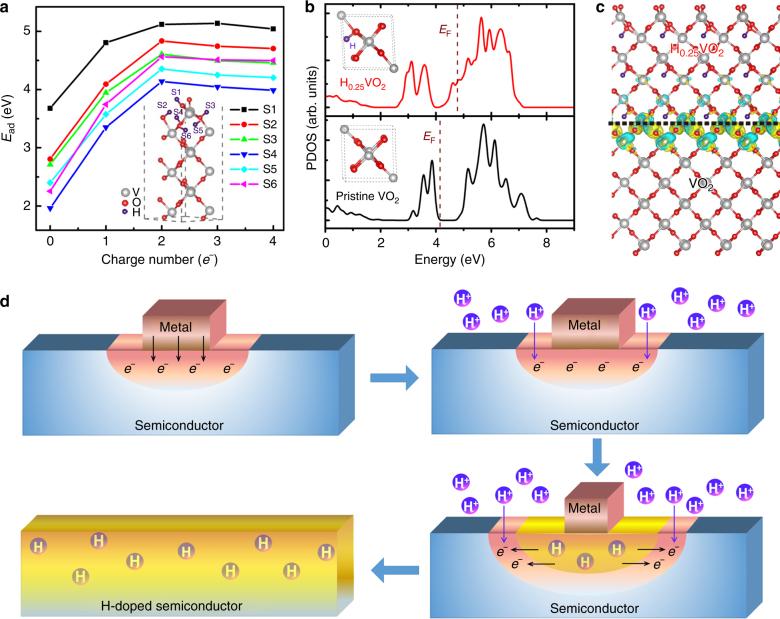
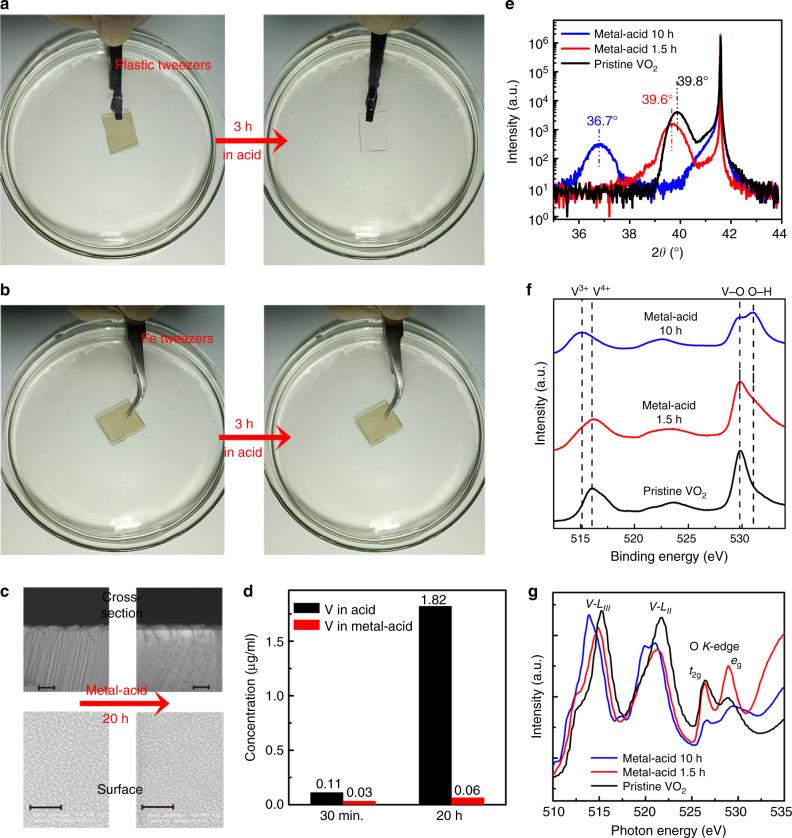
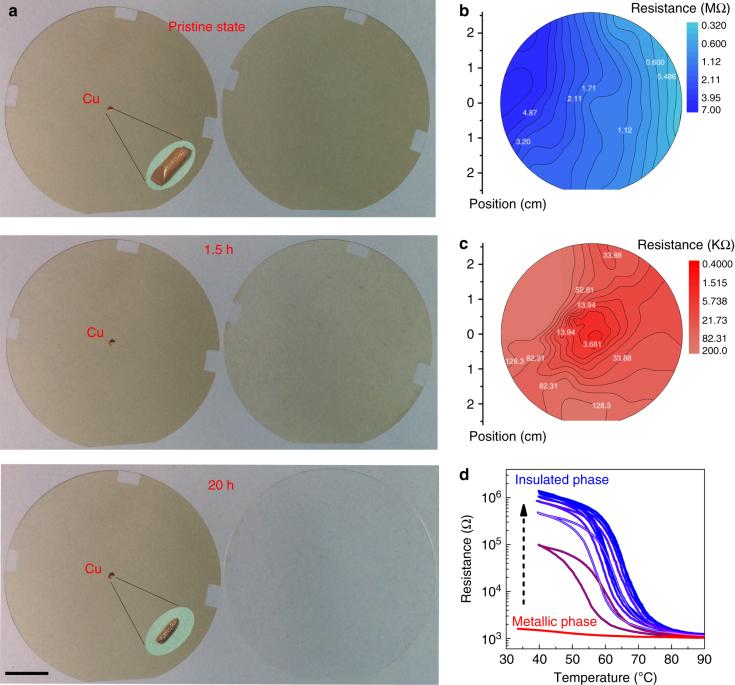
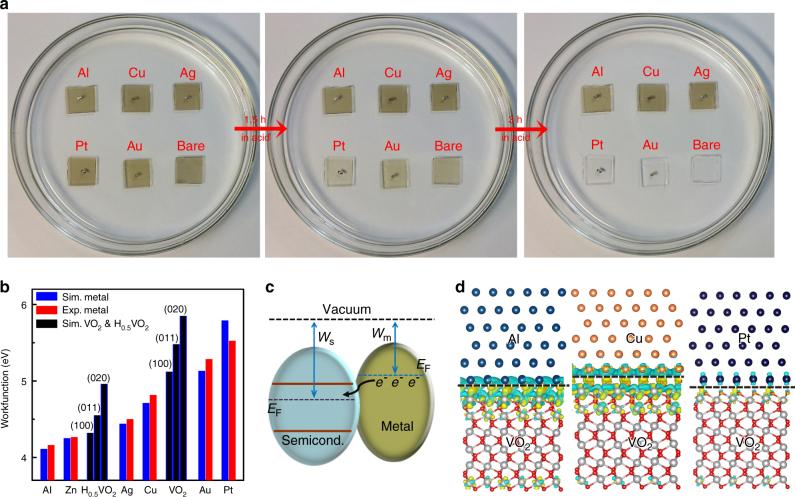
Hydrogenation is an effective way to tune the property of metal oxides. It can conventionally be performed by doping hydrogen into solid materials with noble-metal catalysis, high-temperature/pressure annealing treatment, or high-energy proton implantation in vacuum condition. Acid solution naturally provides a rich proton source, but it should cause corrosion rather than hydrogenation to metal oxides. Here we report a facile approach to hydrogenate monoclinic vanadium dioxide (VO) in acid solution at ambient condition by placing a small piece of low workfunction metal (Al, Cu, Ag, Zn, or Fe) on VO surface. It is found that the attachment of a tiny metal particle (~1.0 mm) can lead to the complete hydrogenation of an entire wafer-size VO (>2 inch). Moreover, with the right choice of the metal a two-step insulator-metal-insulator phase modulation can even be achieved. An electron-proton co-doping mechanism has been proposed and verified by the first-principles calculations.
氢化是一种调节金属氧化物性质的有效方法。通常可以通过在具有贵金属催化作用、高温/高压退火处理或真空中高能质子注入的条件下将氢气掺杂到固体材料中来实现。酸溶液自然提供了丰富的质子源,但它应该引起金属氧化物的腐蚀而不是氢化。在这里,我们报道了一种在环境条件下通过在 VO 表面放置一小片低功函数金属(Al、Cu、Ag、Zn 或 Fe)在酸性溶液中氢化单斜晶氧化钒(VO)的简便方法。研究发现,附着一个微小的金属颗粒(~1.0 毫米)可以导致整个晶圆尺寸的 VO(>2 英寸)完全氢化。此外,通过选择合适的金属,甚至可以实现两步绝缘-金属-绝缘相调制。通过第一性原理计算验证了电子-质子共掺杂机制。
 Zotero 插件