Bowtell Joanna L, Mohr Magni, Fulford Jonathan, Jackman Sarah R, Ermidis Georgios, Krustrup Peter, Mileva Katya N
Sport and Health Sciences, College of Life and Environmental Sciences, Exeter University, Exeter, United Kingdom.
Centre of Health Science, Faculty of Health Sciences, University of the Faroe Islands, Tórshavn, Faroe Islands.
Front Nutr. 2018 Feb 12;5:6. doi: 10.3389/fnut.2018.00006. eCollection 2018.
Caffeine has been shown to enhance exercise performance and capacity. The mechanisms remain unclear but are suggested to relate to adenosine receptor antagonism, resulting in increased central motor drive, reduced perception of effort, and altered peripheral processes such as enhanced calcium handling and extracellular potassium regulation. Our aims were to investigate how caffeine (i) affects knee extensor PCr kinetics and pH during repeated sets of single-leg knee extensor exercise to task failure and (ii) modulates the interplay between central and peripheral neural processes. We hypothesized that the caffeine-induced extension of exercise capacity during repeated sets of exercise would occur despite greater disturbance of the muscle milieu due to enhanced peripheral and corticospinal excitatory output, central motor drive, and muscle contractility.
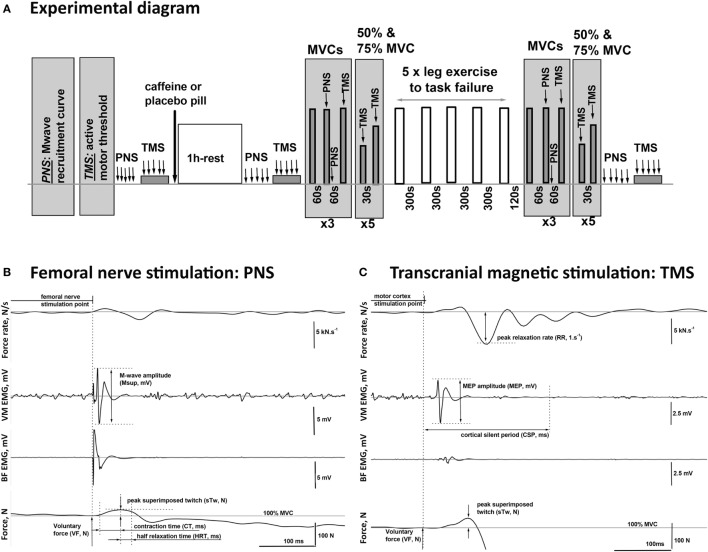
Nine healthy active young men performed five sets of intense single-leg knee extensor exercise to task failure on four separate occasions: for two visits (6 mg·kg caffeine vs placebo), quadriceps P-magnetic resonance spectroscopy scans were performed to quantify phosphocreatine kinetics and pH, and for the remaining two visits (6 mg·kg caffeine vs placebo), femoral nerve electrical and transcranial magnetic stimulation of the quadriceps cortical motor area were applied pre- and post exercise.
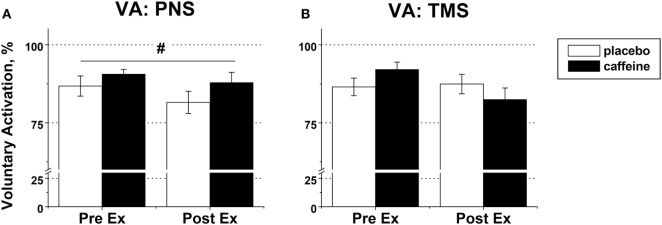
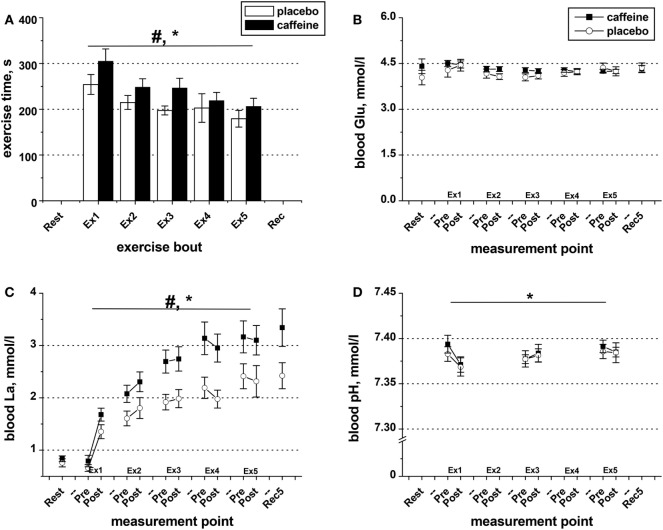
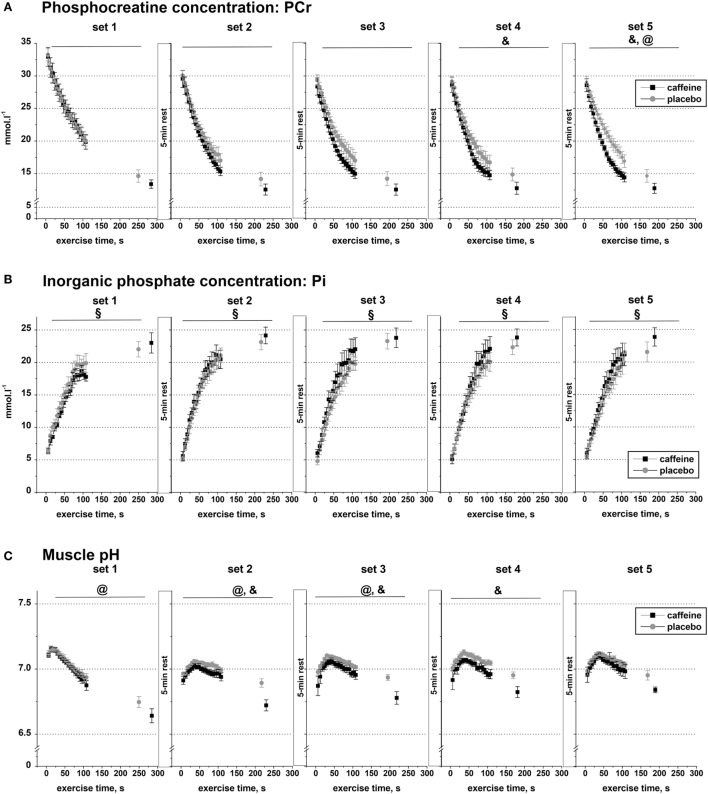
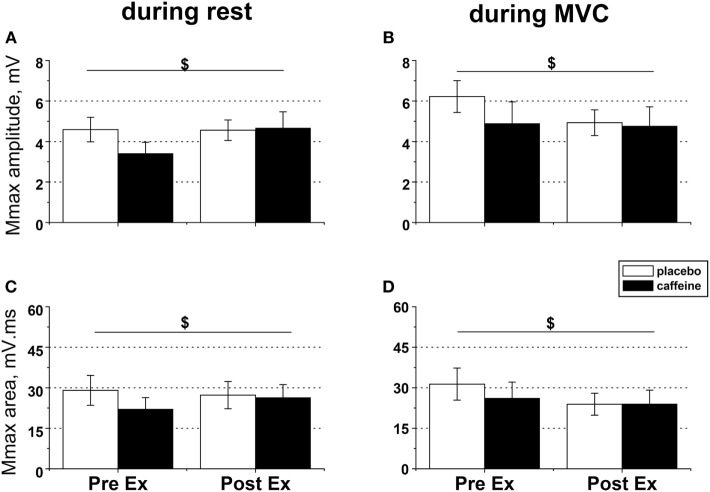
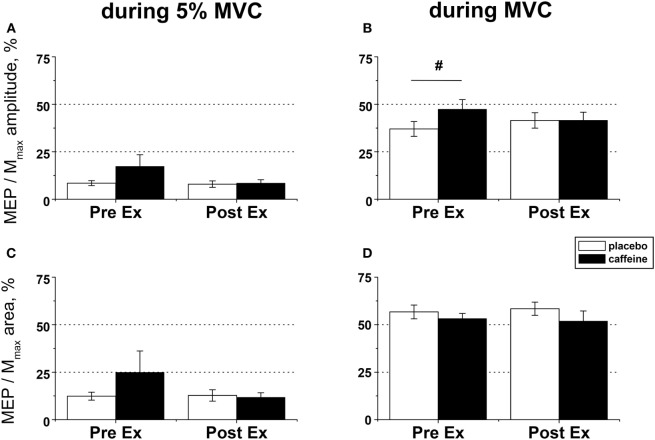
The total exercise time was 17.9 ± 6.0% longer in the caffeine (1,225 ± 86 s) than in the placebo trial (1,049 ± 73 s, = 0.016), and muscle phosphocreatine concentration and pH ( < 0.05) were significantly lower in the latter sets of exercise after caffeine ingestion. Voluntary activation (VA) (peripheral, = 0.007; but not supraspinal, = 0.074), motor-evoked potential (MEP) amplitude ( = 0.007), and contractility (contraction time, = 0.009; and relaxation rate, = 0.003) were significantly higher after caffeine consumption, but at task failure MEP amplitude and VA were not different from placebo. Caffeine prevented the reduction in M-wave amplitude that occurred at task failure ( = 0.039).
Caffeine supplementation improved high-intensity exercise tolerance despite greater-end exercise knee extensor phosphocreatine depletion and H accumulation. Caffeine-induced increases in central motor drive and corticospinal excitability were attenuated at task failure. This may have been induced by the afferent feedback of the greater disturbance of the muscle milieu, resulting in a stronger inhibitory input to the spinal and supraspinal motor neurons. However, causality needs to be established through further experiments.
咖啡因已被证明可提高运动表现和能力。其机制尚不清楚,但推测与腺苷受体拮抗作用有关,从而导致中枢运动驱动增加、努力感知降低以及外周过程改变,如增强钙处理和细胞外钾调节。我们的目的是研究咖啡因如何(i)在单腿伸膝运动重复进行至任务失败的过程中影响股四头肌磷酸肌酸动力学和pH值,以及(ii)调节中枢和外周神经过程之间的相互作用。我们假设,尽管由于外周和皮质脊髓兴奋性输出增强、中枢运动驱动和肌肉收缩力增加导致肌肉环境受到更大干扰,但在重复运动过程中咖啡因诱导的运动能力延长仍会发生。
9名健康活跃的年轻男性在四个不同场合进行了五组高强度单腿伸膝运动直至任务失败:在两次就诊时(6毫克·千克咖啡因与安慰剂),进行股四头肌磷磁共振波谱扫描以量化磷酸肌酸动力学和pH值;在其余两次就诊时(6毫克·千克咖啡因与安慰剂),在运动前后对股神经进行电刺激以及对股四头肌皮质运动区进行经颅磁刺激。
咖啡因组(1225±86秒)的总运动时间比安慰剂组(1049±73秒)长17.9±6.0%(P = 0.016),且在摄入咖啡因后的后续运动组中,肌肉磷酸肌酸浓度和pH值(P < 0.05)显著更低。摄入咖啡因后,自愿激活(VA)(外周,P = 0.007;但脊髓上部分,P = 0.074)、运动诱发电位(MEP)幅度(P = 0.007)和收缩力(收缩时间,P = 0.009;以及舒张速率,P = 0.003)显著更高,但在任务失败时,MEP幅度和VA与安慰剂组无差异。咖啡因可防止任务失败时出现的M波幅度降低(P = 0.039)。
补充咖啡因可提高高强度运动耐力,尽管运动结束时股四头肌磷酸肌酸消耗增加且氢离子积累。在任务失败时,咖啡因诱导的中枢运动驱动和皮质脊髓兴奋性增加减弱。这可能是由肌肉环境更大干扰的传入反馈引起的,导致对脊髓和脊髓上运动神经元的抑制性输入更强。然而,因果关系需要通过进一步实验来确定。