Raghu Chantel, Ekena Joanne, Cullen John M, Webb Craig B, Trepanier Lauren A
Department of Medical Sciences, School of Veterinary Medicine, University of Wisconsin-Madison, Madison, Wisconsin.
Department of Public Health and Pathobiology, North Carolina State University, College of Veterinary Medicine, Raleigh, North Carolina.
J Vet Intern Med. 2018 May;32(3):1009-1018. doi: 10.1111/jvim.15064. Epub 2018 Feb 27.
Serum interleukin 6 (IL-6), chemokine ligand 2 (CCL2), C-reactive protein (CRP), and the ratio of aspartate transaminase to alanine transaminase (AST:ALT) have been correlated with fibrosis and necroinflammatory activity in humans with various hepatopathies.
HYPOTHESIS/OBJECTIVES: To determine whether increases in serum IL-6, CCL2, CRP, or AST:ALT were associated with moderate to severe fibrosis or necroinflammatory activity in dogs with various hepatopathies.
Forty-four client-owned dogs with clinical evidence of liver disease and 10 healthy purpose-bred dogs, all undergoing liver biopsies by laparoscopy or laparotomy.
Measurement of serum IL-6, CCL2, CRP, AST, and ALT before scheduled liver biopsy and evaluation of liver histopathology using the METAVIR scoring system used in human medicine, blinded to clinical presentation.
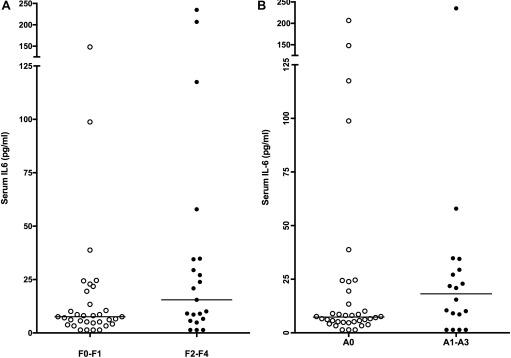
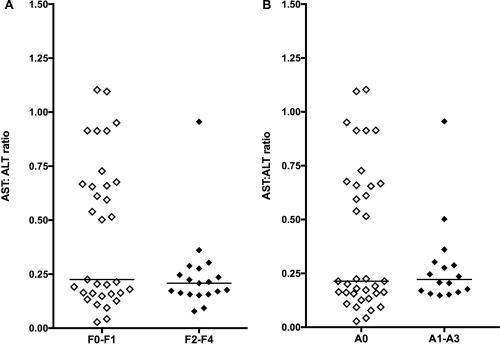
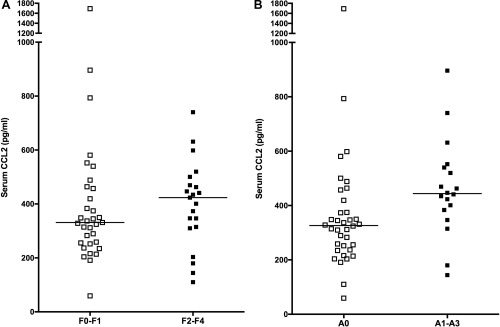
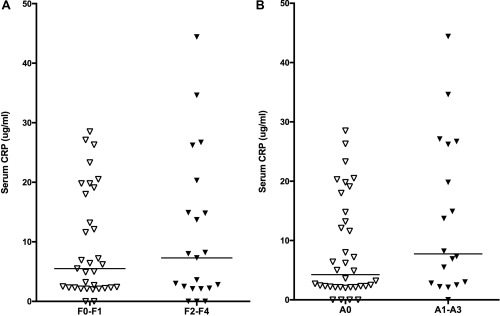
Median serum IL-6 was approximately twice as high in dogs with high fibrosis scores (15.5 pg/mL; range, 1.4 to 235 pg/mL) compared to dogs with low fibrosis scores (7.6 pg/mL; range, 1.4 to 148.1 pg/mL), with marginal significance (P = .05). Median serum CCL2 was significantly higher in dogs with active necroinflammation (444 pg/mL; range, 144 to 896 pg/mL) compared to dogs without detectable necroinflammation (326 pg/mL; range, 59 to 1692 pg/mL; P = .008), but with considerable overlap between groups. Neither serum CRP nor AST:ALT ratios were significantly different based on fibrosis or necroinflammatory scores.
Because of substantial variability among dogs, single measurements of IL-6 and CCL2 have limited diagnostic utility for identifying fibrosis or necroinflammation, respectively, in dogs with various chronic liver diseases. The value of these biomarkers should be explored further in monitoring response to treatment in individual dogs with chronic hepatopathies.
血清白细胞介素6(IL-6)、趋化因子配体2(CCL2)、C反应蛋白(CRP)以及天冬氨酸转氨酶与丙氨酸转氨酶的比值(AST:ALT)已被证实与各种肝病患者的纤维化和坏死性炎症活动相关。
假设/目的:确定血清IL-6、CCL2、CRP或AST:ALT的升高是否与患有各种肝病的犬的中度至重度纤维化或坏死性炎症活动相关。
44只临床诊断患有肝病的客户拥有犬以及10只健康的专门繁育犬,所有犬均通过腹腔镜或剖腹术进行肝活检。
在预定肝活检前测量血清IL-6、CCL2、CRP、AST和ALT,并使用人类医学中使用的METAVIR评分系统对肝组织病理学进行评估,评估过程对临床表现不知情。
与低纤维化评分犬(7.6 pg/mL;范围为1.4至148.1 pg/mL)相比,高纤维化评分犬(15.5 pg/mL;范围为1.4至235 pg/mL)的血清IL-6中位数约高两倍,差异具有边缘显著性(P = 0.05)。与无可检测到的坏死性炎症的犬(326 pg/mL;范围为59至1692 pg/mL)相比,有活动性坏死性炎症的犬(444 pg/mL;范围为144至896 pg/mL)的血清CCL2中位数显著更高(P = 0.008),但两组之间有相当大的重叠。基于纤维化或坏死性炎症评分,血清CRP和AST:ALT比值均无显著差异。
由于犬之间存在显著差异,单次测量IL-6和CCL2在识别患有各种慢性肝病的犬的纤维化或坏死性炎症方面的诊断效用有限。这些生物标志物在监测患有慢性肝病的个体犬对治疗的反应方面的价值应进一步探索。