Leo W. Jenkins Cancer Center, 600 Moye Boulevard, Greenville, NC, 27834, USA.
North Carolina State University, Raleigh, NC, 27695, USA.
Radiat Oncol. 2018 Feb 27;13(1):34. doi: 10.1186/s13014-018-0980-7.
The purpose of this study was to evaluate the prognostic impact of Positron Emission Tomography Response Criteria in Solid Tumors (PERCIST) and Response Evaluation Criteria in Solid Tumors (RECIST) and of pre- and post-treatment maximum Standard Uptake Value (SUV) in regards to survival and tumor control for patients treated for early-stage non-small cell lung cancer (ES-NSCLC) with stereotactic body radiotherapy (SBRT).
This is a retrospective review of patients with ES-NSCLC treated at our institution using SBRT. Lobar, locoregional, and distant failures were evaluated based on PERCIST/RECIST and clinical course. Univariate analysis of the Kaplan-Meier curves for overall survival (OS), progression free survival (PFS), lobar control (LC), locoregional control (LRC), and distant control (DC) was conducted using the log-rank test. Pre- and post-treatment SUV were evaluated using cutoffs of < 5 and ≥ 5, < 4 and ≥ 4, and < 3 and ≥ 3. ∆SUV was also evaluated at various cutoffs. Cox regression analysis was conducted to evaluate survival outcomes based on age, gender, pre-treatment gross tumor volume (GTV), longest tumor dimension on imaging, and Charlson Comorbidity Index (CCI).
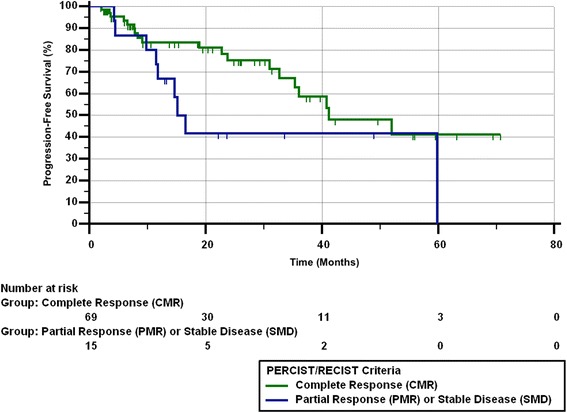
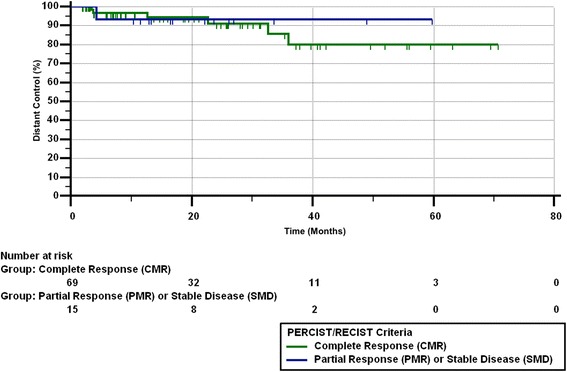
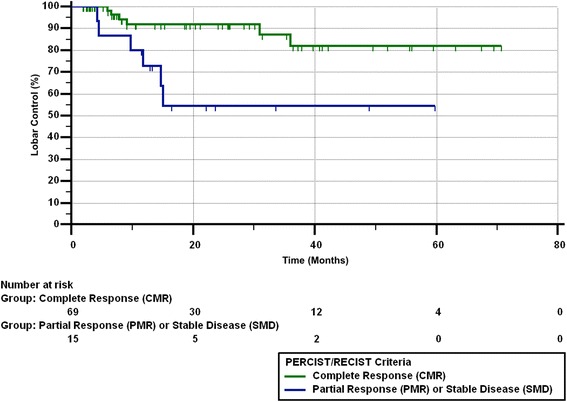
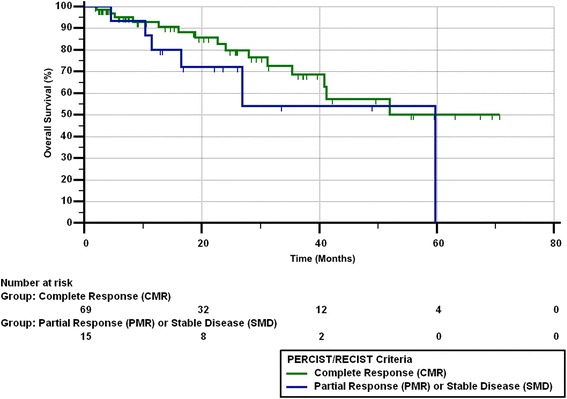
This study included 95 patients (53 female, 42 male), median age 75. Lung SBRT was delivered in 3-5 fractions to a total of 48-60 Gy, with a BED of at least 100 Gy. Median OS and PFS from the end of SBRT was 15.4 and 11.9 months, respectively. On univariate analysis, PERCIST/RECIST response correlated with PFS (p = 0.039), LC (p = 0.007), and LRC (p = 0.015) but not OS (p = 0.21) or DC (p = 0.94). Pre-treatment SUV and post-treatment SUV with cutoff values of < 5 and ≥ 5, < 4 and ≥ 4, and < 3 and ≥ 3 did not predict for OS, PFS, LC, LRC, or DC. ∆SUV did not predict for OS, PFS, LC, LRC, or DC. On multivariate analysis, pre-treatment GTV ≥ 30 cm was significantly associated with worse survival outcomes when accounting for other confounding variables.
PERCIST/RECIST response is associated with improved LC and PFS in patients treated for ES-NSCLC with SBRT. In contrast, pre- and post-treatment SUV is not predictive of disease control or survival.
本研究旨在评估正电子发射断层扫描反应标准在实体瘤(PERCIST)和实体瘤反应评估标准(RECIST)中的预后影响,以及在接受立体定向体部放射治疗(SBRT)治疗的早期非小细胞肺癌(ES-NSCLC)患者的治疗前后最大标准摄取值(SUV)与生存和肿瘤控制之间的关系。
这是一项对在我院接受 SBRT 治疗的 ES-NSCLC 患者进行的回顾性研究。根据 PERCIST/RECIST 和临床病程评估肺叶、局部区域和远处失败情况。使用对数秩检验对总生存(OS)、无进展生存(PFS)、肺叶控制(LC)、局部区域控制(LRC)和远处控制(DC)的 Kaplan-Meier 曲线进行单因素分析。使用 SUV <5 和 ≥5、SUV <4 和 ≥4、SUV <3 和 ≥3 的截断值评估治疗前后 SUV,并评估 SUV 的变化值。基于年龄、性别、治疗前大体肿瘤体积(GTV)、影像学上最长肿瘤尺寸和 Charlson 合并症指数(CCI),采用 Cox 回归分析评估生存结果。
本研究纳入了 95 例患者(53 例女性,42 例男性),中位年龄为 75 岁。肺部 SBRT 采用 3-5 个分次,总剂量为 48-60Gy,生物等效剂量(BED)至少为 100Gy。从 SBRT 结束到中位 OS 和 PFS 时间分别为 15.4 个月和 11.9 个月。单因素分析显示,PERCIST/RECIST 反应与 PFS(p=0.039)、LC(p=0.007)和 LRC(p=0.015)相关,但与 OS(p=0.21)或 DC(p=0.94)无关。治疗前后 SUV <5 和 ≥5、SUV <4 和 ≥4、SUV <3 和 ≥3 的截断值与 OS、PFS、LC、LRC 或 DC 均无相关性。SUV 的变化值与 OS、PFS、LC、LRC 或 DC 也无相关性。多因素分析显示,治疗前 GTV≥30cm 与其他混杂变量相比与较差的生存结果显著相关。
在接受 SBRT 治疗的 ES-NSCLC 患者中,PERCIST/RECIST 反应与 LC 和 PFS 的改善相关。相比之下,治疗前后 SUV 不能预测疾病控制或生存。