The Key Laboratory of Pathobiology, Ministry of Education, Norman Bethune College of Medicine, Jilin University, Changchun, 130021, People's Republic of China.
Stem Cell Res Ther. 2018 Mar 1;9(1):52. doi: 10.1186/s13287-018-0798-0.
Human mesenchymal stem cell (hMSC) differentiation into osteoblasts has important clinical significance in treating bone injury, and the stiffness of the extracellular matrix (ECM) has been shown to be an important regulatory factor for hMSC differentiation. The aim of this study was to further delineate how matrix stiffness affects intracellular signaling through integrin α5/β1, FAK, and Wnt signaling, subsequently regulating the osteogenic phenotype of hMSCs.
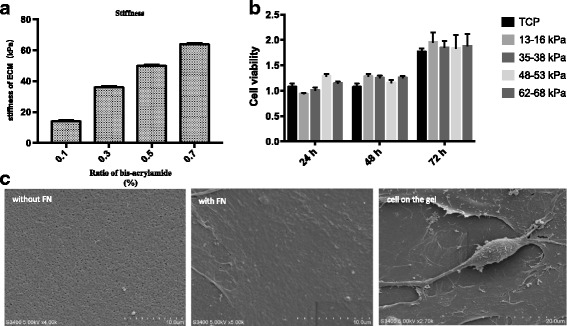
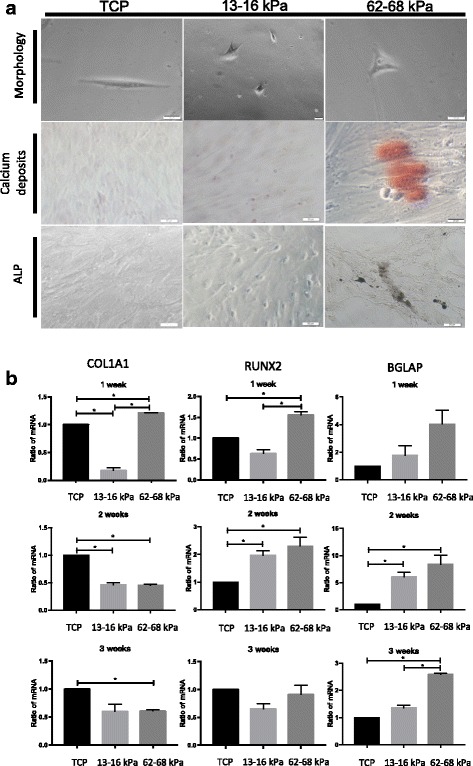
hMSCs were cultured on tunable polyacrylamide hydrogels coated with fibronectin with stiffness corresponding to a Young's modulus of 13-16 kPa and 62-68 kPa. After hMSCs were cultured on gels for 1 week, gene expression of alpha-1 type I collagen, BGLAP, and RUNX2 were evaluated by real-time PCR. After hMSCs were cultured on gels for 24 h, signaling molecules relating to integrin α5 (FAK, ERK, p-ERK, Akt, p-Akt, GSK-3β, p-GSK-3β, and β-catenin) were evaluated by western blot analysis.
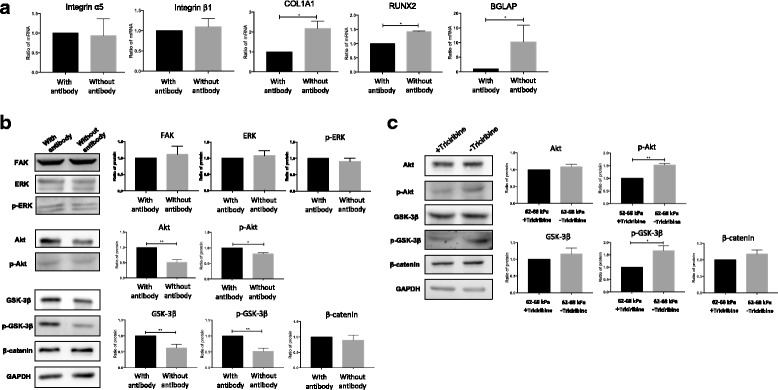
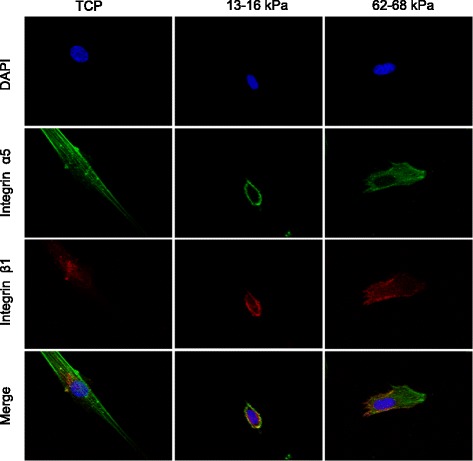
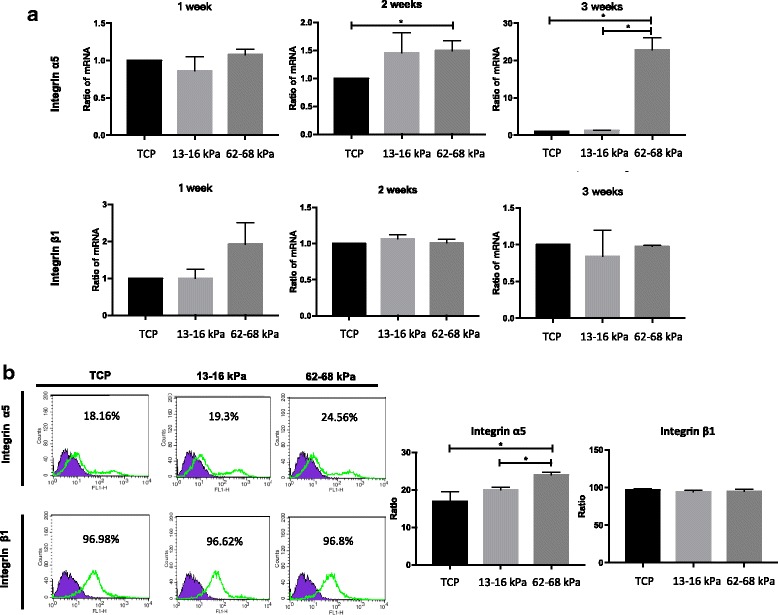
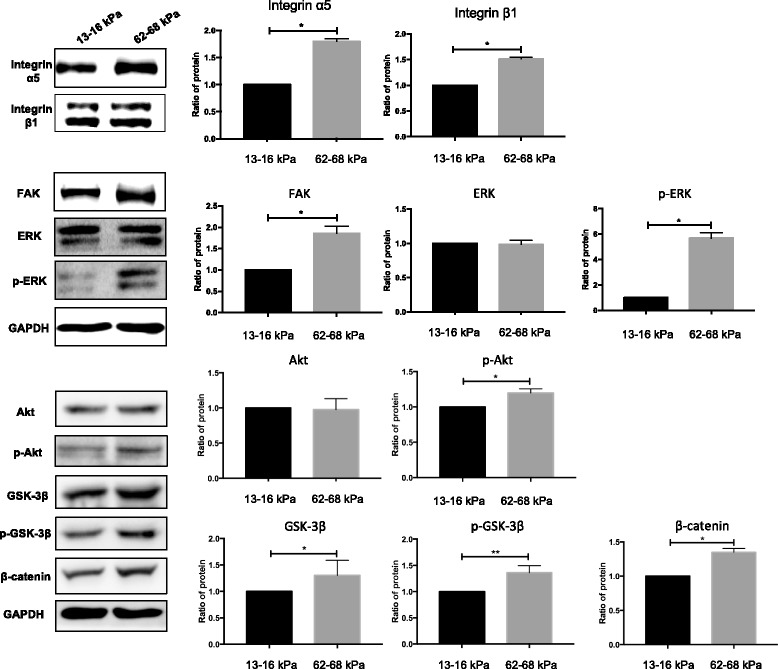
Osteogenic differentiation was increased on 62-68 kPa ECM, as evidenced by alpha-1 type I collagen, BGLAP, and RUNX2 gene expression, calcium deposition, and ALP staining. In the process of differentiation, gene and protein expression of integrin α5/β1 increased, together with protein expression of the downstream signaling molecules FAK, p-ERK, p-Akt, GSK-3β, p-GSK-3β, and β-catenin, indicating that these molecules can affect the osteogenic differentiation of hMSCs. An antibody blocking integrin α5 suppressed the stiffness-induced expression of all osteoblast markers examined. In particular, alpha-1 type I collagen, RUNX2, and BGLAP were significantly downregulated, indicating that integrin α5 regulates hMSC osteogenic differentiation. Downstream expression of FAK, ERK, p-ERK, and β-catenin protein was unchanged, whereas Akt, p-Akt, GSK-3β, and p-GSK-3β were upregulated. Moreover, expression of Akt and p-Akt was upregulated with anti-integrin α5 antibody, but no difference was observed for FAK, ERK, and p-ERK between the with or without anti-integrin α5 antibody groups. At the same time, expression of GSK-3β and p-GSK-3β was upregulated and β-catenin levels showed no difference between the groups with or without anti-integrin α5 antibody. Since Akt, p-Akt, GSK-3β, and p-GSK-3β displayed the same changes between the groups with or without anti-integrin α5 antibody, we then detected the links among them. Expression of p-Akt and p-GSK-3β was reduced effectively in the presence of the Akt inhibitor Triciribine. However, Akt, GSK-3β, and β-catenin were unchanged. These results suggested that expression of p-GSK-3β was regulated by p-Akt on 62-68 kPa ECM.
Taken together, our results provide evidence that matrix stiffness (62-68 kPa) affects the osteogenic outcome of hMSCs through mechanotransduction events that are mediated by integrin α5.
人骨髓间充质干细胞(hMSC)向成骨细胞分化在治疗骨损伤方面具有重要的临床意义,细胞外基质(ECM)的刚度已被证明是调控 hMSC 分化的重要因素。本研究旨在进一步阐述基质刚度如何通过整合素 α5/β1、FAK 和 Wnt 信号转导来影响细胞内信号,进而调节 hMSC 的成骨表型。
将 hMSC 培养在涂有纤维连接蛋白的可调节聚丙稀酰胺水凝胶上,其基质刚度对应于杨氏模量为 13-16 kPa 和 62-68 kPa 的水凝胶。hMSC 在凝胶上培养 1 周后,通过实时 PCR 评估α-1 型 I 胶原、BGLAP 和 RUNX2 的基因表达。hMSC 在凝胶上培养 24 h 后,通过 Western blot 分析评估与整合素 α5(FAK、ERK、p-ERK、Akt、p-Akt、GSK-3β、p-GSK-3β 和β-连环蛋白)相关的信号分子。
在 62-68 kPa ECM 上,成骨分化增加,表现为α-1 型 I 胶原、BGLAP 和 RUNX2 基因表达、钙沉积和 ALP 染色增加。在分化过程中,整合素 α5/β1 的基因和蛋白表达增加,同时下游信号分子 FAK、p-ERK、p-Akt、GSK-3β、p-GSK-3β 和β-连环蛋白的蛋白表达也增加,表明这些分子可以影响 hMSC 的成骨分化。整合素 α5 的抗体阻断抑制了所有检测到的成骨细胞标志物的表达。特别是,α-1 型 I 胶原、RUNX2 和 BGLAP 的表达显著下调,表明整合素 α5 调节 hMSC 成骨分化。FAK、ERK、p-ERK 和β-连环蛋白的下游表达没有变化,而 Akt、p-Akt、GSK-3β 和 p-GSK-3β 则被上调。此外,整合素 α5 抗体增加了 Akt 和 p-Akt 的表达,但 FAK、ERK 和 p-ERK 在有或没有整合素 α5 抗体的组之间没有差异。同时,GSK-3β 和 p-GSK-3β 的表达上调,而β-连环蛋白水平在有或没有整合素 α5 抗体的组之间没有差异。由于 Akt、p-Akt、GSK-3β 和 p-GSK-3β 在有或没有整合素 α5 抗体的组之间表现出相同的变化,我们随后检测了它们之间的联系。在 Akt 抑制剂 Triciribine 的存在下,p-Akt 和 p-GSK-3β 的表达有效减少。然而,Akt、GSK-3β 和β-连环蛋白没有变化。这些结果表明,p-GSK-3β 的表达受 62-68 kPa ECM 中 p-Akt 的调控。
综上所述,我们的研究结果提供了证据,表明基质刚度(62-68 kPa)通过整合素 α5 介导的力学转导事件影响 hMSC 的成骨结果。