Juvenile Diabetes Research Foundation Danielle Alberti Memorial Centre for Diabetes Complications, Diabetes Division, Baker IDI Heart and Diabetes Institute, Melbourne, Victoria, Australia.
University College Dublin Diabetes Complications Research Centre, UCD Conway Institute of Biomolecular and Biomedical Research, UCD School of Medicine and Medical Sciences, and.
J Am Soc Nephrol. 2018 May;29(5):1437-1448. doi: 10.1681/ASN.2017101112. Epub 2018 Feb 28.
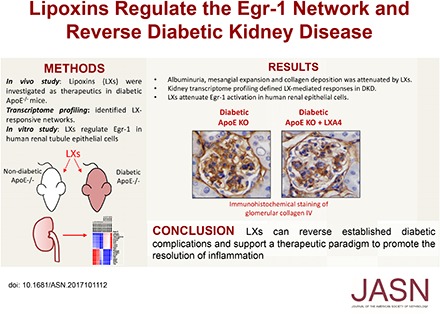
The failure of spontaneous resolution underlies chronic inflammatory conditions, including microvascular complications of diabetes such as diabetic kidney disease. The identification of endogenously generated molecules that promote the physiologic resolution of inflammation suggests that these bioactions may have therapeutic potential in the context of chronic inflammation. Lipoxins (LXs) are lipid mediators that promote the resolution of inflammation. We investigated the potential of LXA and a synthetic LX analog (Benzo-LXA) as therapeutics in a murine model of diabetic kidney disease, ApoE mice treated with streptozotocin. Intraperitoneal injection of LXs attenuated the development of diabetes-induced albuminuria, mesangial expansion, and collagen deposition. Notably, LXs administered 10 weeks after disease onset also attenuated established kidney disease, with evidence of preserved kidney function. Kidney transcriptome profiling defined a diabetic signature (725 genes; false discovery rate ≤0.05). Comparison of this murine gene signature with that of human diabetic kidney disease identified shared renal proinflammatory/profibrotic signals (TNF-, IL-1, NF-B). In diabetic mice, we identified 20 and 51 transcripts regulated by LXA and Benzo-LXA, respectively, and pathway analysis identified established (TGF-1, PDGF, TNF-, NF-B) and novel (early growth response-1 [EGR-1]) networks activated in diabetes and regulated by LXs. In cultured human renal epithelial cells, treatment with LXs attenuated TNF--driven Egr-1 activation, and Egr-1 depletion prevented cellular responses to TGF-1 and TNF- These data demonstrate that LXs can reverse established diabetic complications and support a therapeutic paradigm to promote the resolution of inflammation.
自发性消退的失败是慢性炎症状态的基础,包括糖尿病的微血管并发症,如糖尿病肾病。内源性产生的促进炎症生理性消退的分子的鉴定表明,这些生物活性物质在慢性炎症的情况下可能具有治疗潜力。脂氧素 (LXs) 是促进炎症消退的脂质介质。我们研究了 LXA 和一种合成的 LX 类似物 (Benzo-LXA) 在糖尿病肾病的小鼠模型中的治疗潜力,即用链脲佐菌素处理载脂蛋白 E (ApoE) 小鼠。LXs 的腹腔内注射可减轻糖尿病诱导的白蛋白尿、系膜扩张和胶原沉积的发展。值得注意的是,LXs 在疾病发病 10 周后给药也可减轻已建立的肾脏疾病,证据表明肾功能得到保留。肾脏转录组谱定义了糖尿病特征 (725 个基因;错误发现率≤0.05)。将这种小鼠基因特征与人类糖尿病肾病的基因特征进行比较,发现了共享的肾脏促炎/促纤维化信号 (TNF-α、IL-1、NF-κB)。在糖尿病小鼠中,我们分别鉴定了 LXA 和 Benzo-LXA 调节的 20 个和 51 个转录本,通路分析鉴定了在糖尿病中激活的已建立的 (TGF-β1、PDGF、TNF-α、NF-κB) 和新的 (早期生长反应-1 [EGR-1]) 网络,并受 LXs 调节。在培养的人肾小管上皮细胞中,用 LXs 处理可减弱 TNF-α驱动的 Egr-1 激活,而 Egr-1 耗竭可防止细胞对 TGF-β1 和 TNF-α的反应。这些数据表明 LXs 可以逆转已建立的糖尿病并发症,并支持一种促进炎症消退的治疗范式。