Department of Experimental and Clinical Medicine, Section of Physiological Sciences, University of Florence, Florence 50134, Italy.
World J Gastroenterol. 2018 Feb 28;24(8):882-893. doi: 10.3748/wjg.v24.i8.882.
To investigate the signaling pathways involved in the relaxin (RLX) effects on ileal preparations from mice through mechanical and electrophysiological experiments.
For mechanical experiments, ileal preparations from female mice were mounted in organ baths containing Krebs-Henseleit solution. The mechanical activity was recorded force-displacement transducers, which were coupled to a polygraph for continuous recording of isometric tension. Electrophysiological measurements were performed in current- and voltage-clamp conditions by a microelectrode inserted in a single smooth muscle cell (SMC) of the ileal longitudinal layer. Both the membrane passive properties and inward voltage-dependent L-type Ca currents were recorded using suitable solutions and voltage stimulation protocols.
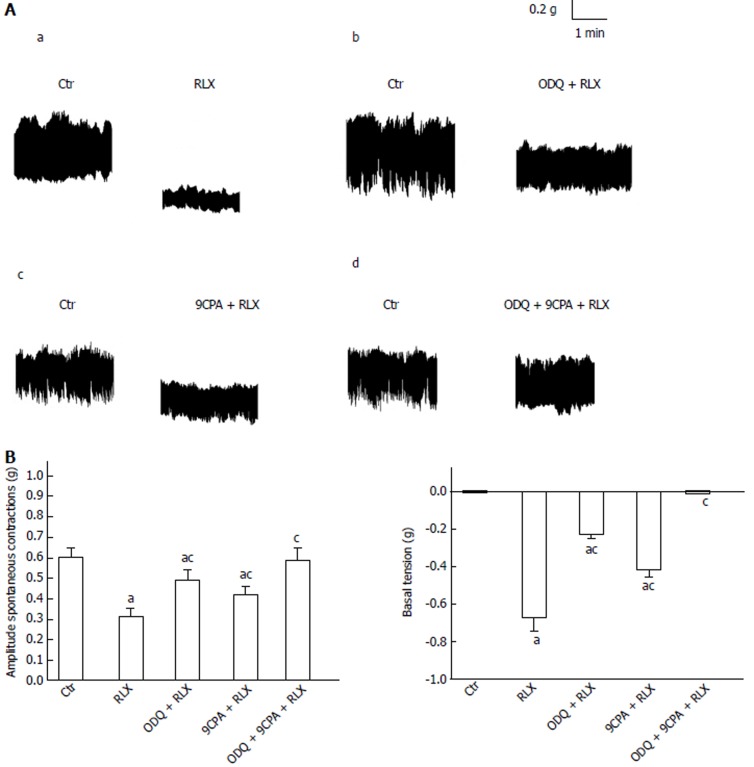
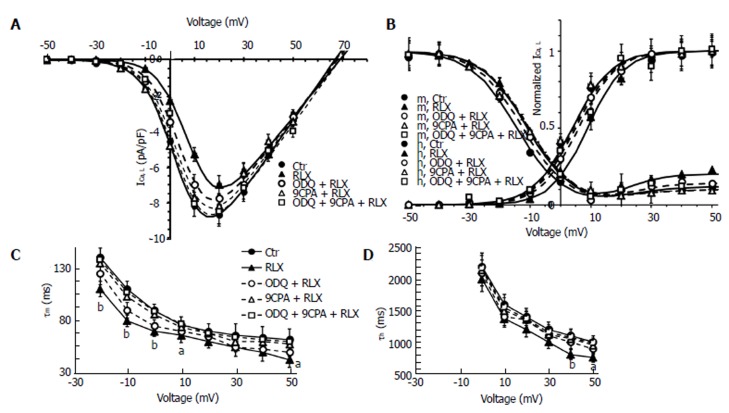
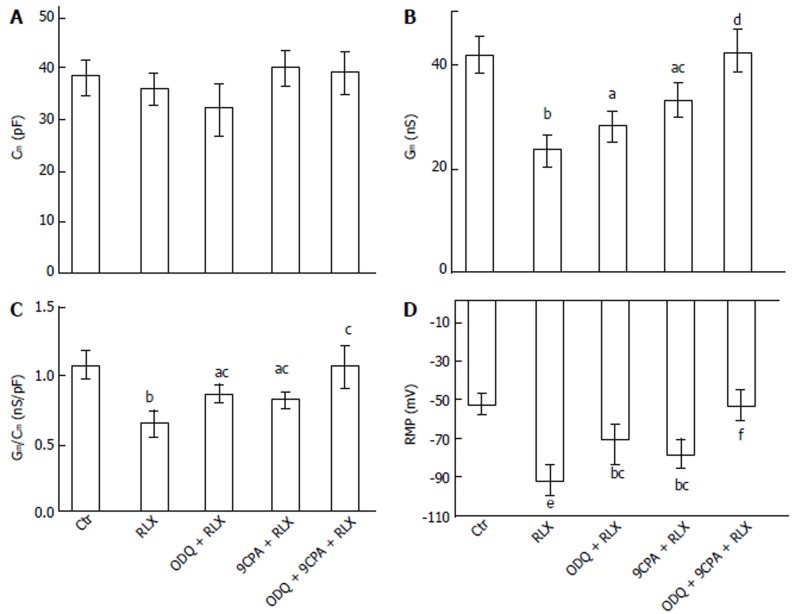
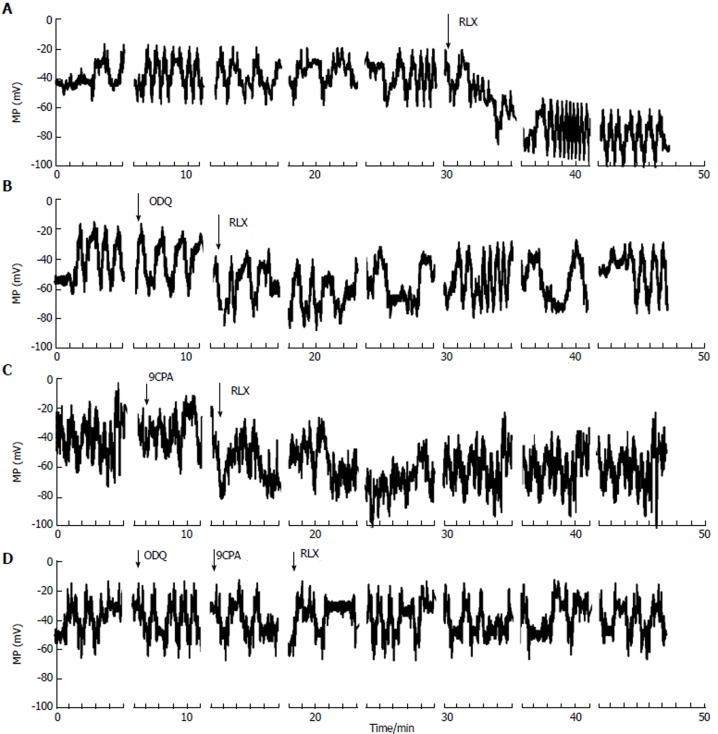
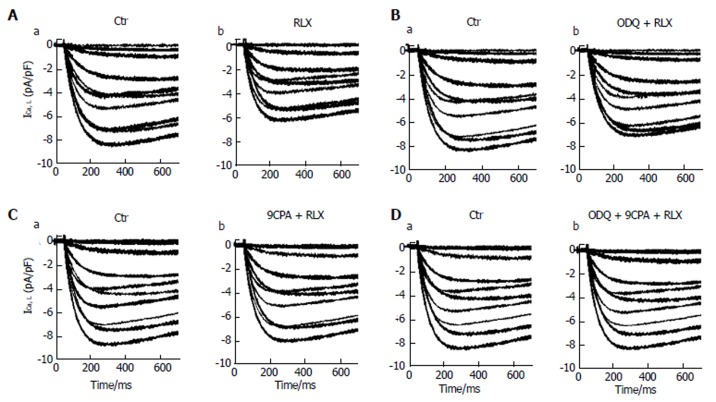
Mechanical experiments showed that RLX induced a decay of the basal tension and a reduction in amplitude of the spontaneous contractions. The effects of RLX were partially reduced by 1H-[1,2,4]oxadiazolo[4,3-]-quinoxalin-1-one (ODQ) or 9-cyclopentyladenine mesylate (9CPA), inhibitors of guanylate cyclase (GC) and adenylate cyclase (AC), respectively, and were abolished in the concomitant presence of both drugs. Electrophysiological experiments demonstrated that RLX directly influenced the biophysical properties of ileal SMCs, decreasing the membrane conductance, hyperpolarizing the resting membrane potential, reducing the L-type calcium current amplitude and affecting its kinetics. The voltage dependence of the current activation and inactivation time constant was significantly speeded by RLX. Each electrophysiological effect of RLX was reduced by ODQ or 9CPA, and abolished in the concomitant presence of both drugs as observed in mechanical experiments.
Our new findings demonstrate that RLX influences ileal muscle through a dual mechanism involving both GC and AC.
通过机械和电生理实验研究松弛素(RLX)对小鼠回肠制剂的信号通路。
在含有 Krebs-Henseleit 溶液的器官浴中,对雌性小鼠的回肠制剂进行机械实验。通过与描记器相连的力-位移换能器记录机械活性,以连续记录等长张力。通过微电极插入回肠纵层的单个平滑肌细胞(SMC),在电流和电压钳条件下进行电生理测量。使用合适的溶液和电压刺激方案记录膜的被动特性和内向电压依赖性 L 型钙电流。
机械实验表明,RLX 诱导基础张力衰减和自发性收缩幅度减小。RLX 的作用部分被鸟苷酸环化酶(GC)抑制剂 1H-[1,2,4]恶二唑并[4,3-a]喹喔啉-1-酮(ODQ)或腺苷酸环化酶(AC)抑制剂 9-环戊基腺嘌呤甲磺酸盐(9CPA)减弱,并且在两种药物同时存在时被消除。电生理实验表明,RLX 直接影响回肠 SMC 的生物物理特性,降低膜电导,超极化静息膜电位,减少 L 型钙电流幅度并影响其动力学。RLX 显著加快电流激活和失活时间常数的电压依赖性。RLX 的每个电生理作用都被 ODQ 或 9CPA 减弱,并且在机械实验中观察到两种药物同时存在时被消除。
我们的新发现表明,RLX 通过涉及 GC 和 AC 的双重机制影响回肠肌肉。