Herbeck Joshua T, Mittler John E, Gottlieb Geoffrey S, Goodreau Steven M, Murphy James T, Cori Anne, Pickles Michael, Fraser Christophe
International Clinical Research Center, Department of Global Health, University of Washington, Seattle, WA 98104, USA.
Department of Microbiology, University of Washington, Seattle, WA 98195, USA.
Virus Evol. 2016 Oct 3;2(2):vew028. doi: 10.1093/ve/vew028. eCollection 2016 Jul.
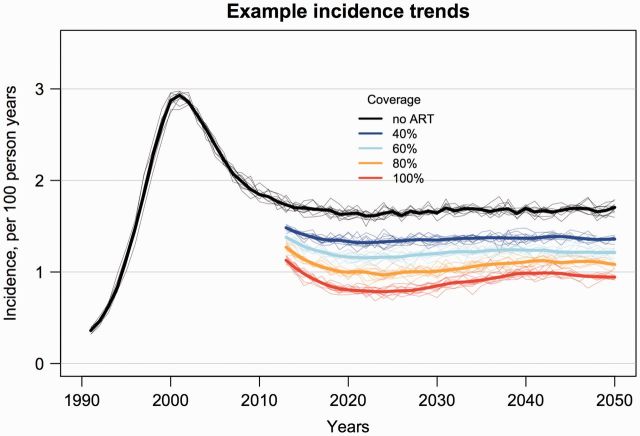
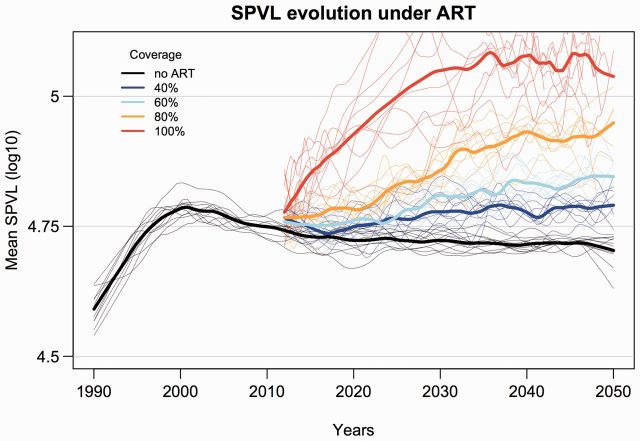
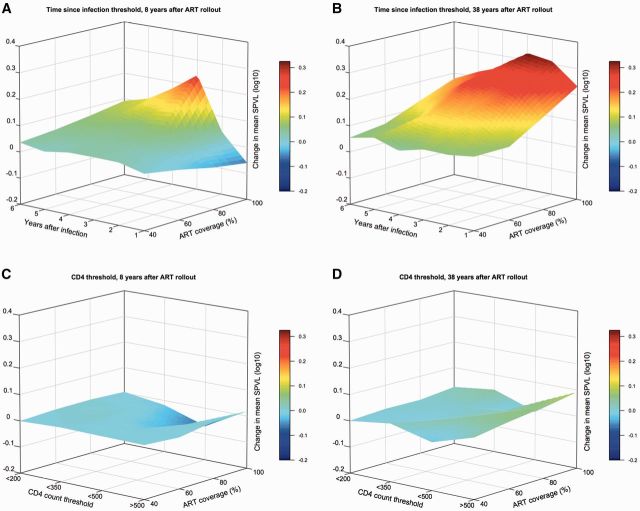
There are global increases in the use of HIV antiretroviral therapy (ART), guided by clinical benefits of early ART initiation and the efficacy of treatment as prevention of transmission. Separately, it has been shown theoretically and empirically that HIV virulence can evolve over time; observed virulence levels may reflect an adaptive balance between infected lifespan and per-contact transmission rate. However, the potential effects of widespread ART usage on HIV virulence are unknown. To predict these effects, we used an agent-based stochastic model to simulate evolutionary trends in HIV virulence, using set point viral load as a proxy for virulence. We calibrated our model to prevalence and incidence trends of South Africa. We explored two distinct ART scenarios: (1) ART initiation based on HIV-infected individuals reaching a CD4 count threshold; and (2) ART initiation based on individual time elapsed since HIV infection (a scenario that mimics "universal testing and treatment" (UTT) aspirations). In each case, we considered a range in population uptake of ART. We found that HIV virulence is generally unchanged in scenarios of CD4-based initiation. However, with ART initiation based on time since infection, virulence can increase moderately within several years of ART rollout, under high coverage levels and early treatment initiation (albeit within the context of epidemics that are rapidly decreasing in size). Sensitivity analyses suggested the impact of ART on virulence is relatively insensitive to model calibration. Our modeling study suggests that increasing HIV virulence driven by UTT is likely not a major public health concern, but should be monitored in sentinel surveillance, in a manner similar to transmitted resistance to antiretroviral drugs.
在早期启动抗逆转录病毒疗法(ART)的临床益处以及治疗作为预防传播的有效性的指导下,全球范围内HIV抗逆转录病毒疗法的使用有所增加。另外,理论和实证研究均表明,HIV毒力会随时间演变;观察到的毒力水平可能反映了感染寿命与每次接触传播率之间的适应性平衡。然而,广泛使用ART对HIV毒力的潜在影响尚不清楚。为了预测这些影响,我们使用基于主体的随机模型来模拟HIV毒力的进化趋势,使用设定点病毒载量作为毒力的替代指标。我们将模型校准到南非的流行率和发病率趋势。我们探讨了两种不同的ART方案:(1)基于HIV感染者达到CD4细胞计数阈值启动ART;(2)基于自感染HIV以来的个体时间启动ART(一种模拟“普遍检测和治疗”(UTT)愿望的方案)。在每种情况下,我们都考虑了ART在人群中的不同使用范围。我们发现,在基于CD4的启动方案中,HIV毒力总体上没有变化。然而,在基于感染时间启动ART的情况下,在高覆盖率和早期治疗启动的情况下(尽管是在规模迅速下降的疫情背景下),毒力可能在ART推出后的几年内适度增加。敏感性分析表明,ART对毒力的影响对模型校准相对不敏感。我们的建模研究表明,UTT导致的HIV毒力增加可能不是一个主要的公共卫生问题,但应以类似于对抗逆转录病毒药物的传播耐药性监测的方式,在哨点监测中进行监测。