Laboratory of Plant Physiology and Biochemistry, Department of Botany, University of Delhi, Delhi 110007, India.
Department of Botany, Jangipur College, University of Kalyani, West Bengal 742213, India.
Int J Mol Sci. 2018 Feb 25;19(3):647. doi: 10.3390/ijms19030647.
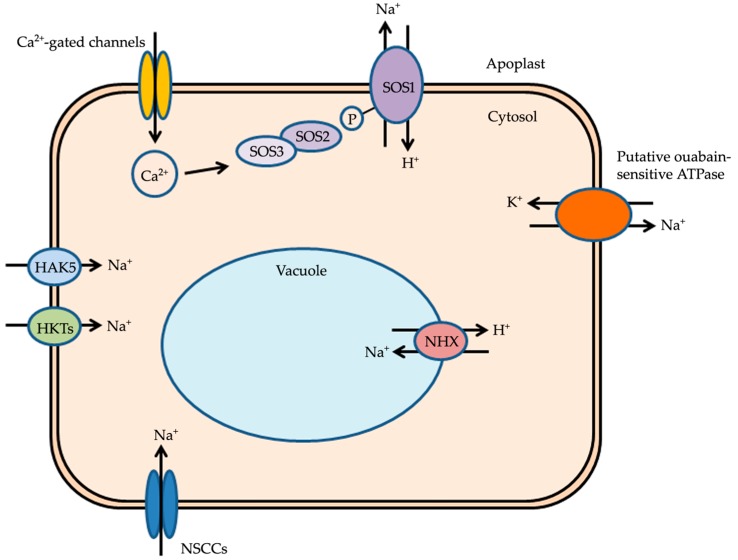
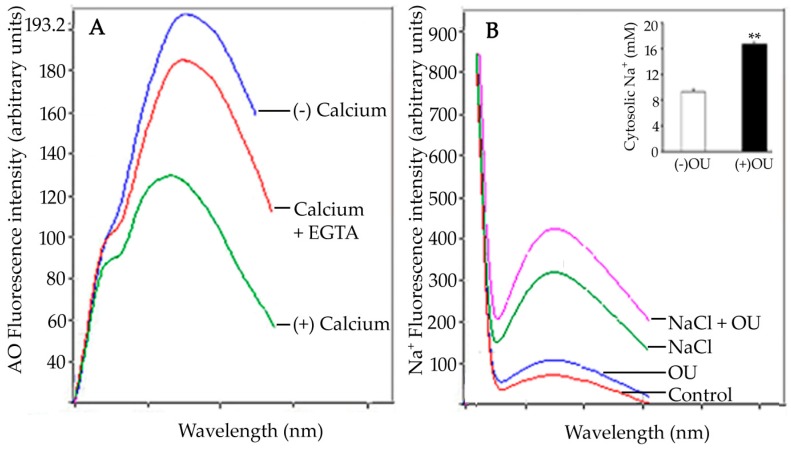
Understanding the mechanisms of sodium (Na⁺) influx, effective compartmentalization, and efflux in higher plants is crucial to manipulate Na⁺ accumulation and assure the maintenance of low Na⁺ concentration in the cytosol and, hence, plant tolerance to salt stress. Na⁺ influx across the plasma membrane in the roots occur mainly via nonselective cation channels (NSCCs). Na⁺ is compartmentalized into vacuoles by Na⁺/H⁺ exchangers (NHXs). Na⁺ efflux from the plant roots is mediated by the activity of Na⁺/H⁺ antiporters catalyzed by the salt overly sensitive 1 (SOS1) protein. In animals, ouabain (OU)-sensitive Na⁺, K⁺-ATPase (a P-type ATPase) mediates sodium efflux. The evolution of P-type ATPases in higher plants does not exclude the possibility of sodium efflux mechanisms similar to the Na⁺, K⁺-ATPase-dependent mechanisms characteristic of animal cells. Using novel fluorescence imaging and spectrofluorometric methodologies, an OU-sensitive sodium efflux system has recently been reported to be physiologically active in roots. This review summarizes and analyzes the current knowledge on Na⁺ influx, compartmentalization, and efflux in higher plants in response to salt stress.
了解钠离子(Na⁺)流入、有效区室化和流出的机制对操纵 Na⁺积累和确保细胞质中低 Na⁺浓度的维持至关重要,从而保证植物对盐胁迫的耐受性。根细胞中 Na⁺通过非选择性阳离子通道(NSCCs)主要进入质膜。Na⁺通过 Na⁺/H⁺交换器(NHXs)区室化到液泡中。Na⁺从植物根部流出是由 SOS1 蛋白催化的 Na⁺/H⁺反向转运体的活性介导的。在动物中,哇巴因(OU)敏感的 Na⁺,K⁺-ATPase(一种 P 型 ATPase)介导 Na⁺流出。高等植物 P 型 ATPase 的进化并不排除存在类似于动物细胞中特征性的 Na⁺,K⁺-ATPase 依赖性机制的 Na⁺流出机制的可能性。最近,使用新的荧光成像和荧光分光光度法方法,据报道在根中生理上存在 OU 敏感的钠流出系统。本文综述并分析了高等植物在盐胁迫下 Na⁺流入、区室化和流出的最新知识。