Hanin Moez, Ebel Chantal, Ngom Mariama, Laplaze Laurent, Masmoudi Khaled
Laboratoire de Biotechnologie et Amélioration des Plantes, Centre de Biotechnologie de SfaxSfax, Tunisia; Institut Supérieur de Biotechnologie, Université de SfaxSfax, Tunisia.
Laboratoire mixte international Adaptation des Plantes et microorganismes associés aux Stress EnvironnementauxDakar, Senegal; Laboratoire Commun de Microbiologie, Institut de Recherche pour le Développement/Institut Sénégalais de Recherches Agricoles/Université Cheikh Anta DiopDakar, Senegal.
Front Plant Sci. 2016 Nov 29;7:1787. doi: 10.3389/fpls.2016.01787. eCollection 2016.
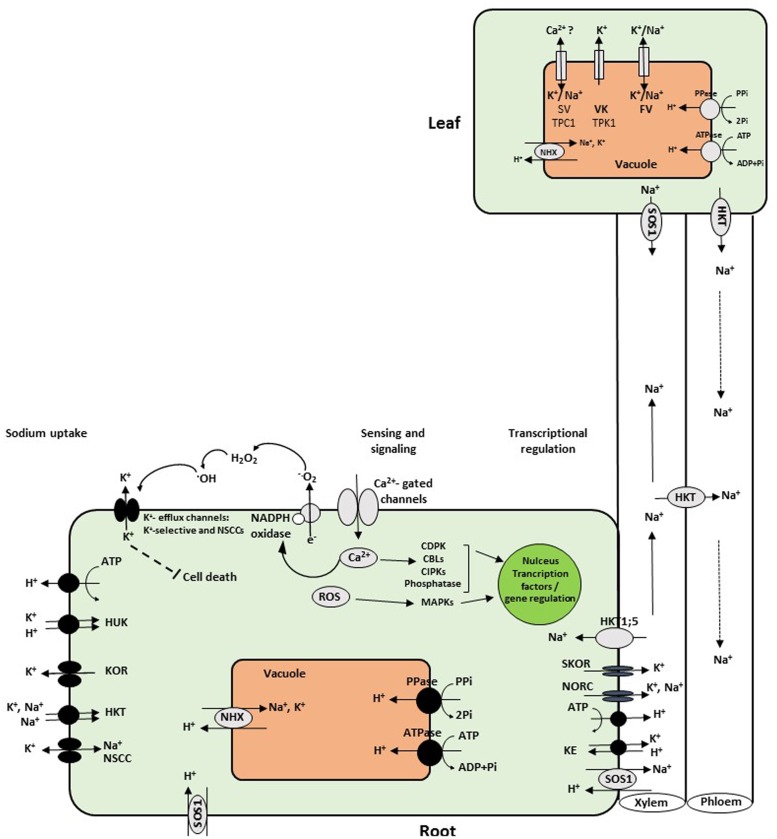
Soil salinization is a major threat to agriculture in arid and semi-arid regions, where water scarcity and inadequate drainage of irrigated lands severely reduce crop yield. Salt accumulation inhibits plant growth and reduces the ability to uptake water and nutrients, leading to osmotic or water-deficit stress. Salt is also causing injury of the young photosynthetic leaves and acceleration of their senescence, as the Na cation is toxic when accumulating in cell cytosol resulting in ionic imbalance and toxicity of transpiring leaves. To cope with salt stress, plants have evolved mainly two types of tolerance mechanisms based on either limiting the entry of salt by the roots, or controlling its concentration and distribution. Understanding the overall control of Na accumulation and functional studies of genes involved in transport processes, will provide a new opportunity to improve the salinity tolerance of plants relevant to food security in arid regions. A better understanding of these tolerance mechanisms can be used to breed crops with improved yield performance under salinity stress. Moreover, associations of cultures with nitrogen-fixing bacteria and arbuscular mycorrhizal fungi could serve as an alternative and sustainable strategy to increase crop yields in salt-affected fields.
土壤盐渍化是干旱和半干旱地区农业面临的主要威胁,在这些地区,水资源短缺和灌溉土地排水不畅严重降低了作物产量。盐分积累抑制植物生长,降低植物吸收水分和养分的能力,导致渗透胁迫或水分亏缺胁迫。盐分还会损伤幼嫩的光合叶片并加速其衰老,因为钠离子在细胞溶质中积累时具有毒性,会导致离子失衡和蒸腾叶片中毒。为了应对盐胁迫,植物主要进化出了两种耐受机制,一种是通过根系限制盐分进入,另一种是控制盐分的浓度和分布。了解钠积累的整体调控以及参与运输过程的基因的功能研究,将为提高干旱地区与粮食安全相关的植物的耐盐性提供新的机会。更好地理解这些耐受机制可用于培育在盐胁迫下产量表现更好的作物。此外,将作物与固氮细菌和丛枝菌根真菌结合起来,可作为一种替代的可持续策略,以提高盐渍化农田的作物产量。