Siriwardhana Dhammika D, Hardoon Sarah, Rait Greta, Weerasinghe Manuj C, Walters Kate R
Research Department of Primary Care and Population Health, University College London, London, UK.
Department of Disability Studies, Faculty of Medicine, University of Kelaniya, Ragama, Sri Lanka.
BMJ Open. 2018 Mar 1;8(3):e018195. doi: 10.1136/bmjopen-2017-018195.
To systematically review the research conducted on prevalence of frailty and prefrailty among community-dwelling older adults in low-income and middle-income countries (LMICs) and to estimate the pooled prevalence of frailty and prefrailty in community-dwelling older adults in LMICs.
Systematic review and meta-analysis. PROSPERO registration number is CRD42016036083.
MEDLINE, EMBASE, AMED, Web of Science, CINAHL and WHO Global Health Library were searched from their inception to 12 September 2017.
Low-income and middle-income countries.
Community-dwelling older adults aged ≥60 years.
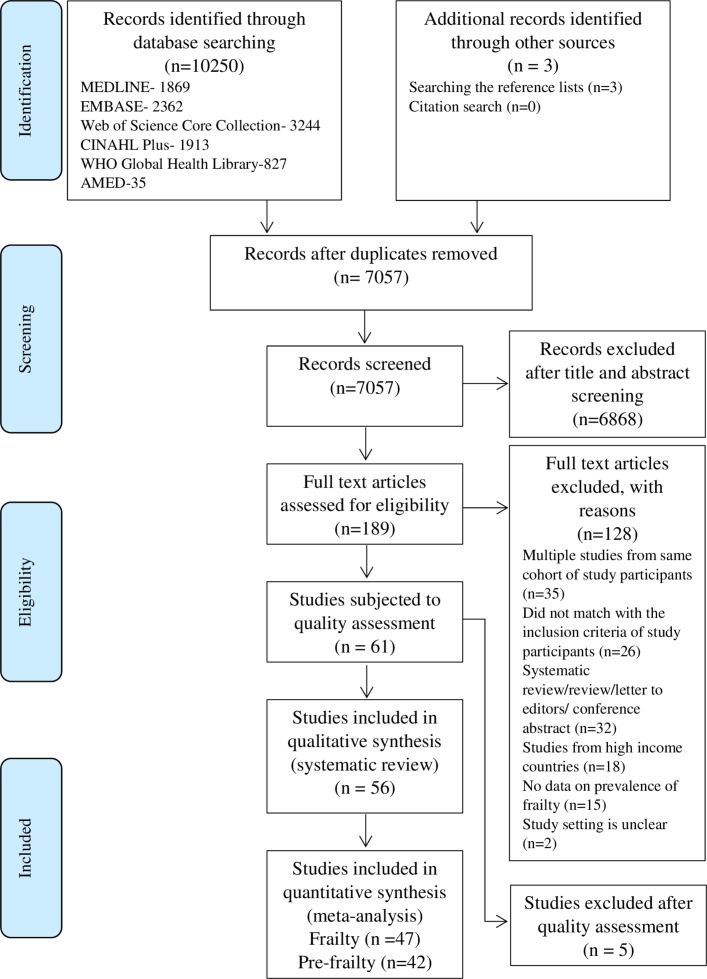
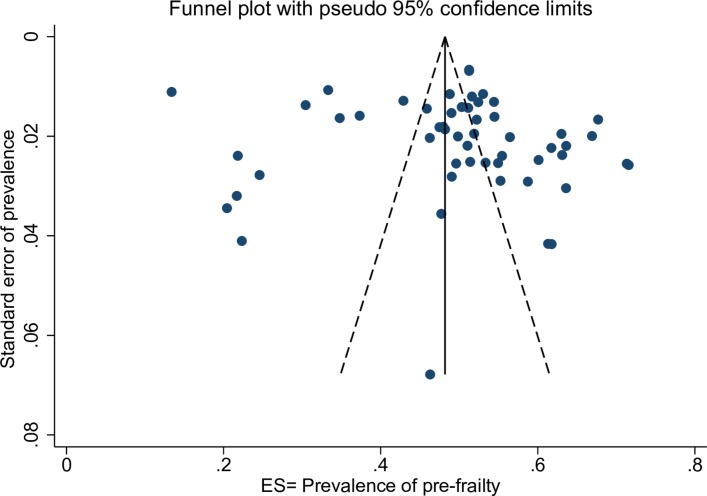
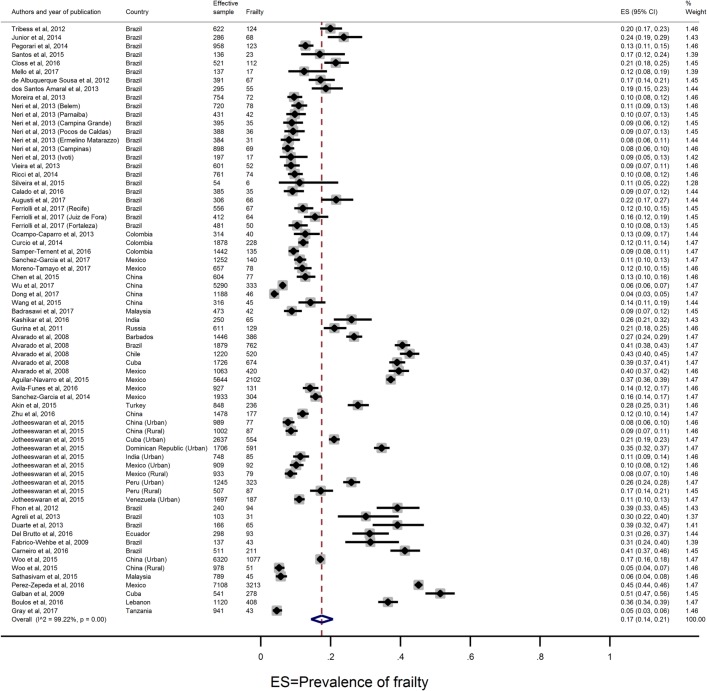
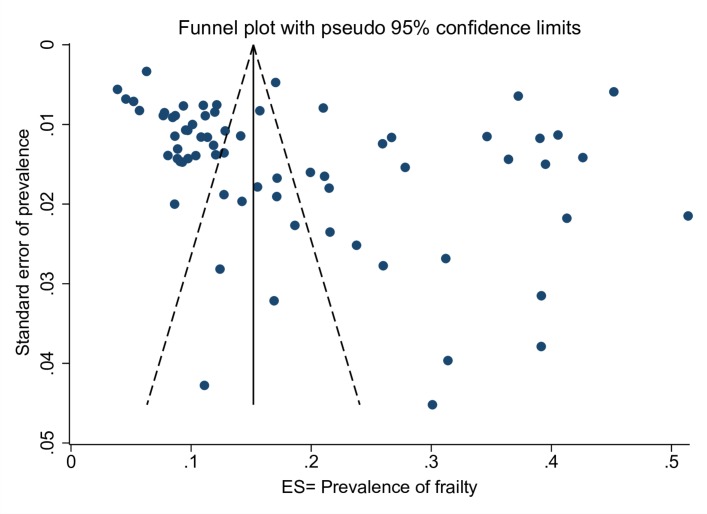
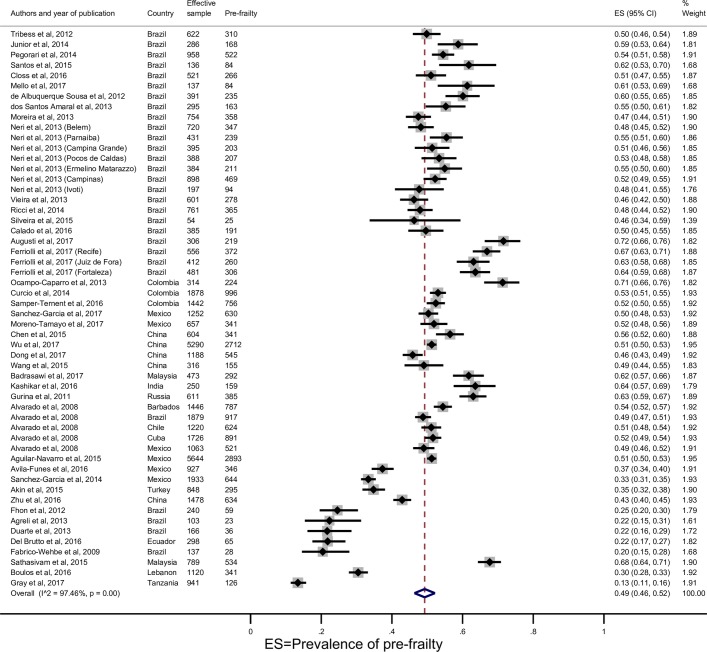
We screened 7057 citations and 56 studies were included. Forty-seven and 42 studies were included in the frailty and prefrailty meta-analysis, respectively. The majority of studies were from upper middle-income countries. One study was available from low-income countries. The prevalence of frailty varied from 3.9% (China) to 51.4% (Cuba) and prevalence of prefrailty ranged from 13.4% (Tanzania) to 71.6% (Brazil). The pooled prevalence of frailty was 17.4% (95% CI 14.4% to 20.7%, I=99.2%) and prefrailty was 49.3% (95% CI 46.4% to 52.2%, I=97.5%). The wide variation in prevalence rates across studies was largely explained by differences in frailty assessment method and the geographic region. These findings are for the studies with a minimum recruitment age 60, 65 and 70 years.
The prevalence of frailty and prefrailty appears higher in community-dwelling older adults in upper middle-income countries compared with high-income countries, which has important implications for healthcare planning. There is limited evidence on frailty prevalence in lower middle-income and low-income countries.
CRD42016036083.
系统回顾低收入和中等收入国家(LMICs)社区居住老年人中衰弱和衰弱前期患病率的相关研究,并估计LMICs社区居住老年人中衰弱和衰弱前期的合并患病率。
系统回顾和荟萃分析。PROSPERO注册号为CRD42016036083。
检索MEDLINE、EMBASE、AMED、科学网、CINAHL和世界卫生组织全球健康图书馆,检索时间从建库至2017年9月12日。
低收入和中等收入国家。
年龄≥60岁的社区居住老年人。
我们筛选了7057篇文献,纳入56项研究。衰弱和衰弱前期的荟萃分析分别纳入47项和42项研究。大多数研究来自中高收入国家。低收入国家仅有1项研究。衰弱患病率从3.9%(中国)到51.4%(古巴)不等,衰弱前期患病率从13.4%(坦桑尼亚)到71.6%(巴西)不等。衰弱的合并患病率为17.4%(95%CI 14.4%至20.7%,I=99.2%),衰弱前期为49.3%(95%CI 46.4%至52.2%,I=97.5%)。各研究患病率的广泛差异在很大程度上是由衰弱评估方法和地理区域的差异所致。这些结果是针对最低招募年龄为60、65和70岁的研究。
与高收入国家相比,中高收入国家社区居住老年人中衰弱和衰弱前期的患病率似乎更高,这对医疗保健规划具有重要意义。关于低收入和中等收入国家衰弱患病率的证据有限。
PROSPERO注册号:CRD42016036083。