NIHR CLAHRC South West Peninsula, University of Exeter Medical School, Exeter, UK.
NIHR CLAHRC South West Peninsula, Plymouth University, Plymouth, UK.
BMC Geriatr. 2018 Mar 2;18(1):63. doi: 10.1186/s12877-018-0756-9.
People with dementia may receive physiotherapy for a variety of reasons. This may be for musculoskeletal conditions or as a result of falls, fractures or mobility difficulties. While previous studies have sought to determine the effectiveness of physiotherapy interventions for people with dementia, little research has focused on the experiences of people receiving such treatment. The aim of this study was to gain an in-depth understanding of people's experiences of receiving physiotherapy and to explore these experiences in the context of principles of person-centred care.
Semi-structured interviews were undertaken with people with dementia or their carers between September 2016 and January 2017. A purposive sampling strategy recruited participants with dementia from the South West of England who had recently received physiotherapy. We also recruited carers to explore their involvement in the intervention. Thematic analysis was used to analyse the data.
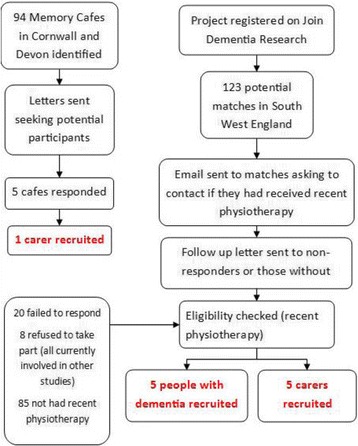
A total of eleven participants were recruited to the study. Six people with dementia were interviewed and five interviews undertaken separately with carers of people with dementia. Three themes were identified. The first explores the factors that enable exercises to be undertaken successfully, the second deals with perceived resource pressures, and the final theme "the physiotherapy just vanished" explores the feeling of abandonment felt when goals and expectations of physiotherapy were not discussed. When mapped against the principles of person-centred care, our participants did not describe physiotherapy adopting such an approach.
Lack of a person-centred care approach was evident by ineffective communication, thus failing to develop a shared understanding of the role and aims of physiotherapy. The incorporation of person-centred care may help reduce the frustration and feelings of dissatisfaction that some of our participants reported.
痴呆症患者可能因多种原因接受物理治疗。这可能是由于肌肉骨骼疾病,或者是由于跌倒、骨折或行动困难。虽然以前的研究试图确定物理治疗干预对痴呆症患者的有效性,但很少有研究关注接受这种治疗的人的体验。本研究旨在深入了解人们接受物理治疗的体验,并探讨这些体验在以患者为中心的护理原则背景下的情况。
2016 年 9 月至 2017 年 1 月期间,对痴呆症患者或其照顾者进行了半结构化访谈。采用目的性抽样策略,从英格兰西南部招募了最近接受过物理治疗的痴呆症患者。我们还招募了照顾者,以探讨他们对干预措施的参与情况。采用主题分析对数据进行分析。
共有 11 名参与者参与了这项研究。对 6 名痴呆症患者进行了访谈,并分别对 5 名痴呆症患者的照顾者进行了访谈。确定了三个主题。第一个主题探讨了使锻炼能够成功进行的因素,第二个主题涉及感知到的资源压力,最后一个主题“物理治疗突然消失”探讨了当物理治疗的目标和期望没有得到讨论时,患者感到被抛弃的感觉。当将这些主题映射到以患者为中心的护理原则时,我们的参与者并没有描述物理治疗采用这种方法。
缺乏以患者为中心的护理方法表现为沟通不畅,从而未能就物理治疗的角色和目标达成共同理解。纳入以患者为中心的护理方法可能有助于减少一些参与者所报告的挫折感和不满情绪。