Department of Physical Therapy, Saitama Prefectural University, Koshigaya 343-8540, Japan.
Int J Environ Res Public Health. 2021 Sep 29;18(19):10282. doi: 10.3390/ijerph181910282.
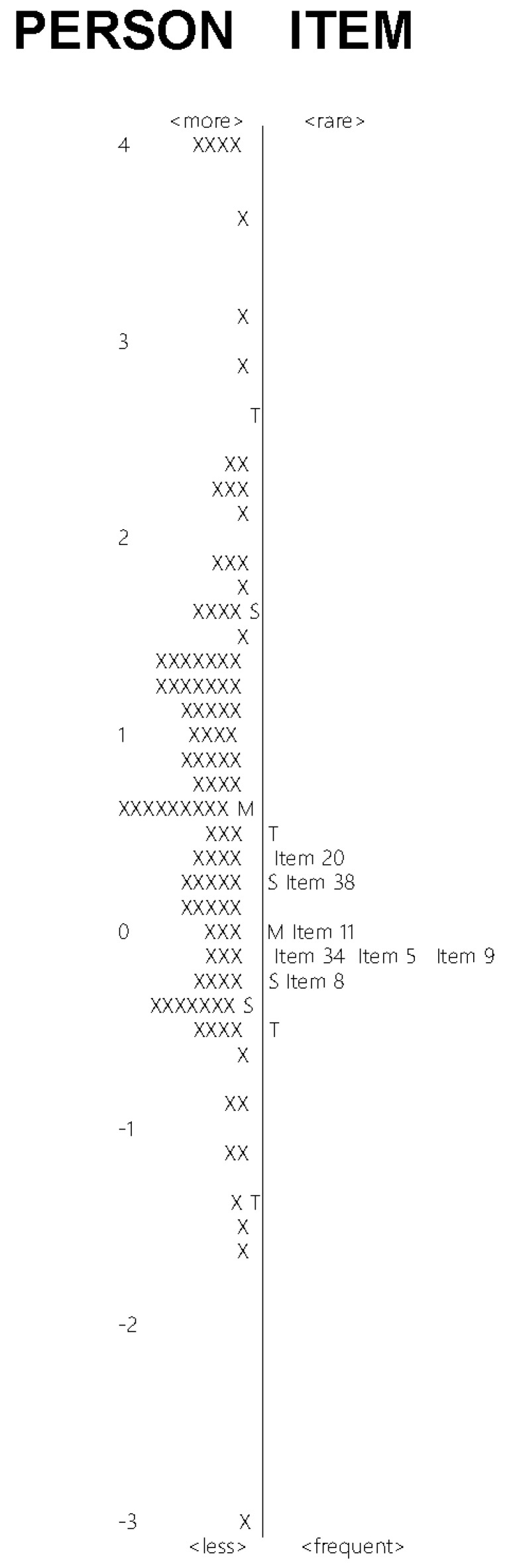
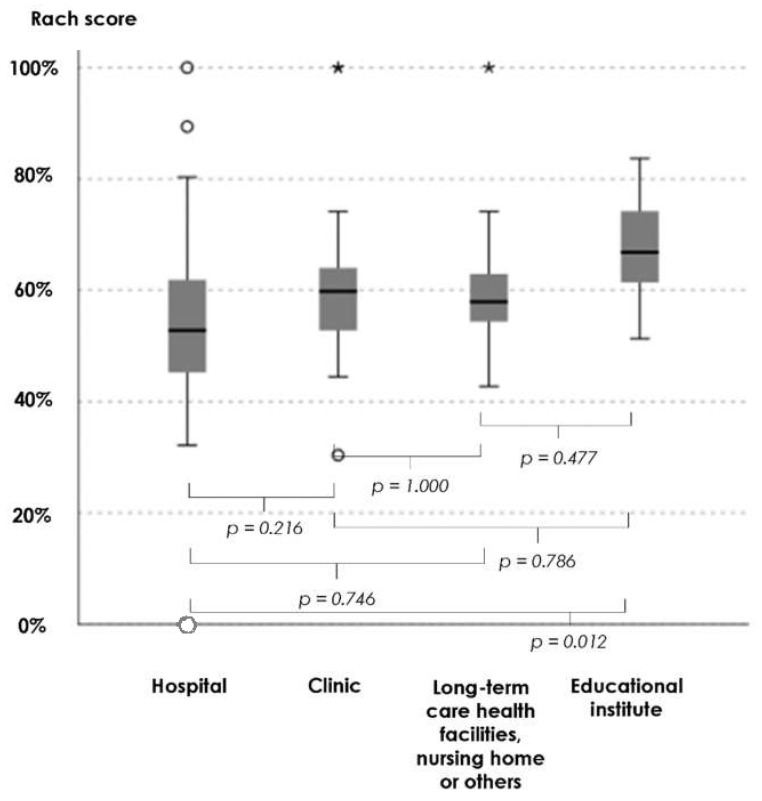
This study primarily aimed to develop a shorter version of the self-reported adherence to patient-centered physical therapy (s-SAPCPTS) by using Rasch analysis and secondarily aimed to preliminarily investigate the relationship between the s-SAPCPTS scores and demographics (i.e., age, sex, final academic degree (non-postgraduate degrees or postgraduate degrees), and practice environment). In an online anonymous survey, 110 Japanese physical therapists completed the self-reported adherence to patient-centered physical therapy and provided data on their demographics. Through the Rasch analysis, items were excluded in a stepwise manner, until certain pre-established criteria of the unidimensionality were satisfied. Subsequently, a conversion table for the Rasch score was developed. Furthermore, multiple regression analysis was conducted by using the independent variables age, sex, and final academic degree. Using the Kruskal-Wallis test, we compared the Rasch s-SAPCPTS scores among four practice environments. Consequently, the seven-item s-SAPCPTS was developed by excluding seven items through the Rasch analysis. Postgraduate degree was a statistically significant contributing factor for Rasch s-SAPCPTS scores ( = 0.038, = 0.20). The Kruskal-Wallis test demonstrated statistically significant differences in the Rasch s-SAPCPTS scores among the four practice environments ( = 0.006). In conclusion, the seven-item s-SAPCPTS was developed with the preliminary evidence of construct validity. It was also found that the final academic degree and practice environment could be the contributing factors of s-SAPCPTS scores.
本研究主要旨在通过使用 Rasch 分析开发自我报告的以患者为中心的物理治疗依从性(s-SAPCPTS)的简短版本,并初步探讨 s-SAPCPTS 评分与人口统计学(即年龄、性别、最终学术学位(非研究生学位或研究生学位)和实践环境)之间的关系。在一项在线匿名调查中,110 名日本物理治疗师完成了自我报告的以患者为中心的物理治疗依从性,并提供了有关其人口统计学的数据。通过 Rasch 分析,逐步排除项目,直到满足某些预先设定的维度性标准。随后,开发了 Rasch 分数的转换表。此外,通过使用独立变量年龄、性别和最终学术学位进行多元回归分析。通过 Kruskal-Wallis 检验,我们比较了四个实践环境中的 Rasch s-SAPCPTS 评分。结果,通过 Rasch 分析排除了七个项目,开发了七个项目的 s-SAPCPTS。研究生学位是 Rasch s-SAPCPTS 评分的统计学上显著的影响因素( = 0.038, = 0.20)。Kruskal-Wallis 检验表明四个实践环境之间的 Rasch s-SAPCPTS 评分存在统计学差异( = 0.006)。总之,开发了具有初步结构有效性证据的七个项目的 s-SAPCPTS。还发现最终学术学位和实践环境可能是 s-SAPCPTS 评分的影响因素。