Ketelaars Rein, Stollman Joram T, van Eeten Evelien, Eikendal Ties, Bruhn Jörgen, van Geffen Geert-Jan
Department of Anesthesiology, Pain and Palliative medicine, Radboud university medical center, Geert Grooteplein-Zuid 10, 6525 GA, Nijmegen, The Netherlands.
Emergency Department, Radboud university medical center, Geert Grooteplein-Zuid 10, 6525 GA, Nijmegen, The Netherlands.
Int J Emerg Med. 2018 Mar 2;11(1):12. doi: 10.1186/s12245-018-0173-z.
The treatment of acute pain in the emergency department is not always optimal. Peripheral nerve blocks using "blind" or nerve stimulator techniques have substantial disadvantages. Ultrasound-guided regional anesthesia may provide quick, safe, and effective pain relief in patients with proximal femoral fractures with severe pain. However, no evidence exists on emergency physician-performed ultrasound-guided regional anesthesia in these patients in Dutch emergency departments. We hypothesized that emergency physicians can be effectively trained to safely perform and implement ultrasound-guided femoral nerve blocks, resulting in effective pain relief in patients with proximal femoral fractures.
In this prospective observational study, emergency physicians were trained by expert anesthesiologists to perform ultrasound-guided femoral nerve blocks during a single-day course. Femoral nerve blocks were performed on patients with proximal femoral fractures. A system of direct supervision by skilled anesthesiologists and residents was put in place.
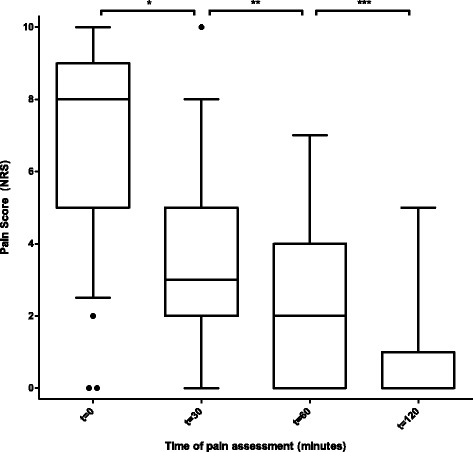
A total of 64 femoral nerve blocks were performed. After 30 min, blocks were effective in 69% of patients, and after 60 min, in 83.3%. The mean reduction in pain scores after 30 and 60 min was 3.84 and 4.77, respectively (both p < 0.001). Patients reported a mean satisfaction of 8.42 (1 to 10 scale). No adverse events occurred.
Ultrasound-guided femoral nerve block is an effective, safe, and easy to learn (single-day course) procedure for emergency physicians to implement and perform in the emergency department. Patient satisfaction was high.
急诊科急性疼痛的治疗并不总是理想的。使用“盲法”或神经刺激器技术进行周围神经阻滞存在诸多弊端。超声引导下区域麻醉可为近端股骨骨折且疼痛剧烈的患者提供快速、安全且有效的疼痛缓解。然而,在荷兰急诊科,尚无关于急诊医生对这类患者实施超声引导下区域麻醉的证据。我们推测急诊医生能够得到有效培训,从而安全地实施超声引导下股神经阻滞,为近端股骨骨折患者有效缓解疼痛。
在这项前瞻性观察研究中,急诊医生由专家麻醉医师进行培训,在为期一天的课程中学习实施超声引导下股神经阻滞。对近端股骨骨折患者实施股神经阻滞。建立了由熟练麻醉医师和住院医师进行直接监督的体系。
共实施了64例股神经阻滞。30分钟后,69%的患者阻滞有效,60分钟后,83.3%的患者阻滞有效。30分钟和60分钟后疼痛评分的平均降低值分别为3.84和4.77(均p < 0.001)。患者报告的平均满意度为8.42(1至10分制)。未发生不良事件。
超声引导下股神经阻滞对于急诊医生在急诊科实施而言,是一种有效、安全且易于学习(为期一天的课程)的操作。患者满意度较高。