Department of Anesthesiology and Intensive Care, Hôpital Saint-Antoine, Assistance Publique-Hôpitaux de Paris, Paris, France.
GRC 29, DMU DREAM, Assistance Publique-Hôpitaux de Paris, Sorbonne University, Paris, France.
PLoS One. 2021 Jun 4;16(6):e0252716. doi: 10.1371/journal.pone.0252716. eCollection 2021.
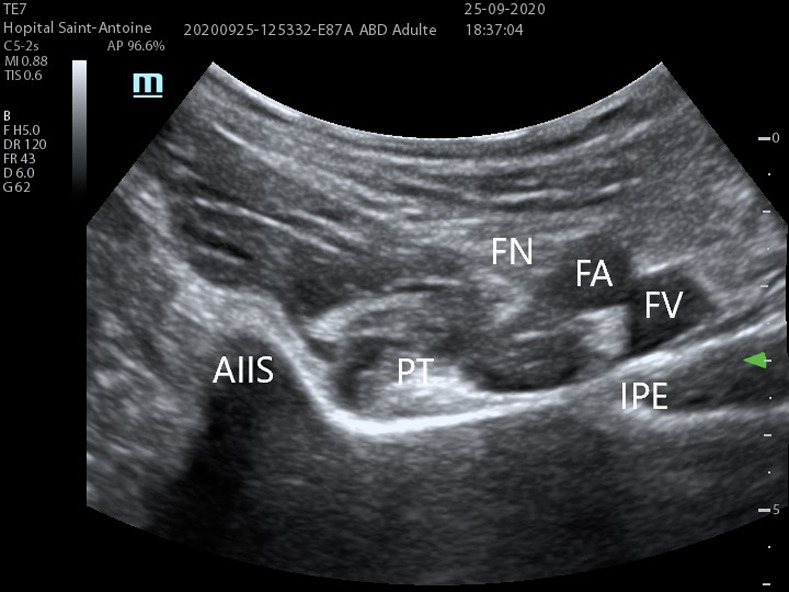
Regional analgesia is worth performing in the multimodal postoperative management of hip fracture (HF) because it reduces hospital morbidity and mortality. The aim of this study is to compare the efficacy and side effects of the recently described "Pericapsular Nerve Group (PENG) Block" with those of the femoral block, which is considered the standard of care for postoperative pain control after femoral neck fracture.
We conducted a comparative observational study at a university hospital (Saint Antoine Hospital, Sorbonne University, Paris, France), where the PENG block was introduced in August 2019. We include all patients from June to October 2019, who were coming for femoral neck fractures and who had an analgesic femoral block or PENG block before their surgery. The primary outcome was the comparison of cumulative postoperative morphine consumption 48 hours after surgery.
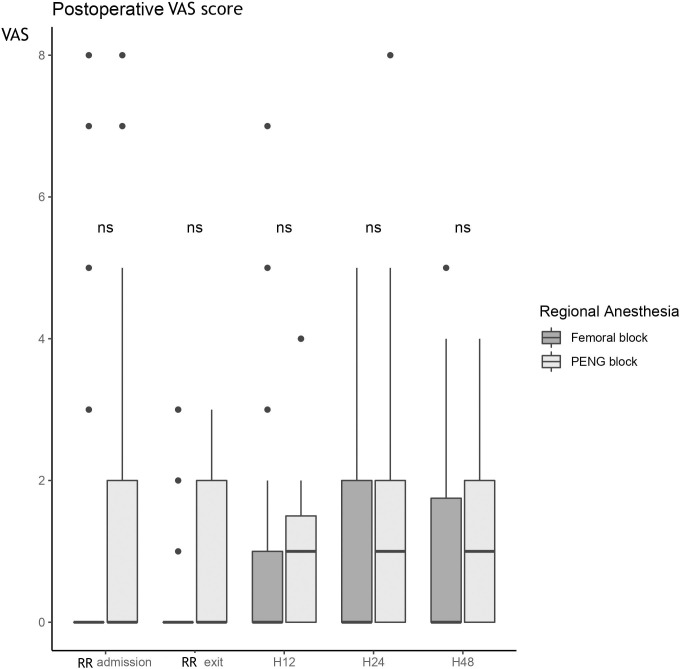
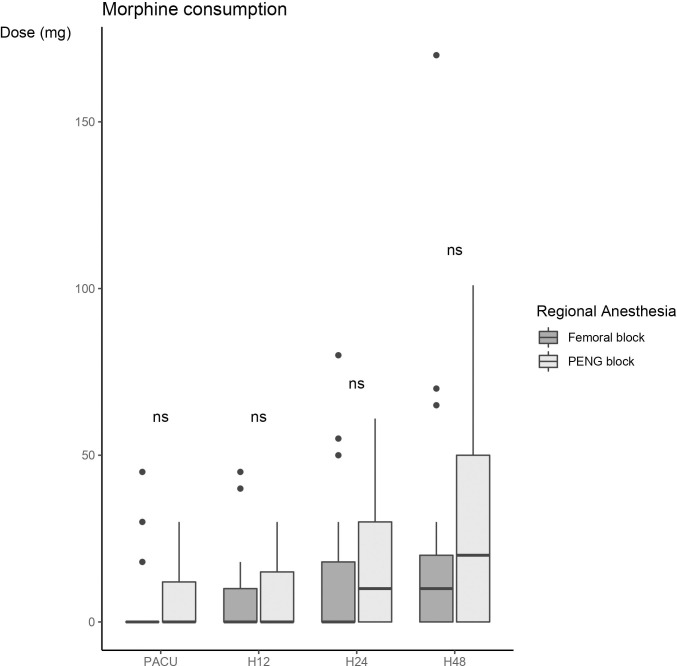
Demographics, medical charts, and perioperative data of 42 patients were reviewed: 21 patients before (Femoral group) and 21 patients after the introduction of PENG block (PENG group) in clinical practice. Thirteen total hip arthroplasties (THA) and eight hemi arthroplasties (HA) were included in each group. Demographics were also comparable. The median, postoperative, morphine equivalent consumption at 48 hours was 10 [0-20] mg and 20 [0-50] mg in Femoral and PENG groups respectively (p = 0.458). No statistically significant differences were found in postoperative pain intensity, time to ambulation, incidence of morphine-related side effects, or length of hospital stay. The postoperative muscle strength of the quadriceps was greater in the PENG group than in the Femoral group (5/5 vs. 2/5, p = 0.001).
In the management of hip fractures, PENG block is not associated in our study with a significant change in postoperative morphine consumption, compared to femoral block. However, it does significantly improve the immediate mobility of the operated limb, making it appropriate for inclusion in enhanced recovery programs after surgery.
区域麻醉在髋部骨折(HF)的多模式术后管理中具有价值,因为它降低了住院发病率和死亡率。本研究的目的是比较最近描述的“囊周神经群(PENG)阻滞”与股神经阻滞的疗效和副作用,股神经阻滞被认为是股骨颈骨折后术后疼痛控制的标准治疗方法。
我们在一家大学医院(法国巴黎索邦大学圣安东尼医院)进行了一项比较观察性研究,PENG 阻滞于 2019 年 8 月引入。我们纳入了 2019 年 6 月至 10 月期间因股骨颈骨折前来就诊并在手术前接受股神经阻滞或 PENG 阻滞的所有患者。主要结局是比较术后 48 小时累积术后吗啡消耗量。
回顾了 42 例患者的人口统计学、病历和围手术期数据:21 例患者在(股神经组)之前和 21 例患者在 PENG 阻滞(PENG 组)引入临床实践后。每组包括 13 例全髋关节置换术(THA)和 8 例半髋关节置换术(HA)。人口统计学数据也相似。中位数、术后吗啡等效消耗量在 48 小时分别为 10 [0-20]mg 和 20 [0-50]mg 在股神经组和 PENG 组(p = 0.458)。术后疼痛强度、下床时间、吗啡相关副作用发生率和住院时间无统计学差异。与股神经组相比,PENG 组术后股四头肌肌力更强(5/5 比 2/5,p = 0.001)。
在髋部骨折的管理中,与股神经阻滞相比,本研究中 PENG 阻滞并未显著改变术后吗啡消耗量。然而,它确实显著改善了手术肢体的即时活动能力,使其适合纳入手术后的强化康复计划。