Madsen Bjarne K, Søgaard Karen, Andersen Lars L, Skotte Jørgen, Tornøe Birte, Jensen Rigmor H
Danish Headache Center, Department of Neurology, University of Copenhagen, Rigshospitalet-Glostrup, Glostrup.
Institute of Sports Science and Clinical Biomechanics, Physical Activity and Health in Work Life University of Southern Denmark, Odense.
J Pain Res. 2018 Feb 23;11:445-454. doi: 10.2147/JPR.S146050. eCollection 2018.
Muscle pain has been associated with reduced maximal muscle strength, and reduced rate of force development (RFD). Strength training (ST) has shown an effect in not only normalizing muscle function but also reducing neck muscle pain.
The aims of this study were to compare muscle function in terms of strength, force steadiness in neck flexion, as well as extension, and rate of RFD of the shoulder in tension-type headache (TTH) patients and healthy controls and to examine the correlation to tenderness. Furthermore, the aim of the study was to examine the effect of ST on neck and shoulder functions in TTH patients.
In all, 60 TTH patients and 30 sex- and age-matched healthy controls were included for a case-control comparison. The 60 patients with TTH were randomized into an ST and an ergonomic and posture correction (EP) control group. The ST group trained for 10 weeks with elastic bands.
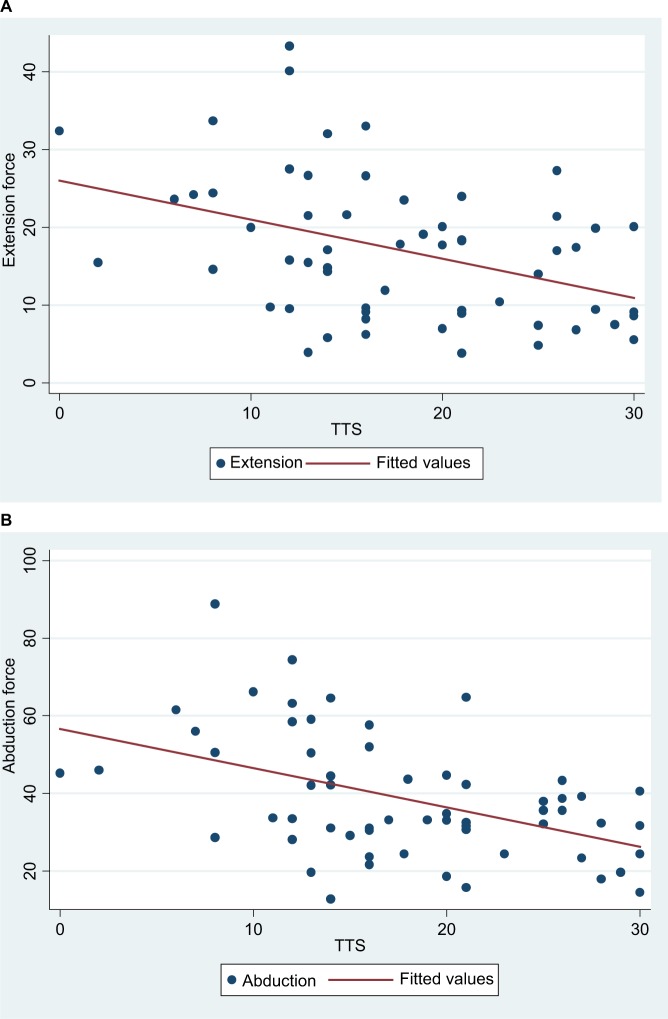
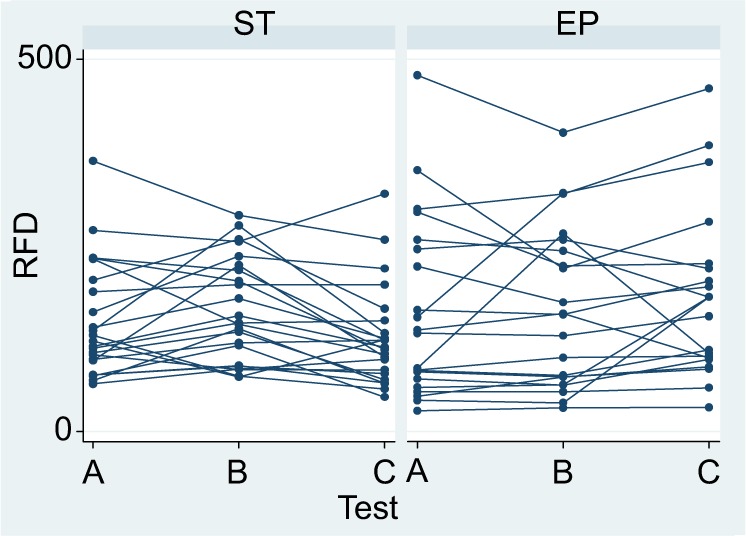
TTH patients had a lower extension force steadiness with a significant 15% higher coefficient of variation (CoV) compared to healthy controls (=0.047). A significantly lower RFD (25%) was noted in the TTH group than in the healthy controls (=0.031). A significant (<0.01) and moderate correlation to muscle tenderness was found. In the intervention, 23 patients completed ST and 21 patients completed EP. No significant between-group effect was observed, but at 22 weeks follow-up, both groups had a significant within-group effect of improved extension force steadiness (ST: =0.011 and EP: <0.01).
TTH patients showed a deteriorated muscle function, indicated by a lower force steadiness and RFD, compared to the healthy controls. The effect of ST was not larger than EP as both groups of TTH patients showed some improvement in neck and shoulder functions during the 10 weeks intervention and at follow-up. Future interventions are needed to elucidate if normalization of muscle function can lead to a reduction in headache.
肌肉疼痛与最大肌肉力量降低以及力量发展速率(RFD)降低有关。力量训练(ST)不仅对使肌肉功能正常化有效果,而且对减轻颈部肌肉疼痛也有效果。
本研究的目的是比较紧张型头痛(TTH)患者和健康对照者在力量、颈部前屈以及后伸时的力量稳定性,以及肩部的RFD方面的肌肉功能,并检查与压痛的相关性。此外,本研究的目的是检查ST对TTH患者颈部和肩部功能的影响。
总共纳入60例TTH患者和30例性别和年龄匹配的健康对照者进行病例对照比较。60例TTH患者被随机分为ST组和人体工程学与姿势矫正(EP)对照组。ST组使用弹力带训练10周。
与健康对照者相比,TTH患者的后伸力量稳定性较低,变异系数(CoV)显著高出15%(P = 0.047)。TTH组的RFD显著低于健康对照者(25%)(P = 0.031)。发现与肌肉压痛存在显著(P < 0.01)且中等程度的相关性。在干预过程中,23例患者完成了ST,21例患者完成了EP。未观察到组间显著效应,但在22周随访时,两组均有组内显著效应,即后伸力量稳定性得到改善(ST组:P = 0.011,EP组:P < 0.01)。
与健康对照者相比,TTH患者表现出肌肉功能恶化,表现为力量稳定性和RFD较低。ST的效果并不比EP大,因为两组TTH患者在10周干预期间和随访时颈部和肩部功能均有一定改善。未来需要进行干预以阐明肌肉功能正常化是否能导致头痛减轻。