Gram Bibi, Andersen Christoffer, Zebis Mette K, Bredahl Thomas, Pedersen Mogens T, Mortensen Ole S, Jensen Rigmor H, Andersen Lars L, Sjøgaard Gisela
Institute of Sports Science and Clinical Biomechanics, University of Southern Denmark, 5230 Odense, Denmark ; Institute of Regional Health Research, University of Southern Denmark, 5230 Odense, Denmark.
National Research Centre for the Working Environment, 2100 Copenhagen, Denmark.
Biomed Res Int. 2014;2014:693013. doi: 10.1155/2014/693013. Epub 2014 Feb 19.
To investigate the effect of workplace neck/shoulder strength training with and without regular supervision on neck/shoulder pain and headache among office workers.
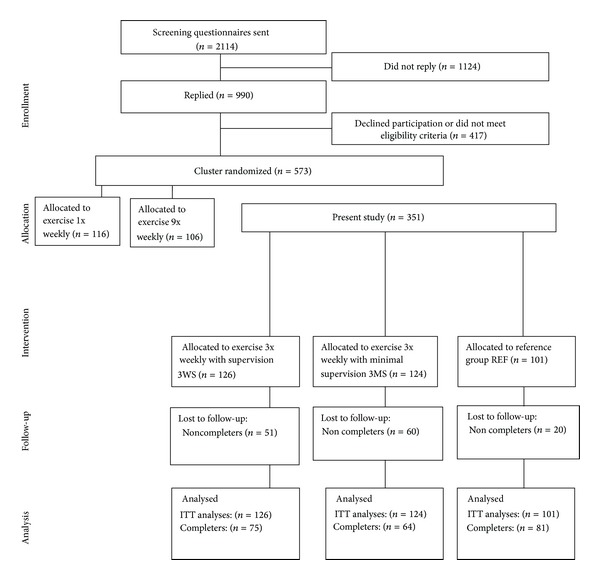
A 20-week cluster randomized controlled trial among 351 office workers was randomized into three groups: two training groups with the same total amount of planned exercises three times per week (1) with supervision (3WS) throughout the intervention period, (2) with minimal supervision (3MS) only initially, and (3) a reference group (REF). Main outcome is self-reported pain intensity in neck and shoulder (scale 0-9) and headache (scale 0-10).
Intention-to-treat analyses showed a significant decrease in neck pain intensity the last 7 days in 3MS compared with REF: -0.5 ± 0.2 (P < 0.02) and a tendency for 3WS versus REF: -0.4 ± 0.2 (P < 0.07). Intensity of headache the last month decreased in both training groups: 3WS versus REF: -1.1 ± 0.2 (P < 0.001) and 3MS versus REF: -1.1 ± 0.2 (P < 0.001). Additionally, days of headache decreased 1.0 ± 0.5 in 3WS and 1.3 ± 0.5 in 3MS versus REF. There were no differences between the two training groups for any of the variables.
Neck/shoulder training at the workplace reduced neck pain and headache among office workers independently of the extent of supervision. This finding has important practical implications for future workplace interventions.
探讨有或无定期监督的职场颈部/肩部力量训练对办公室职员颈部/肩部疼痛及头痛的影响。
对351名办公室职员进行为期20周的整群随机对照试验,将其随机分为三组:两个训练组,每周进行三次计划锻炼,总量相同,(1)在整个干预期内有监督(3WS),(2)仅在最初有最低限度监督(3MS),(3)一个参照组(REF)。主要结局指标为自我报告的颈部和肩部疼痛强度(0 - 9级)及头痛强度(0 - 10级)。
意向性分析显示,与参照组相比,3MS组在过去7天颈部疼痛强度显著降低:-0.5±0.2(P<0.02),3WS组与参照组相比有降低趋势:-0.4±0.2(P<0.07)。两个训练组在过去一个月的头痛强度均降低:3WS组与参照组相比:-1.1±0.2(P<0.001),3MS组与参照组相比:-1.1±0.2(P<0.001)。此外,与参照组相比,3WS组头痛天数减少1.0±0.5天,3MS组减少1.3±0.5天。两个训练组在任何变量上均无差异。
职场颈部/肩部训练可减轻办公室职员的颈部疼痛和头痛,且与监督程度无关。这一发现对未来职场干预具有重要的实际意义。