Chongqing Key Laboratory of Ultrasound Molecular Imaging, Institute of ultrasound imaging, Second Affiliated Hospital, Chongqing Medical University, Chongqing, 400010, P. R. China.
State Key Lab of High-Performance Ceramics and Superfine Microstructure, Shanghai Institute of Ceramics, Chinese Academy of Sciences, Shanghai, 200050, P. R. China.
Theranostics. 2018 Feb 2;8(5):1327-1339. doi: 10.7150/thno.21492. eCollection 2018.
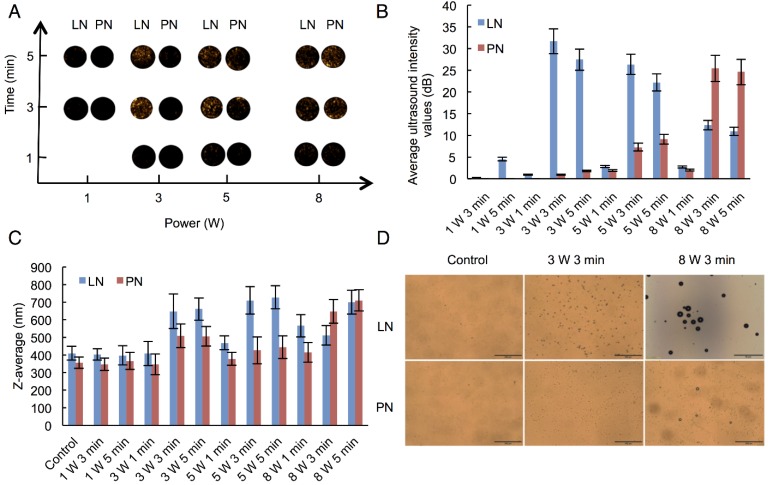
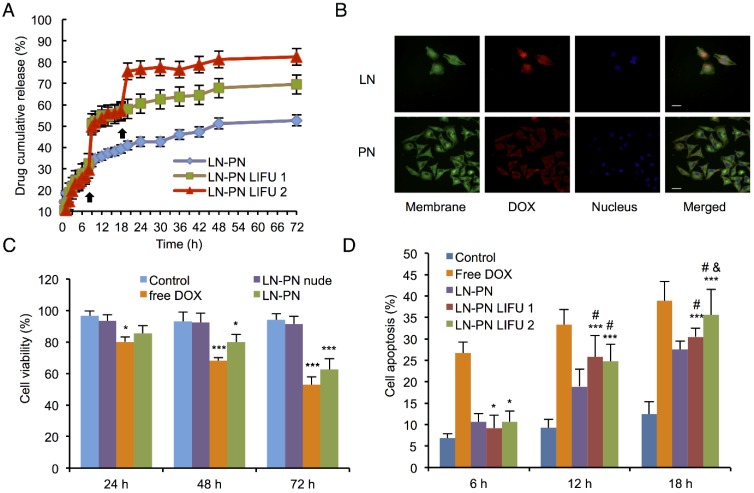
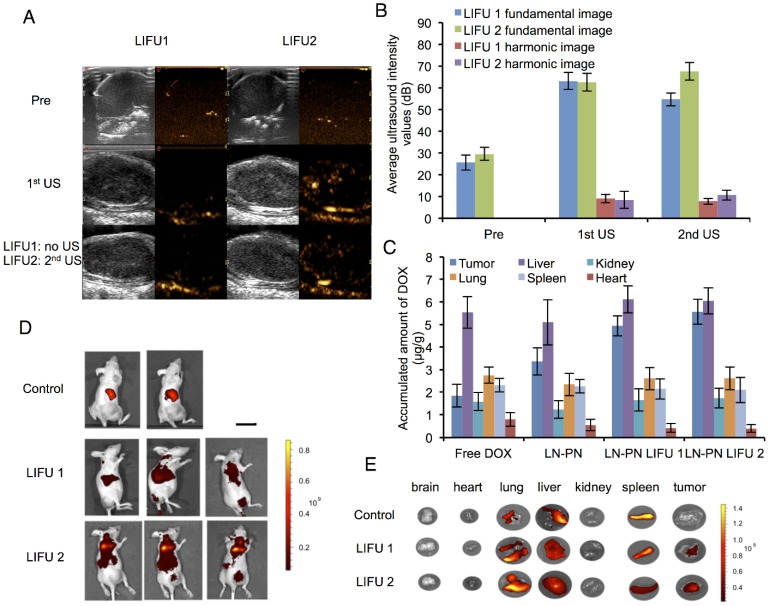
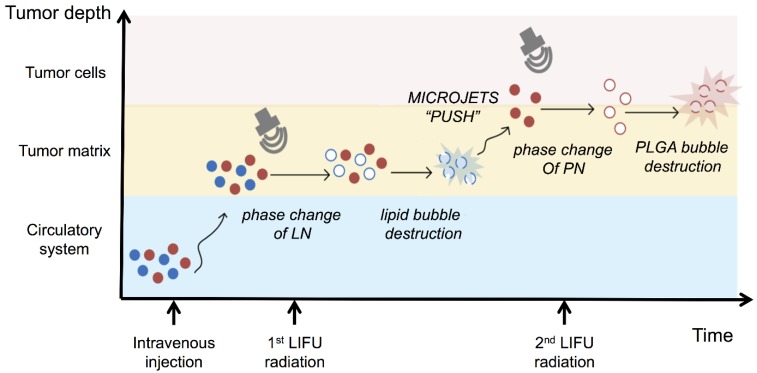
As one of the most effective triggers with high tissue-penetrating capability and non-invasive feature, ultrasound shows great potential for controlling the drug release and enhancing the chemotherapeutic efficacy. In this study, we report, for the first time, construction of a phase-changeable drug-delivery nanosystem with programmable low-intensity focused ultrasound (LIFU) that could trigger drug-release and significantly enhance anticancer drug delivery. Liquid-gas phase-changeable perfluorocarbon (perfluoropentane) and an anticancer drug (doxorubicin) were simultaneously encapsulated in two kinds of nanodroplets. By triggering LIFU, the nanodroplets could be converted into microbubbles locally in tumor tissues for acoustic imaging and the loaded anticancer drug (doxorubicin) was released after the microbubble collapse. Based on the acoustic property of shell materials, such as shell stiffness, two types of nanodroplets (lipid-based nanodroplets and PLGA-based nanodroplets) were activated by different acoustic pressure levels. Ultrasound irradiation duration and power of LIFU were tested and selected to monitor and control the drug release from nanodroplets. Various ultrasound energies were introduced to induce the phase transition and microbubble collapse of nanodroplets in vitro (3 W/3 min for lipid nanodroplets; 8 W/3 min for PLGA nanodroplets). We detected three steps in the drug-releasing profiles exhibiting the programmable patterns. Importantly, the intratumoral accumulation and distribution of the drug with LIFU exposure were significantly enhanced, and tumor proliferation was substantially inhibited. Co-delivery of two drug-loaded nanodroplets could overcome the physical barriers of tumor tissues during chemotherapy. Our study provides a new strategy for the efficient ultrasound-triggered chemotherapy by nanocarriers with programmable LIFU capable of achieving the on-demand drug release.
作为一种具有高效组织穿透能力和非侵入性特征的最有效触发方式之一,超声在控制药物释放和增强化学治疗效果方面显示出巨大的潜力。在这项研究中,我们首次报告了一种具有可编程低强度聚焦超声(LIFU)的相变药物递送纳米系统的构建,该系统可以触发药物释放并显著增强抗癌药物的递送。液态-气态可相变全氟碳(全氟戊烷)和一种抗癌药物(阿霉素)同时被包裹在两种纳米液滴中。通过触发 LIFU,纳米液滴可以在肿瘤组织中局部转化为微泡,用于声像,并在微泡破裂后释放负载的抗癌药物(阿霉素)。基于壳材料的声学特性,如壳硬度,两种类型的纳米液滴(基于脂质的纳米液滴和基于 PLGA 的纳米液滴)通过不同的声压水平被激活。测试并选择了超声辐射持续时间和 LIFU 功率,以监测和控制纳米液滴中的药物释放。引入各种超声能量以在体外诱导纳米液滴的相变和微泡破裂(脂质纳米液滴为 3 W/3 min;PLGA 纳米液滴为 8 W/3 min)。我们检测到药物释放曲线呈现出可编程模式的三个步骤。重要的是,LIFU 暴露后肿瘤内药物的蓄积和分布明显增强,肿瘤增殖受到显著抑制。两种载药纳米液滴的共递送可以克服化疗期间肿瘤组织的物理障碍。我们的研究为纳米载体的高效超声触发化疗提供了一种新策略,该策略具有可编程的 LIFU,能够实现按需药物释放。