Yang Wei, Schwartz Gary N, Marotti Jonathan D, Chen Vivian, Traphagen Nicole A, Gui Jiang, Miller Todd W
Department of Molecular and Systems Biology, Norris Cotton Cancer Center, Dartmouth-Hitchcock Medical Center, Geisel School of Medicine at Dartmouth, Lebanon, NH, USA.
Department of Hematology/Oncology, Norris Cotton Cancer Center, Dartmouth-Hitchcock Medical Center, Geisel School of Medicine at Dartmouth, Lebanon, NH, USA.
Oncotarget. 2018 Jan 15;9(10):8810-8822. doi: 10.18632/oncotarget.24256. eCollection 2018 Feb 6.
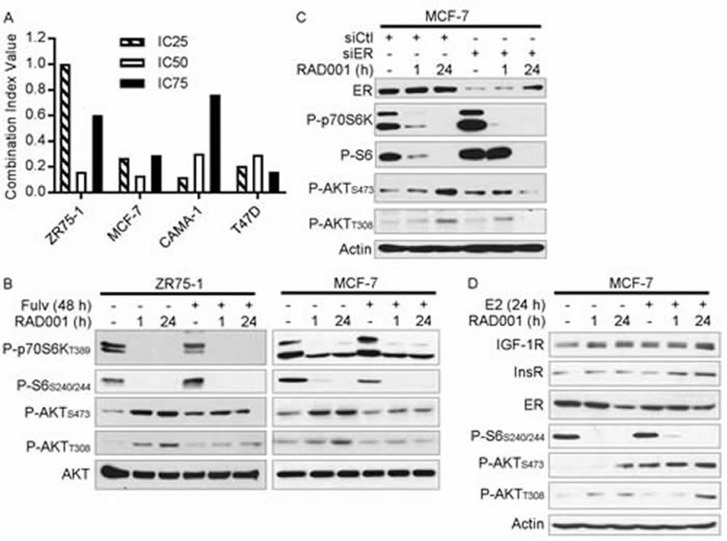
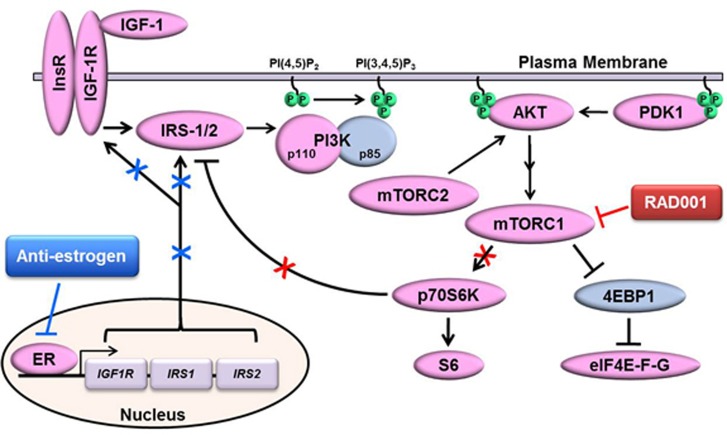
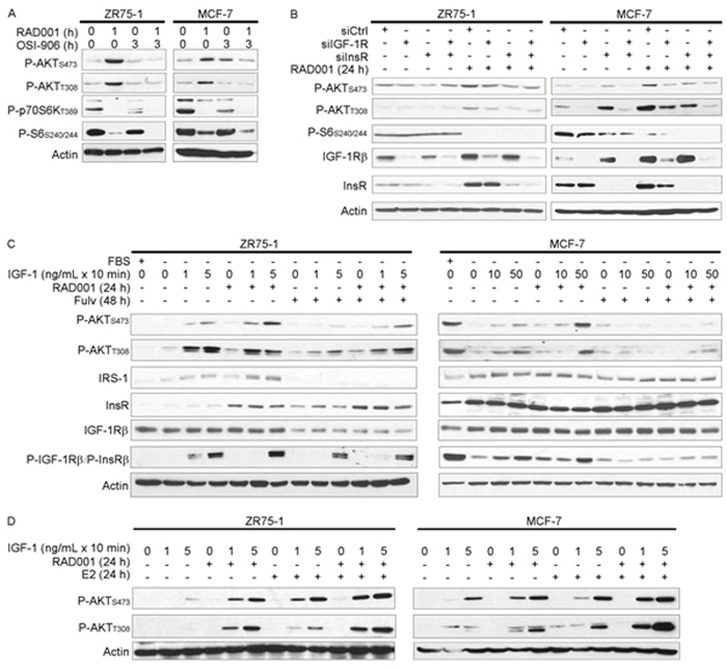
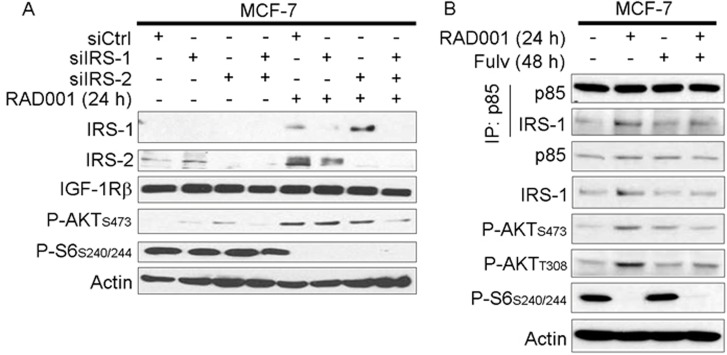
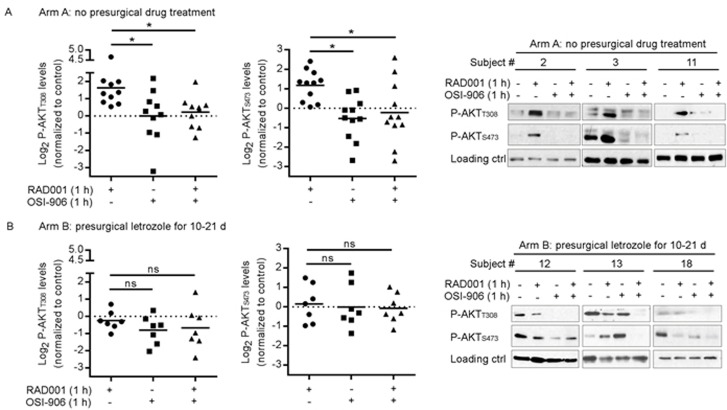
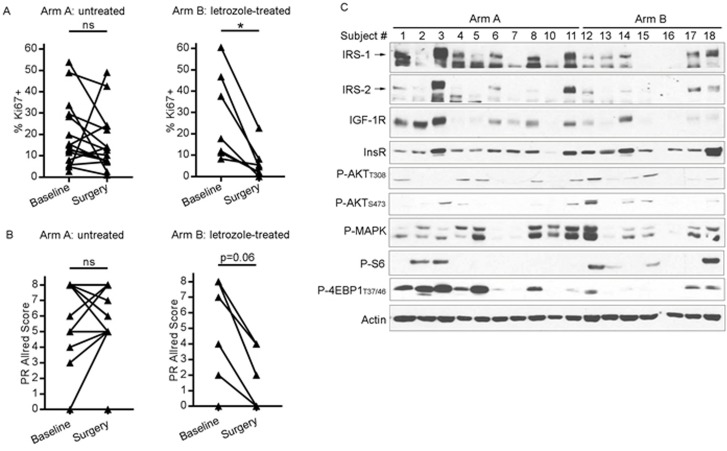
The mTORC1 inhibitor RAD001 (everolimus) is approved for treatment of recurrent/metastatic estrogen receptor (ER)-positive breast cancer in combination with the aromatase inhibitor (AI) exemestane. The benefits of A) continued anti-estrogen therapy for anti-estrogen-resistant disease in the context of mTORC1 inhibition, and B) adjuvant everolimus in combination with anti-estrogen therapy for early-stage disease are being tested clinically, but molecular rationale remains unclear. We hypothesized that mTORC1 inhibition activates the IGF-1R/InsR/IRS-1/2 axis in an ER-dependent manner to drive PI3K/AKT and promote cancer cell survival, implicating ER in survival signaling induced by mTORC1 inhibition. Anti-estrogen treatment synergized with RAD001 to inhibit ER+ breast cancer cell growth. Inhibition of ER, IGF-1R/InsR, or IRS-1/2 suppressed AKT activation induced by mTORC1 inhibition. RAD001 primed IGF-1R/InsR for activation, which was enhanced by ER signaling. Post-menopausal patients with early-stage ER+ breast cancer were treated presurgically +/- the AI letrozole. Viable tumor fragments from surgical specimens were treated with RAD001 and/or OSI-906 ; RAD001 increased AKT activation, which was abrogated by presurgical letrozole. Letrozole decreased IGF-1R and IRS-1/2 tumor levels. These data suggest that ER drives PI3K/AKT activation in response to mTORC1 inhibition, providing molecular rationale for therapeutic combinations of anti-estrogens and mTORC1 inhibitors in endocrine-sensitive disease.
mTORC1抑制剂RAD001(依维莫司)已被批准与芳香化酶抑制剂(AI)依西美坦联合用于治疗复发/转移性雌激素受体(ER)阳性乳腺癌。A)在mTORC1抑制的情况下,持续进行抗雌激素治疗以治疗抗雌激素抵抗性疾病;B)辅助使用依维莫司与抗雌激素治疗早期疾病的益处正在进行临床测试,但分子机制仍不清楚。我们假设mTORC1抑制以ER依赖性方式激活IGF-1R/InsR/IRS-1/2轴,从而驱动PI3K/AKT并促进癌细胞存活,这表明ER参与了mTORC1抑制诱导的存活信号传导。抗雌激素治疗与RAD001协同作用以抑制ER+乳腺癌细胞生长。抑制ER、IGF-1R/InsR或IRS-1/2可抑制mTORC1抑制诱导的AKT激活。RAD001使IGF-1R/InsR易于激活,而ER信号可增强这种激活。绝经后早期ER+乳腺癌患者在手术前接受或不接受AI来曲唑治疗。手术标本中的存活肿瘤碎片用RAD001和/或OSI-906处理;RAD001增加了AKT激活,而术前使用来曲唑可消除这种激活。来曲唑降低了IGF-1R和IRS-1/2的肿瘤水平。这些数据表明,ER在mTORC1抑制反应中驱动PI3K/AKT激活,为内分泌敏感疾病中抗雌激素和mTORC1抑制剂的联合治疗提供了分子机制。