Fernandez I Marti Angel, Saski Christopher A, Manganaris George A, Gasic Ksenija, Crisosto Carlos H
Department of Plant Sciences, University of California, Davis, Davis, CA, United States.
Genomics and Computational Biology Laboratory, Biosystems Research Complex, Clemson, SC, United States.
Front Plant Sci. 2018 Feb 19;9:21. doi: 10.3389/fpls.2018.00021. eCollection 2018.
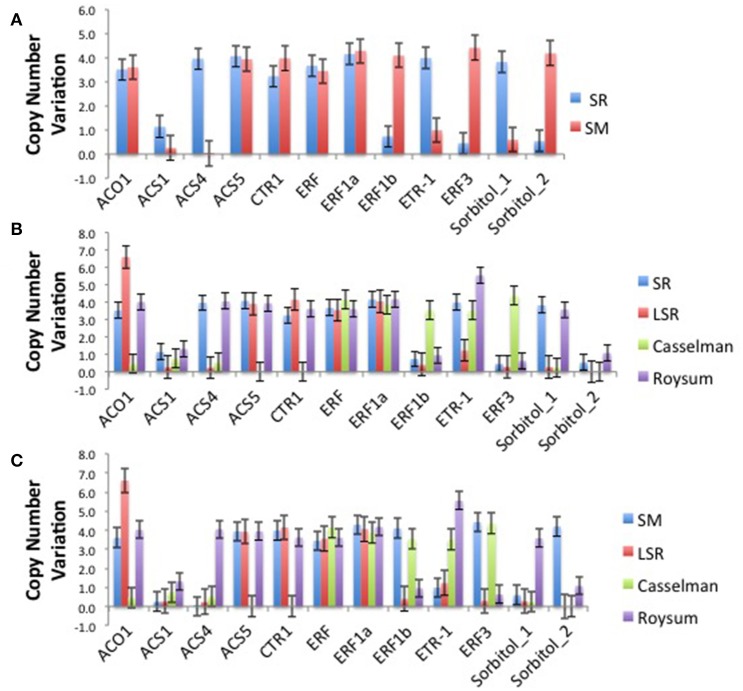
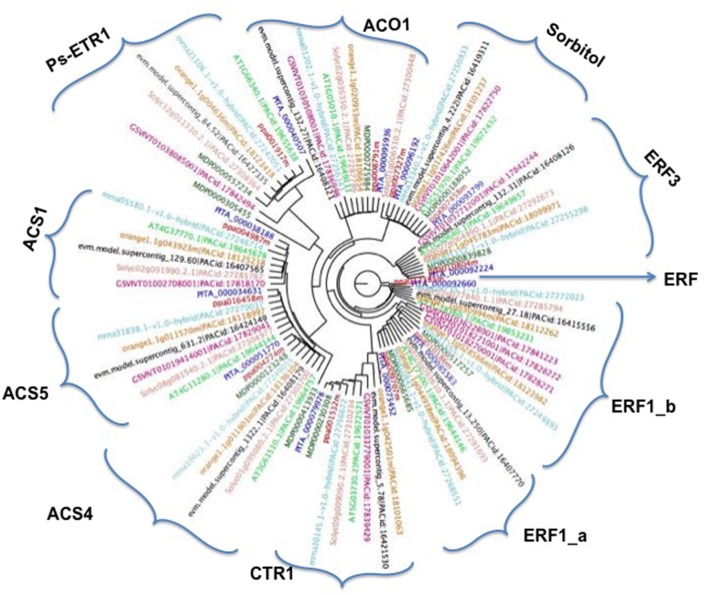
It has recently been described that the Japanese plum "Santa Rosa" bud sport series contains variations in ripening pattern: climacteric, suppressed-climacteric and non-climacteric types. This provides an interesting model to study the role of ethylene and other key mechanisms governing fruit ripening, softening and senescence. The aim of the current study was to investigate such differences at the genomic level, using this series of plum bud sports, with special reference to genes involved in ethylene biosynthesis, signal transduction, and sugar metabolism. Genomic DNA, isolated from leaf samples of six Japanese plum cultivars ("Santa Rosa", "July Santa Rosa", "Late Santa Rosa", "Sweet Miriam", "Roysum", and "Casselman"), was used to construct paired-end standard Illumina libraries. Sequences were aligned to the genome, and genomic variations (SNPs, INDELS, and CNV's) were investigated. Results determined 12 potential candidate genes with significant copy number variation (CNV), being associated with ethylene perception and signal transduction components. Additionally, the Maximum Likelihood (ML) phylogenetic tree showed two sorbitol dehydrogenase genes grouping into a distinct clade, indicating that this natural group is well-defined and presents high sequence identity among its members. In contrast, the ethylene group, which includes ACO1, ACS1, ACS4, ACS5, CTR1, ERF1, ERF3, and ethylene-receptor genes, was widely distributed and clustered into 10 different groups. Thus, ACS, ERF, and sorbitol dehydrogenase proteins potentially share a common ancestor for different plant genomes, while the expansion rate may be related to ancestral expansion rather than species-specific events. Based on the distribution of the clades, we suggest that gene function diversification for the ripening pathway occurred prior to family extension. We herein report all the frameshift mutations in genes involved in sugar transport and ethylene biosynthesis detected as well as the gene CNV implicated in ripening differences.
最近有描述称,日本李“圣罗莎”芽变系列在成熟模式上存在差异:跃变型、抑制跃变型和非跃变型。这为研究乙烯以及其他控制果实成熟、软化和衰老的关键机制的作用提供了一个有趣的模型。本研究的目的是利用这一系列李芽变品种,在基因组水平上研究此类差异,特别关注参与乙烯生物合成、信号转导和糖代谢的基因。从六个日本李品种(“圣罗莎”、“七月圣罗莎”、“晚熟圣罗莎”、“甜米里亚姆”、“罗伊瑟姆”和“卡斯尔曼”)的叶片样本中分离出基因组DNA,用于构建配对末端标准Illumina文库。将序列与基因组进行比对,并研究基因组变异(单核苷酸多态性、插入缺失和拷贝数变异)。结果确定了12个具有显著拷贝数变异(CNV)的潜在候选基因,它们与乙烯感知和信号转导成分相关。此外,最大似然(ML)系统发育树显示两个山梨醇脱氢酶基因聚为一个独特的分支,表明这个自然群体定义明确,其成员之间具有高度的序列同一性。相比之下,包括ACO1、ACS1、ACS4、ACS5、CTR1、ERF1、ERF3和乙烯受体基因的乙烯基因群体分布广泛,聚为10个不同的组。因此,ACS、ERF和山梨醇脱氢酶蛋白可能在不同植物基因组中有一个共同的祖先,而扩展速率可能与祖先扩展有关,而非物种特异性事件。基于分支的分布,我们认为成熟途径的基因功能多样化发生在家族扩展之前。我们在此报告了检测到的参与糖转运和乙烯生物合成基因中的所有移码突变以及与成熟差异相关的基因CNV。