Seoane Luís F, Solé Ricard V
Department of Physics, Massachusetts Institute of Technology, Cambridge, MA 02139, USA.
ICREA-Complex Systems Lab, Universitat Pompeu Fabra (GRIB), Dr Aiguader 80, 08003 Barcelona, Spain.
R Soc Open Sci. 2018 Feb 21;5(2):172221. doi: 10.1098/rsos.172221. eCollection 2018 Feb.
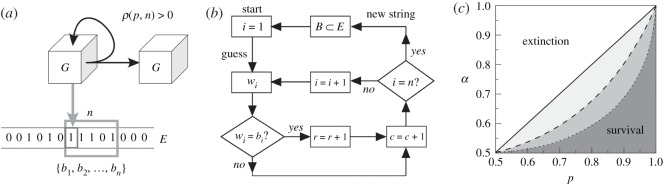
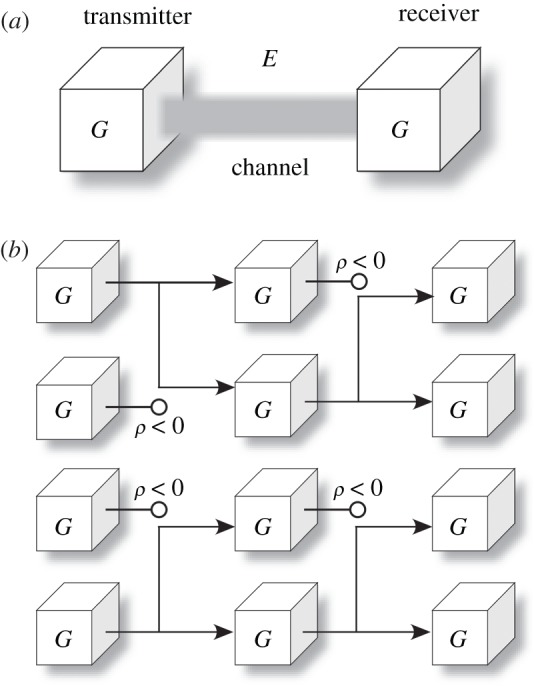
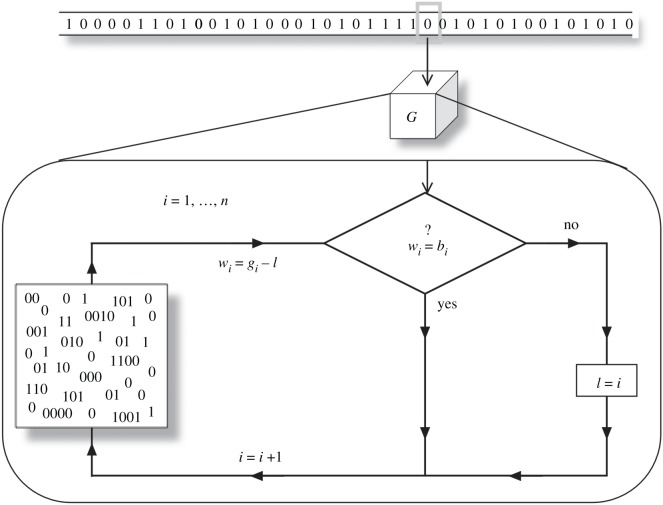
Despite the obvious advantage of simple life forms capable of fast replication, different levels of cognitive complexity have been achieved by living systems in terms of their potential to cope with environmental uncertainty. Against the inevitable cost associated with detecting environmental cues and responding to them in adaptive ways, we conjecture that the potential for predicting the environment can overcome the expenses associated with maintaining costly, complex structures. We present a minimal formal model grounded in information theory and selection, in which successive generations of agents are mapped into transmitters and receivers of a coded message. Our agents are guessing machines and their capacity to deal with environments of different complexity defines the conditions to sustain more complex agents.
尽管能够快速复制的简单生命形式具有明显优势,但生命系统在应对环境不确定性的潜力方面已经实现了不同程度的认知复杂性。鉴于检测环境线索并以适应性方式对其做出反应必然会产生成本,我们推测预测环境的潜力可以克服维持昂贵复杂结构所带来的费用。我们提出了一个基于信息论和选择的最小形式模型,其中连续几代的智能体被映射为编码消息的发送器和接收器。我们的智能体是猜测机器,它们处理不同复杂程度环境的能力定义了维持更复杂智能体的条件。