Department of Cell Biology and Anatomy, College of Medicine, National Cheng Kung University, Tainan, Taiwan.
Department of Nursing, Chang Gung University of Science and Technology, Chia-Yi County, Taiwan.
J Cell Mol Med. 2018 May;22(5):2896-2907. doi: 10.1111/jcmm.13584. Epub 2018 Mar 7.
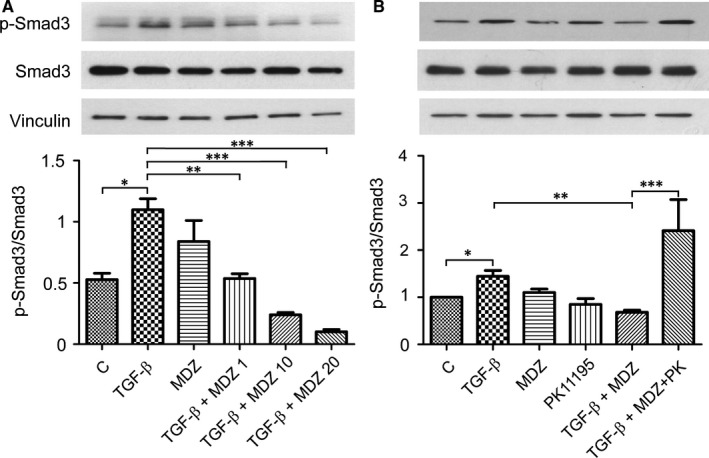
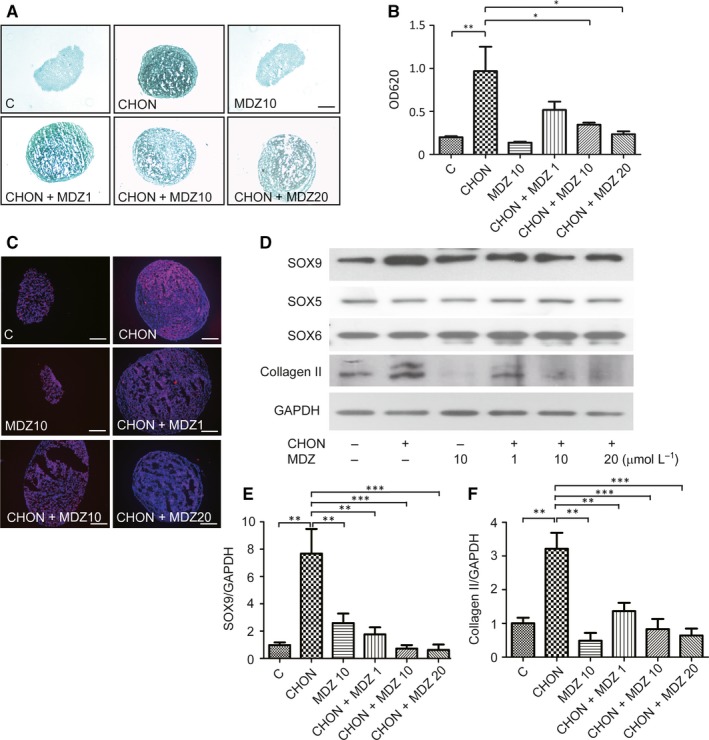
Midazolam, a benzodiazepine derivative, is widely used for sedation and surgery. However, previous studies have demonstrated that Midazolam is associated with increased risks of congenital malformations, such as dwarfism, when used during early pregnancy. Recent studies have also demonstrated that Midazolam suppresses osteogenesis of mesenchymal stem cells (MSCs). Given that hypertrophic chondrocytes can differentiate into osteoblast and osteocytes and contribute to endochondral bone formation, the effect of Midazolam on chondrogenesis remains unclear. In this study, we applied a human MSC line, the KP cell, to serve as an in vitro model to study the effect of Midazolam on chondrogenesis. We first successfully established an in vitro chondrogenic model in a micromass culture or a 2D high-density culture performed with TGF-β-driven chondrogenic induction medium. Treatment of the Midazolam dose-dependently inhibited chondrogenesis, examined using Alcian blue-stained glycosaminoglycans and the expression of chondrogenic markers, such as SOX9 and type II collagen. Inhibition of Midazolam by peripheral benzodiazepine receptor (PBR) antagonist PK11195 or small interfering RNA rescued the inhibitory effects of Midazolam on chondrogenesis. In addition, Midazolam suppressed transforming growth factor-β-induced Smad3 phosphorylation, and this inhibitory effect could be rescued using PBR antagonist PK11195. This study provides a possible explanation for Midazolam-induced congenital malformations of the musculoskeletal system through PBR.
咪达唑仑是苯二氮䓬类衍生物的一种,被广泛应用于镇静和手术。然而,先前的研究表明,咪达唑仑在妊娠早期使用时与先天性畸形(如矮小症)的风险增加有关。最近的研究还表明,咪达唑仑抑制间充质干细胞(MSCs)的成骨作用。鉴于肥大的软骨细胞可以分化为成骨细胞和骨细胞,并有助于软骨内骨的形成,咪达唑仑对软骨形成的影响尚不清楚。在这项研究中,我们应用人 MSC 系 KP 细胞作为体外模型,研究咪达唑仑对软骨形成的影响。我们首先成功地在微团培养或 TGF-β 驱动的软骨形成诱导培养基的 2D 高密度培养中建立了体外软骨形成模型。咪达唑仑的剂量依赖性抑制软骨形成,通过阿尔新蓝染色的糖胺聚糖和软骨形成标志物(如 SOX9 和 II 型胶原)的表达来检测。外周苯二氮䓬受体(PBR)拮抗剂 PK11195 或小干扰 RNA 抑制咪达唑仑可挽救其对软骨形成的抑制作用。此外,咪达唑仑抑制转化生长因子-β诱导的 Smad3 磷酸化,使用 PBR 拮抗剂 PK11195 可以挽救这种抑制作用。这项研究通过 PBR 为咪达唑仑引起的肌肉骨骼系统先天性畸形提供了一种可能的解释。