Nanophotonics and Metrology Laboratory (NAM), Swiss Federal Institute of Technology Lausanne (EPFL), 1015 Lausanne, Switzerland.
Sensors (Basel). 2018 Mar 7;18(3):800. doi: 10.3390/s18030800.
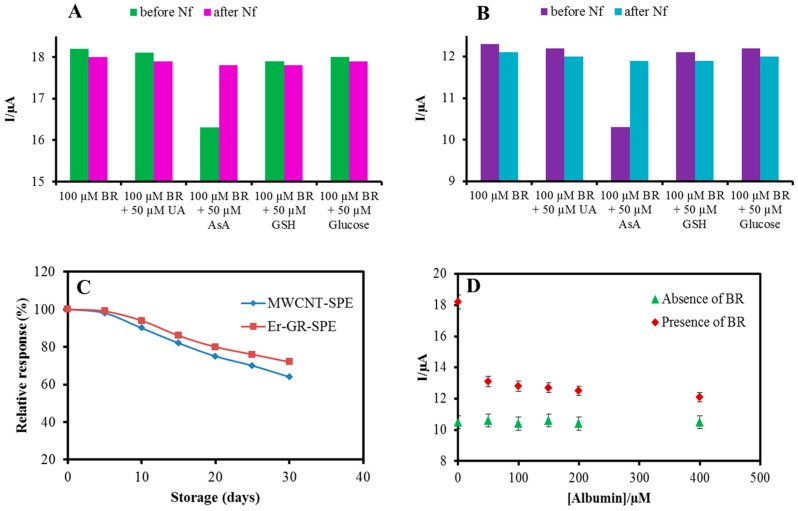
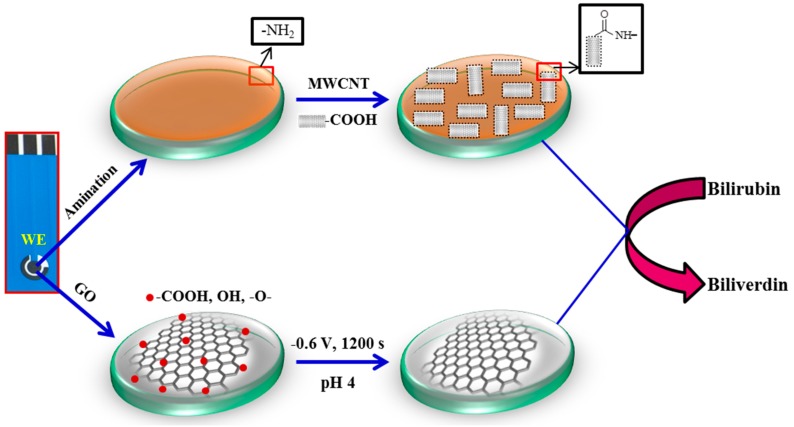
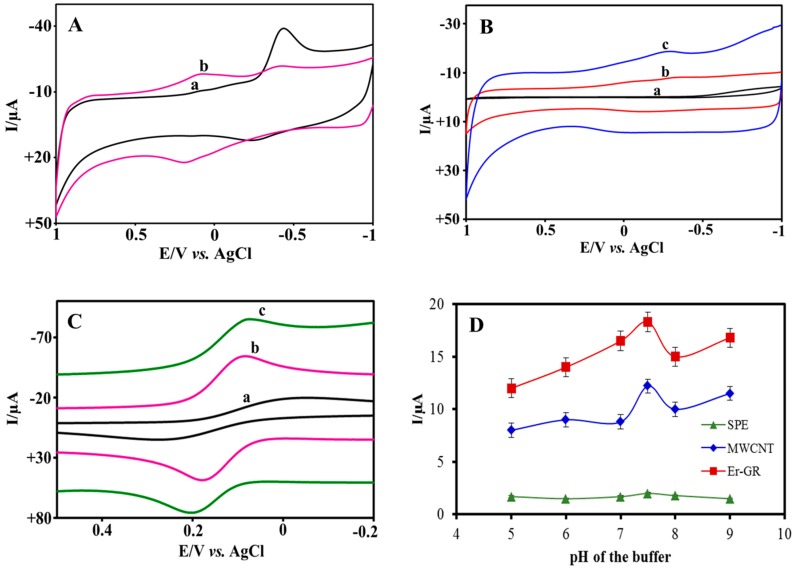
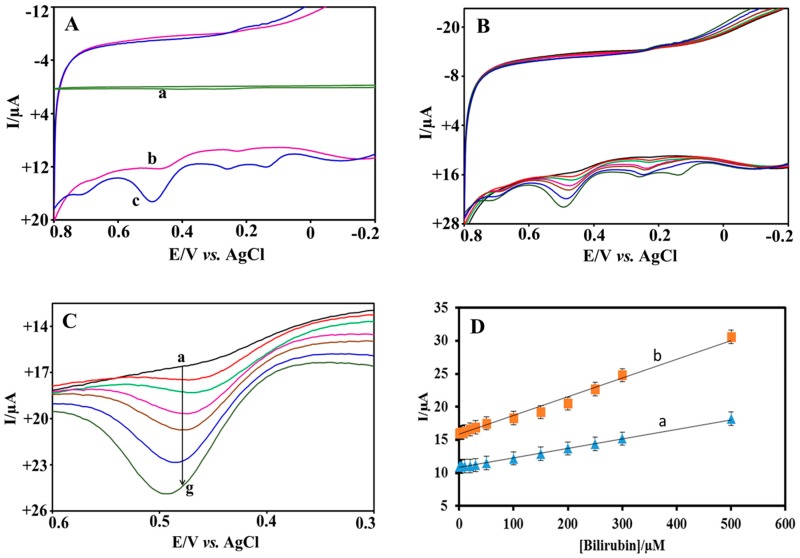
Practice oriented point-of-care diagnostics require easy-to-handle, miniaturized, and low-cost analytical tools. In a novel approach, screen printed carbon electrodes (SPEs), which were functionalized with nanomaterials, are employed for selective measurements of bilirubin, which is an important biomarker for jaundice. Multi-walled carbon nanotubes (MWCNT) and graphene separately deposited on SPEs provide the core of an electrochemical sensor for bilirubin. The electrocatalytic activity towards bilirubin oxidation (bilirubin to biliverdin) was observed at +0.25 V. In addition, a further peak corresponding to the electrochemical conversion of biliverdin into purpurin appeared at +0.48 V. When compared to MWCNT, the graphene type shows a 3-fold lower detection limit (0.3 ± 0.022 nM and 0.1 ± 0.018 nM, respectively), moreover, the graphene type exhibits a larger linear range (0.1-600 µM) than MWCNT (0.5-500 µM) with a two-fold better sensitivity, i.e., 30 nA µM cm, and 15 nA µM cm, respectively. The viability is validated through measurements of bilirubin in blood serum samples and the selectivity is ensured by inhibiting common interfering biological substrates using an ionic nafion membrane. The presented approach enables the design and implementation of low cost and miniaturized electrochemical sensors.
面向实践的即时诊断需要易于操作、微型化和低成本的分析工具。在一种新方法中,采用功能化纳米材料的丝网印刷碳电极 (SPE) 用于选择性测量胆红素,胆红素是黄疸的重要生物标志物。分别沉积在 SPE 上的多壁碳纳米管 (MWCNT) 和石墨烯为胆红素的电化学传感器提供了核心。在 +0.25 V 观察到对胆红素氧化(胆红素转化为胆绿素)的电催化活性。此外,在 +0.48 V 处出现了另一个对应于胆绿素电化学转化为紫质的峰。与 MWCNT 相比,石墨烯型的检测限低 3 倍(分别为 0.3 ± 0.022 nM 和 0.1 ± 0.018 nM),此外,石墨烯型的线性范围(0.1-600 µM)比 MWCNT(0.5-500 µM)大两倍,灵敏度也更好,分别为 30 nA µM cm 和 15 nA µM cm。通过测量血清样本中的胆红素来验证其可行性,并通过使用离子纳滤膜抑制常见的干扰生物底物来确保选择性。该方法可用于设计和实施低成本和微型化的电化学传感器。