Nagesh Prashanth K B, Hatami Elham, Chowdhury Pallabita, Kashyap Vivek K, Khan Sheema, Hafeez Bilal B, Chauhan Subhash C, Jaggi Meena, Yallapu Murali M
Department of Pharmaceutical Sciences and Center for Cancer Research, University of Tennessee Health Science Center, Memphis, TN 38163, USA.
Cancers (Basel). 2018 Mar 7;10(3):68. doi: 10.3390/cancers10030068.
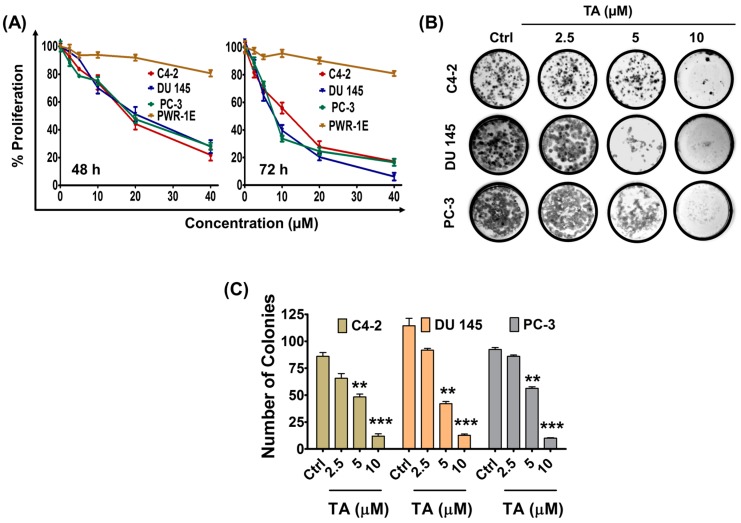
Endoplasmic reticulum (ER) stress is an intriguing target with significant clinical importance in chemotherapy. Interference with ER functions can lead to the accumulation of unfolded proteins, as detected by transmembrane sensors that instigate the unfolded protein response (UPR). Therefore, controlling induced UPR via ER stress with natural compounds could be a novel therapeutic strategy for the management of prostate cancer. Tannic acid (a naturally occurring polyphenol) was used to examine the ER stress mediated UPR pathway in prostate cancer cells. Tannic acid treatment inhibited the growth, clonogenic, invasive, and migratory potential of prostate cancer cells. Tannic acid demonstrated activation of ER stress response (Protein kinase R-like endoplasmic reticulum kinase (PERK) and inositol requiring enzyme 1 (IRE1)) and altered its regulatory proteins (ATF4, Bip, and PDI) expression. Tannic acid treatment affirmed upregulation of apoptosis-associated markers (Bak, Bim, cleaved caspase 3, and cleaved PARP), while downregulation of pro-survival proteins (Bcl-2 and Bcl-xL). Tannic acid exhibited elevated G₁ population, due to increase in p18 and p21 expression, while cyclin D1 expression was inhibited. Reduction of MMP2 and MMP9, and reinstated E-cadherin signifies the anti-metastatic potential of this compound. Altogether, these results demonstrate that tannic acid can promote apoptosis via the ER stress mediated UPR pathway, indicating a potential candidate for cancer treatment.
内质网(ER)应激是化疗中一个具有重要临床意义的有趣靶点。内质网功能的干扰会导致未折叠蛋白的积累,这可通过跨膜传感器检测到,这些传感器会引发未折叠蛋白反应(UPR)。因此,利用天然化合物通过内质网应激控制诱导的UPR可能是一种治疗前列腺癌的新策略。鞣酸(一种天然存在的多酚)被用于研究前列腺癌细胞中内质网应激介导的UPR途径。鞣酸处理抑制了前列腺癌细胞的生长、克隆形成、侵袭和迁移能力。鞣酸显示出内质网应激反应(蛋白激酶R样内质网激酶(PERK)和肌醇需求酶1(IRE1))的激活,并改变了其调节蛋白(ATF4、Bip和PDI)的表达。鞣酸处理证实了凋亡相关标志物(Bak、Bim、裂解的半胱天冬酶3和裂解的PARP)的上调,同时下调了促生存蛋白(Bcl-2和Bcl-xL)。由于p18和p21表达增加,鞣酸使G₁期细胞群体增加,而细胞周期蛋白D1的表达受到抑制。MMP2和MMP9的减少以及E-钙黏蛋白的恢复表明了该化合物的抗转移潜力。总之,这些结果表明鞣酸可通过内质网应激介导的UPR途径促进细胞凋亡,表明其可能是一种癌症治疗的候选药物。