Donner Nina C, Kubala Kenneth H, Hassell James E, Lieb Margaret W, Nguyen Kadi T, Heinze Jared D, Drugan Robert C, Maier Steven F, Lowry Christopher A
Department of Integrative Physiology and Center for Neuroscience, University of Colorado Boulder, Boulder, CO 80309, USA.
Department of Psychology and Neuroscience and Center for Neuroscience, University of Colorado Boulder, Boulder, CO 80302, USA.
Neurobiol Stress. 2018 Jan 17;8:68-81. doi: 10.1016/j.ynstr.2018.01.003. eCollection 2018 Feb.
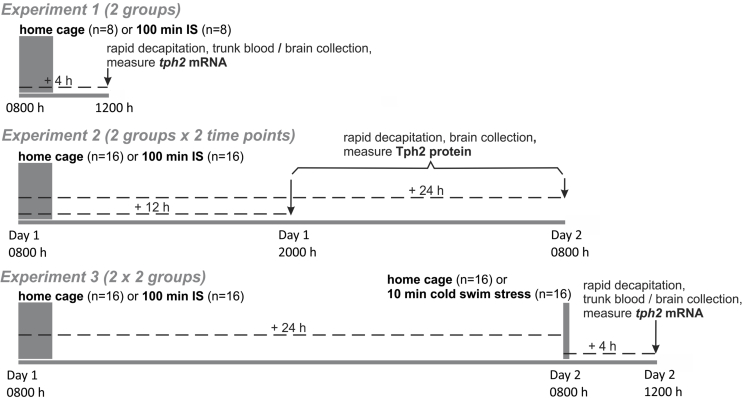
Expression of TPH2, the rate-limiting enzyme for brain serotonin synthesis, is elevated in the dorsal raphe nucleus (DR) of depressed suicide victims. One hypothesis is that this increase in TPH2 expression is stress-induced. Here, we used an established animal model to address whether exposure to an acute stressor, inescapable tail shock (IS), increases mRNA and Tph2 protein expression, and if IS sensitizes the DR to a subsequent, heterotypic stressor. In , we measured mRNA expression 4 h after IS or home cage (HC) control conditions in male rats, using hybridization histochemistry. In , we measured Tph2 protein expression 12 h or 24 h after IS using western blot. In , we measured mRNA expression following IS on Day 1, and cold swim stress (10 min, 15 °C) on Day 2. Inescapable tail shock was sufficient to increase mRNA expression 4 h and 28 h later, selectively in the dorsomedial DR (caudal aspect of the dorsal DR, cDRD; an area just rostral to the caudal DR, DRC) and increased Tph2 protein expression in the DRD (rostral and caudal aspects of the dorsal DR combined) 24 h later. Cold swim increased mRNA expression in the dorsomedial DR (cDRD) 4 h later. These effects were associated with increased immobility during cold swim, elevated plasma corticosterone, and a proinflammatory plasma cytokine milieu (increased interleukin (IL)-6, decreased IL-10). Our data demonstrate that two models of inescapable stress, IS and cold swim, increase mRNA expression selectively in the anxiety-related dorsomedial DR (cDRD).
色氨酸羟化酶2(TPH2)是脑内5-羟色胺合成的限速酶,在抑郁自杀受害者的中缝背核(DR)中表达升高。一种假说认为,TPH2表达的增加是由应激诱导的。在此,我们使用一种成熟的动物模型来研究暴露于急性应激源——不可逃避的尾部电击(IS)是否会增加mRNA和Tph2蛋白的表达,以及IS是否会使DR对随后的异型应激源敏感。在实验1中,我们使用原位杂交组织化学方法,在雄性大鼠接受IS或置于饲养笼(HC)对照条件4小时后,测量其mRNA表达。在实验2中,我们使用蛋白质免疫印迹法,在IS后12小时或24小时测量Tph2蛋白表达。在实验3中,我们在第1天施加IS,在第2天施加冷泳应激(10分钟,15°C)后,测量mRNA表达。不可逃避的尾部电击足以在4小时和28小时后选择性地增加背内侧DR(背侧DR的尾侧部分,cDRD;尾侧DR前方的一个区域,DRC)中的mRNA表达,并在24小时后增加DRD(背侧DR的头侧和尾侧部分合并)中的Tph2蛋白表达。冷泳4小时后增加了背内侧DR(cDRD)中的mRNA表达。这些效应与冷泳期间不动时间增加、血浆皮质酮升高以及促炎血浆细胞因子环境(白细胞介素(IL)-6增加,IL-10减少)有关。我们的数据表明,两种不可逃避应激模型,即IS和冷泳,选择性地增加了与焦虑相关的背内侧DR(cDRD)中的mRNA表达。