Department of Psychiatry, Autism Research Centre, University of Cambridge, Cambridgeshire, UK.
Human Genetics and Cognitive Functions Unit, Institut Pasteur, Paris, France.
Transl Psychiatry. 2018 Mar 12;8(1):35. doi: 10.1038/s41398-017-0082-6.
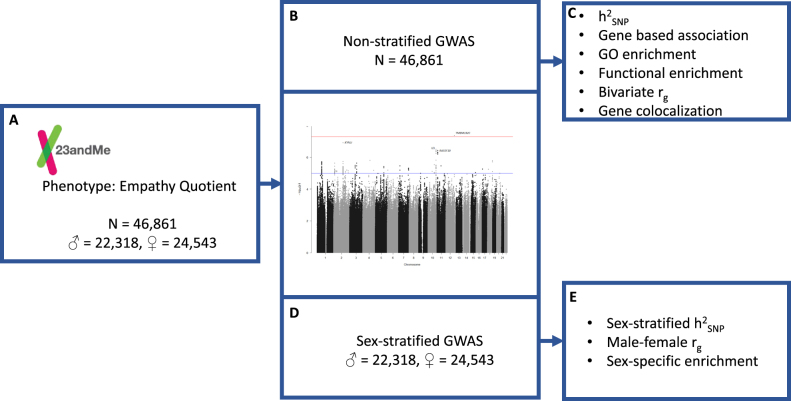
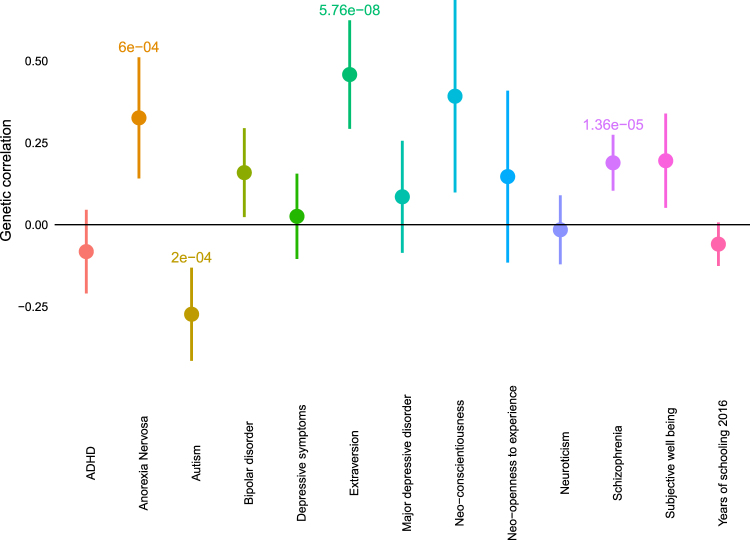
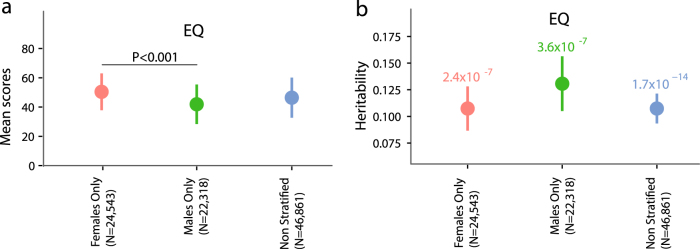
Empathy is the ability to recognize and respond to the emotional states of other individuals. It is an important psychological process that facilitates navigating social interactions and maintaining relationships, which are important for well-being. Several psychological studies have identified difficulties in both self-report and performance-based measures of empathy in a range of psychiatric conditions. To date, no study has systematically investigated the genetic architecture of empathy using genome-wide association studies (GWAS). Here we report the results of the largest GWAS of empathy to date using a well-validated self-report measure of empathy, the Empathy Quotient (EQ), in 46,861 research participants from 23andMe, Inc. We identify 11 suggestive loci (P < 1 × 10), though none were significant at P < 2.5 × 10 after correcting for multiple testing. The most significant SNP was identified in the non-stratified analysis (rs4882760; P = 4.29 × 10), and is an intronic SNP in TMEM132C. The EQ had a modest but significant narrow-sense heritability (0.11 ± 0.014; P = 1.7 × 10). As predicted, based on earlier work, we confirmed a significant female advantage on the EQ (P < 2 × 10, Cohen's d = 0.65). We identified similar SNP heritability and high genetic correlation between the sexes. Also, as predicted, we identified a significant negative genetic correlation between autism and the EQ (r = -0.27 ± 0.07, P = 1.63 × 10). We also identified a significant positive genetic correlation between the EQ and risk for schizophrenia (r = 0.19 ± 0.04; P = 1.36 × 10), risk for anorexia nervosa (r = 0.32 ± 0.09; P = 6 × 10), and extraversion (r = 0.45 ± 0.08; 5.7 × 10). This is the first GWAS of self-reported empathy. The results suggest that the genetic variations associated with empathy also play a role in psychiatric conditions and psychological traits.
同理心是识别和响应他人情绪状态的能力。它是一种重要的心理过程,有助于驾驭社交互动和维持人际关系,这对幸福感很重要。几项心理学研究已经确定,在一系列精神疾病中,同理心的自我报告和基于表现的测量都存在困难。迄今为止,尚无研究使用全基因组关联研究(GWAS)系统地研究同理心的遗传结构。在这里,我们使用来自 23andMe, Inc. 的 46,861 名研究参与者的经过良好验证的同理心自我报告量表(同理心商数,EQ)报告了迄今为止最大的同理心 GWAS 结果。我们确定了 11 个提示性位点(P < 1×10),但在进行多次检验校正后,没有一个位点在 P < 2.5×10 时具有统计学意义。在非分层分析中,最显著的 SNP 是 rs4882760(P = 4.29×10),这是 TMEM132C 的内含子 SNP。EQ 具有适度但显著的狭义遗传力(0.11±0.014;P = 1.7×10)。正如早期工作所预测的那样,我们证实了 EQ 上女性的显著优势(P < 2×10,Cohen's d = 0.65)。我们确定了两性之间相似的 SNP 遗传力和高度遗传相关性。此外,正如预测的那样,我们在自闭症和 EQ 之间确定了显著的负遗传相关性(r = -0.27±0.07,P = 1.63×10)。我们还确定了 EQ 与精神分裂症风险(r = 0.19±0.04;P = 1.36×10)、神经性厌食症风险(r = 0.32±0.09;P = 6×10)和外向性(r = 0.45±0.08;5.7×10)之间存在显著的正遗传相关性。这是对自我报告同理心的首次 GWAS。结果表明,与同理心相关的遗传变异也在精神疾病和心理特征中发挥作用。