Computational Biology, Department of Biology, Friedrich-Alexander University Erlangen-Nürnberg, Erlangen, Germany.
PLoS Comput Biol. 2018 Mar 12;14(3):e1006062. doi: 10.1371/journal.pcbi.1006062. eCollection 2018 Mar.
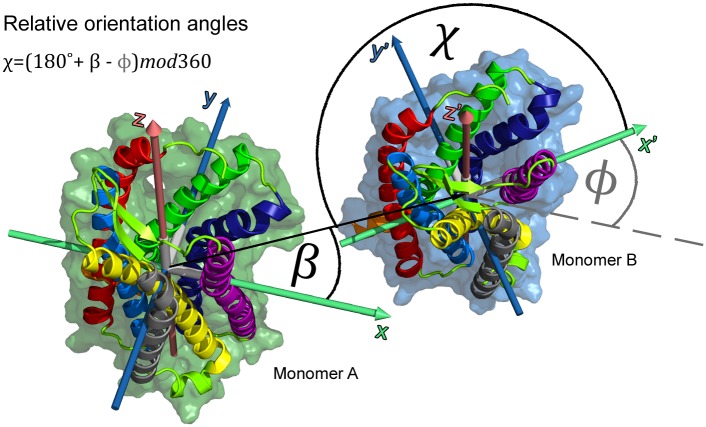
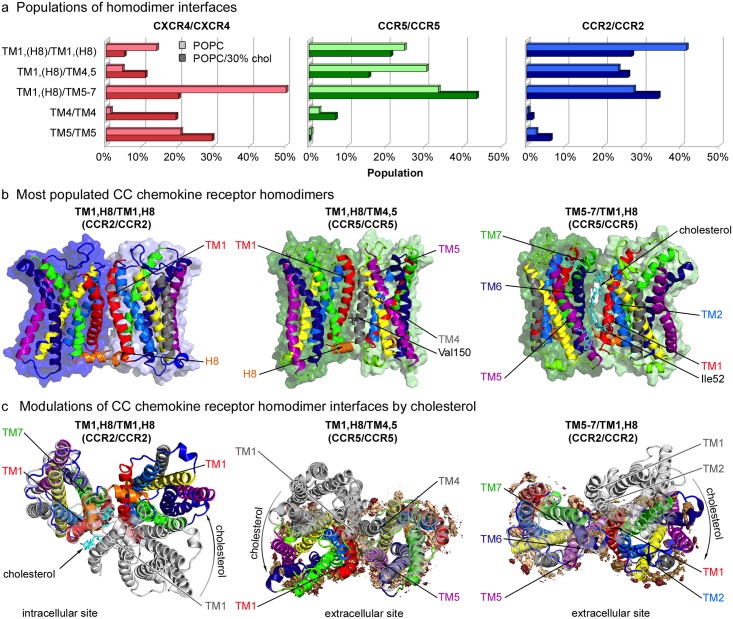
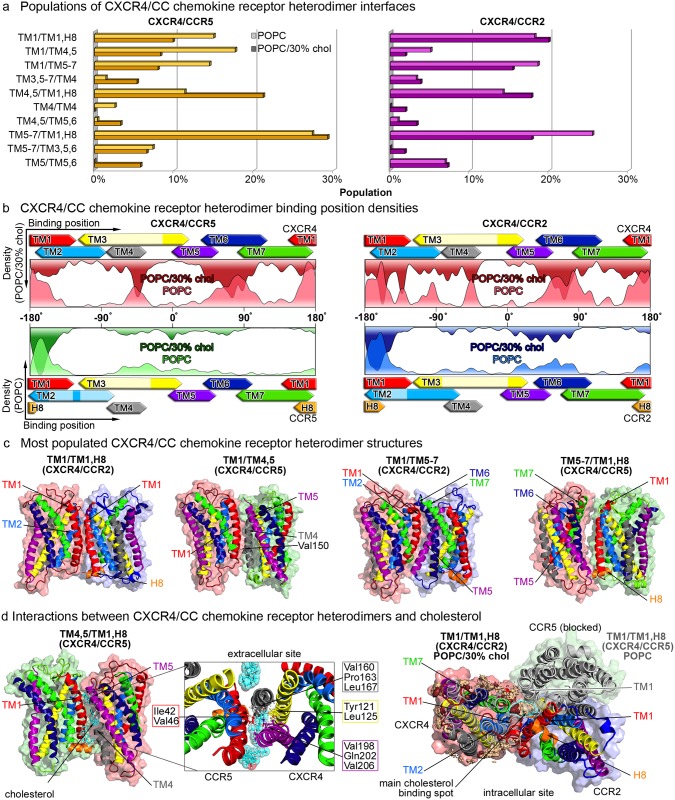
Chemokine receptors, a subclass of G protein coupled receptors (GPCRs), play essential roles in the human immune system, they are involved in cancer metastasis as well as in HIV-infection. A plethora of studies show that homo- and heterodimers or even higher order oligomers of the chemokine receptors CXCR4, CCR5, and CCR2 modulate receptor function. In addition, membrane cholesterol affects chemokine receptor activity. However, structural information about homo- and heterodimers formed by chemokine receptors and their interplay with cholesterol is limited. Here, we report homo- and heterodimer configurations of the chemokine receptors CXCR4, CCR5, and CCR2 at atomistic detail, as obtained from thousands of molecular dynamics simulations. The observed homodimerization patterns were similar for the closely related CC chemokine receptors, yet they differed significantly between the CC receptors and CXCR4. Despite their high sequence identity, cholesterol modulated the CC homodimer interfaces in a subtype-specific manner. Chemokine receptor heterodimers display distinct dimerization patterns for CXCR4/CCR5 and CXCR4/CCR2. Furthermore, associations between CXCR4 and CCR5 reveal an increased cholesterol-sensitivity as compared to CXCR4/CCR2 heterodimerization patterns. This work provides a first comprehensive structural overview over the complex interaction network between chemokine receptors and indicates how heterodimerization and the interaction with the membrane environment diversifies the function of closely related GPCRs.
趋化因子受体是 G 蛋白偶联受体 (GPCR) 的一个亚类,在人体免疫系统中发挥着重要作用,它们参与癌症转移和 HIV 感染。大量研究表明,趋化因子受体 CXCR4、CCR5 和 CCR2 的同源二聚体、异源二聚体甚至更高阶的寡聚体调节受体功能。此外,膜胆固醇会影响趋化因子受体的活性。然而,关于趋化因子受体形成的同源二聚体和异源二聚体以及它们与胆固醇相互作用的结构信息有限。在这里,我们报告了趋化因子受体 CXCR4、CCR5 和 CCR2 的同源二聚体和异源二聚体的原子细节结构,这些结构是通过数千次分子动力学模拟获得的。观察到的同源二聚体模式在密切相关的 CC 趋化因子受体中相似,但在 CC 受体和 CXCR4 之间差异显著。尽管它们的序列高度一致,但胆固醇以亚型特异性的方式调节 CC 同源二聚体界面。趋化因子受体异源二聚体显示出 CXCR4/CCR5 和 CXCR4/CCR2 之间不同的二聚体模式。此外,与 CCR2 相比,CXCR4 和 CCR5 的关联显示出更高的胆固醇敏感性。这项工作首次全面概述了趋化因子受体之间复杂的相互作用网络,并表明异源二聚化和与膜环境的相互作用如何使密切相关的 GPCR 多样化其功能。