Danish Colorectal Cancer Center South, Vejle Hospital, Beriderbakken 4, DK-7100, Vejle, Denmark.
Institute of Regional Health Research, University of Southern Denmark, Odense, Denmark.
J Exp Clin Cancer Res. 2018 Mar 12;37(1):55. doi: 10.1186/s13046-018-0723-5.
Precision medicine calls for an early indicator of treatment efficiency. Circulating tumor DNA (ctDNA) is a promising marker in this setting. Our prospective study explored the association between disease development and change of ctDNA during first line chemotherapy in patients with RAS/RAF mutated metastatic colorectal cancer (mCRC).
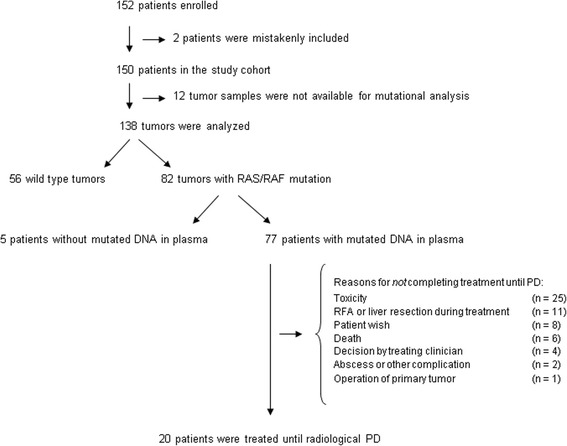
The study included 138 patients with mCRC receiving standard first line treatment. In patients with RAS/RAF mutated tumor DNA the same mutation was quantified in the plasma using droplet digital PCR. The fractional abundance of ctDNA was assessed in plasma before treatment start and at every treatment cycle until radiologically defined progressive disease.
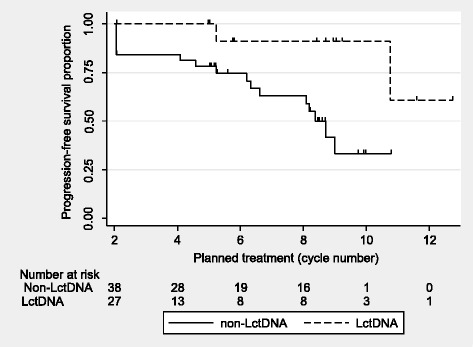
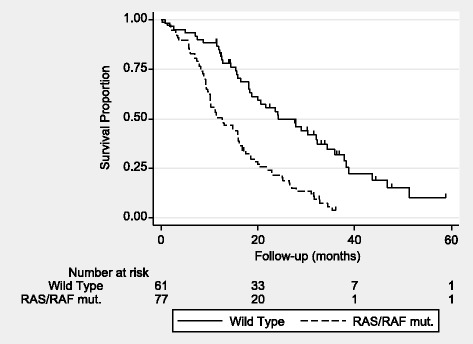
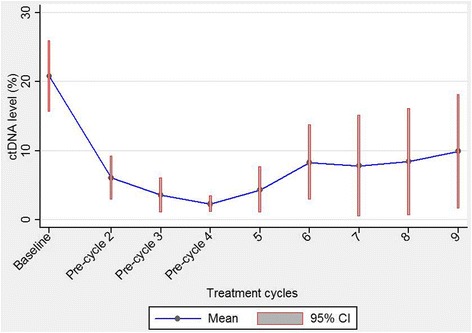
RAS/RAF mutations were detected in the plasma from 77 patients. Twenty patients progressed on treatment and 57 stopped treatment without progression. The presence of mutated DNA in plasma was correlated with poor overall survival. A low level of ctDNA after the first cycle of chemotherapy was associated with a low risk of progression. On the other hand, a significant increase of ctDNA at any time during the treatment course was associated with a high risk of progression on continuous treatment. The first increase in ctDNA level occurred at a median of 51 days before radiologically confirmed progression.
The results indicate that the ctDNA level holds potential as a clinically valuable marker in first line treatment of mCRC. A rapid decrease was associated with a prolonged progression free interval, whereas a significant increase gave notice of early progression with a relevant lead time.
精准医学需要一种治疗效果的早期指标。循环肿瘤 DNA(ctDNA)在这种情况下是一种很有前途的标志物。我们的前瞻性研究探讨了在 RAS/RAF 突变转移性结直肠癌(mCRC)患者的一线化疗中,ctDNA 在疾病发展过程中的变化与治疗效果之间的关系。
该研究纳入了 138 名接受标准一线治疗的 mCRC 患者。在 RAS/RAF 突变肿瘤 DNA 的患者中,使用液滴数字 PCR 在血浆中定量检测相同的突变。在开始治疗前和每个治疗周期评估 ctDNA 在血浆中的分数丰度,直到影像学定义的疾病进展。
77 名患者的血浆中检测到 RAS/RAF 突变。20 名患者在治疗过程中进展,57 名患者在没有进展的情况下停止治疗。血浆中存在突变 DNA 与总生存期较差相关。化疗第一周期后 ctDNA 水平较低与进展风险较低相关。另一方面,治疗过程中任何时间 ctDNA 水平的显著增加与持续治疗时进展风险较高相关。ctDNA 水平的第一次增加发生在影像学确认进展前的中位数 51 天。
结果表明,ctDNA 水平作为 mCRC 一线治疗中具有临床价值的标志物具有潜力。快速下降与无进展间隔延长相关,而显著增加则预示着早期进展,并具有相关的前置时间。