Department of the Sciences of Agriculture, Food and Environment, University of Foggia, Via Napoli 25, 71122 Foggia, Italy.
Wageningen Food & Biobased Research, Wageningen University and Research, Bornse Weilanden 9, P.O. Box 17, 6700 AA Wageningen, The Netherlands.
Molecules. 2018 Mar 13;23(3):644. doi: 10.3390/molecules23030644.
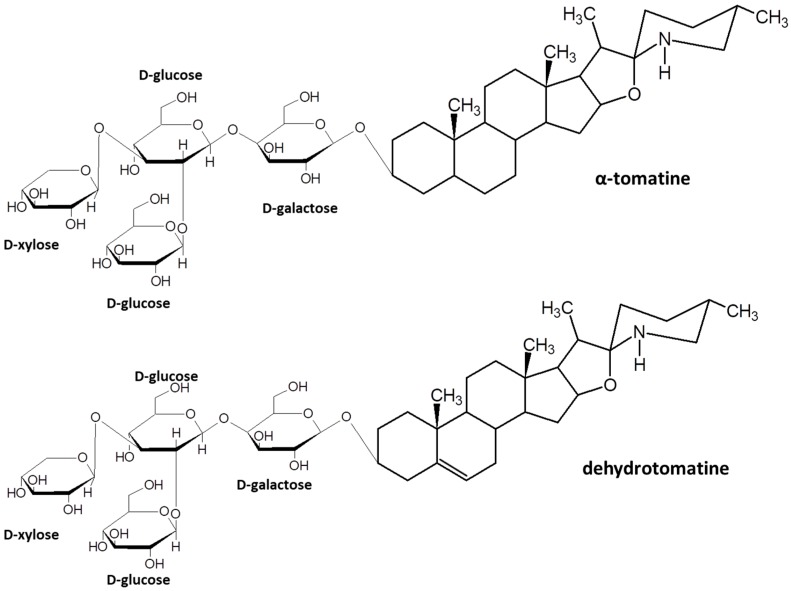
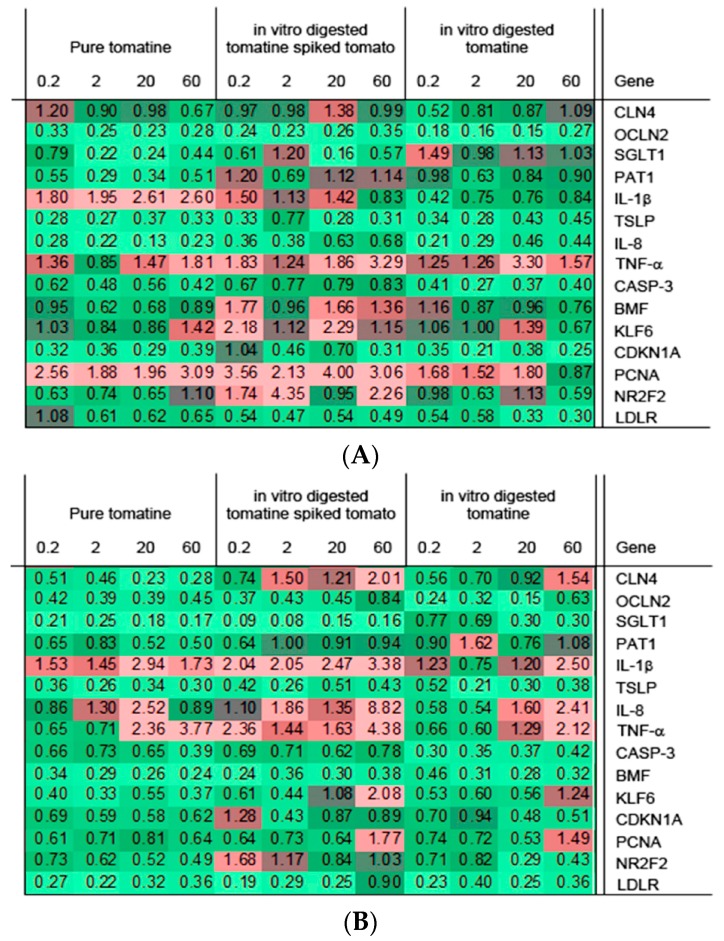
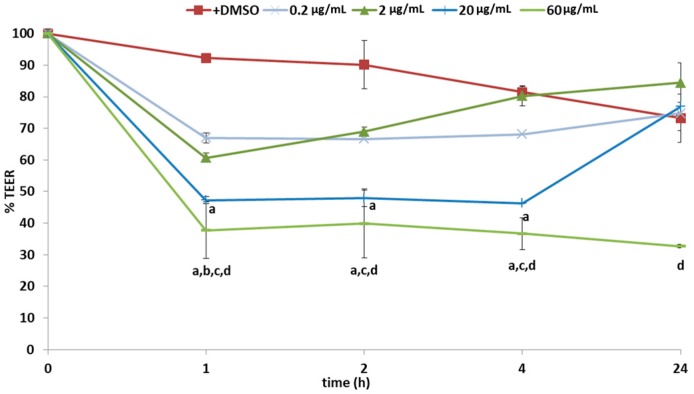
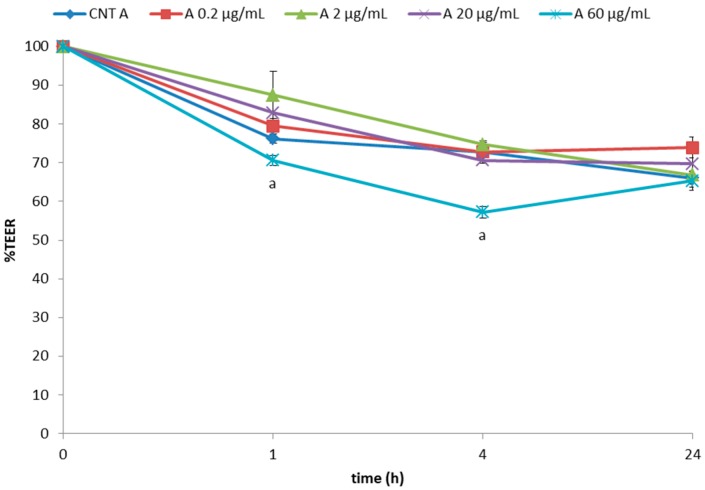
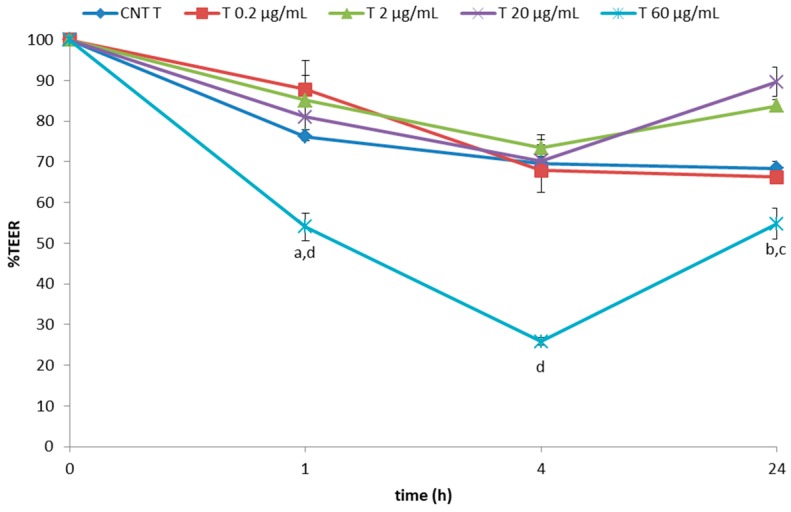
More understanding of the risk-benefit effect of the glycoalkaloid tomatine is required to be able to estimate the role it might play in our diet. In this work, we focused on effects towards intestinal epithelial cells based on a Caco-2 model in order to analyze the influence on the cell monolayer integrity and on the expression levels of genes involved in cholesterol/sterol biosynthesis (LDLR), lipid metabolism (NR2F2), glucose and amino acid uptake (SGLT1, PAT1), cell cycle (PCNA, CDKN1A), apoptosis (CASP-3, BMF, KLF6), tight junctions (CLDN4, OCLN2) and cytokine-mediated signaling (IL-8, IL1β, TSLP, TNF-α). Furthermore, since the bioactivity of the compound might vary in the presence of a food matrix and following digestion, the influence of both pure tomatine and in vitro digested tomatine with and without tomato fruit matrix was studied. The obtained results suggested that concentrations <20 µg/mL of tomatine, either undigested or in vitro digested, do not compromise the viability of Caco-2 cells and stimulate cytokine expression. This effect of tomatine, in vitro digested tomatine or in vitro digested tomatine with tomato matrix differs slightly, probably due to variations of bioactivity or bioavailability of the tomatine. The results lead to the hypothesis that tomatine acts as hormetic compound that can induce beneficial or risk toxic effects whether used in low or high dose.
为了能够评估糖生物碱龙葵碱在我们饮食中可能扮演的角色,我们需要更深入地了解其风险-效益效应。在这项工作中,我们专注于基于 Caco-2 模型的对肠道上皮细胞的影响,以分析其对细胞单层完整性的影响,以及对涉及胆固醇/固醇生物合成(LDLR)、脂质代谢(NR2F2)、葡萄糖和氨基酸摄取(SGLT1、PAT1)、细胞周期(PCNA、CDKN1A)、细胞凋亡(CASP-3、BMF、KLF6)、紧密连接(CLDN4、OCLN2)和细胞因子介导的信号转导(IL-8、IL1β、TSLP、TNF-α)的基因表达水平的影响。此外,由于该化合物的生物活性可能在存在食物基质和消化后发生变化,因此研究了纯龙葵碱和有或没有番茄果实基质的体外消化龙葵碱的影响。研究结果表明,浓度 <20μg/mL 的龙葵碱(无论是未消化的还是体外消化的)都不会损害 Caco-2 细胞的活力,并刺激细胞因子的表达。这种龙葵碱、体外消化龙葵碱或体外消化加番茄基质的龙葵碱的作用略有不同,这可能是由于龙葵碱的生物活性或生物利用度的变化。研究结果表明,龙葵碱可能作为一种有益或风险的毒性效应的化学刺激物,无论低剂量还是高剂量使用,都可能产生有益或风险的毒性效应。