Frontier Research Institute for Interdisciplinary Sciences, Tohoku University, Sendai 980-8578, Japan.
Department of Environmental Life Sciences, Graduate School of Life Sciences, Tohoku University, Sendai 980-8577, Japan.
Int J Mol Sci. 2018 Mar 12;19(3):828. doi: 10.3390/ijms19030828.
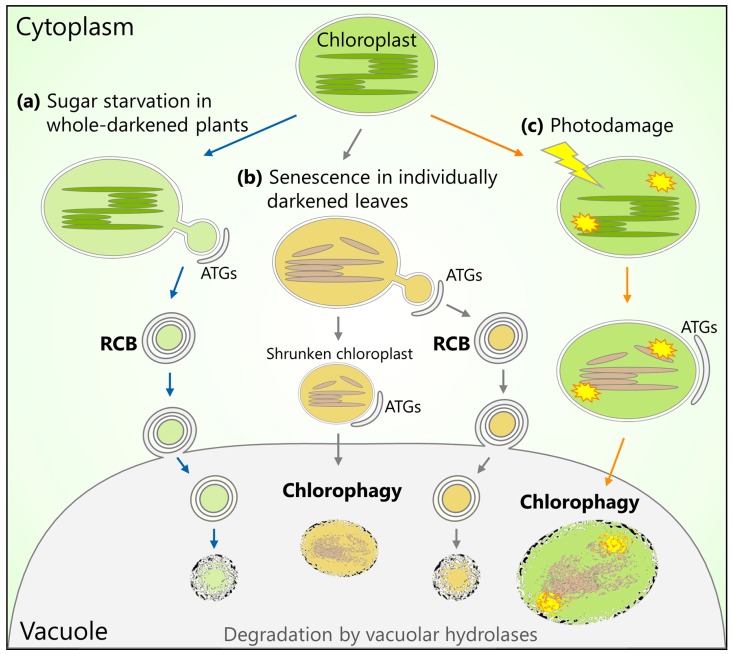
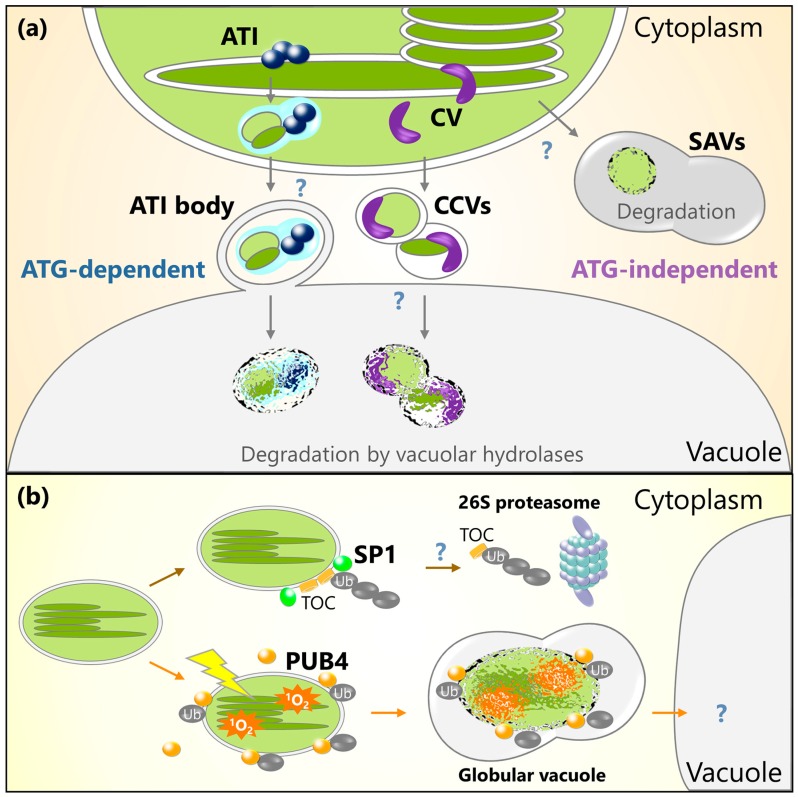
Most assimilated nutrients in the leaves of land plants are stored in chloroplasts as photosynthetic proteins, where they mediate CO₂ assimilation during growth. During senescence or under suboptimal conditions, chloroplast proteins are degraded, and the amino acids released during this process are used to produce young tissues, seeds, or respiratory energy. Protein degradation machineries contribute to the quality control of chloroplasts by removing damaged proteins caused by excess energy from sunlight. Whereas previous studies revealed that chloroplasts contain several types of intraplastidic proteases that likely derived from an endosymbiosed prokaryotic ancestor of chloroplasts, recent reports have demonstrated that multiple extraplastidic pathways also contribute to chloroplast protein turnover in response to specific cues. One such pathway is autophagy, an evolutionarily conserved process that leads to the vacuolar or lysosomal degradation of cytoplasmic components in eukaryotic cells. Here, we describe and contrast the extraplastidic pathways that degrade chloroplasts. This review shows that diverse pathways participate in chloroplast turnover during sugar starvation, senescence, and oxidative stress. Elucidating the mechanisms that regulate these pathways will help decipher the relationship among the diverse pathways mediating chloroplast protein turnover.
陆生植物叶片中大多数同化的营养物质都以光合蛋白的形式储存在叶绿体中,这些蛋白在生长过程中介导 CO₂同化。在衰老或条件不佳时,叶绿体蛋白会被降解,这个过程中释放的氨基酸被用于生成新的组织、种子或呼吸能。蛋白降解机制通过去除由过量阳光能量引起的损伤蛋白,对叶绿体的质量控制做出贡献。虽然先前的研究表明,叶绿体中含有几种可能源自叶绿体原核共生祖先的类质体蛋白酶,但最近的报道表明,多种质外体途径也有助于叶绿体蛋白在响应特定信号时发生周转。自噬就是这样一种途径,它是一种在真核细胞中导致细胞质成分在液泡或溶酶体中降解的进化上保守的过程。在这里,我们描述并对比了降解叶绿体的质外体途径。这篇综述表明,在糖饥饿、衰老和氧化应激期间,多种途径参与了叶绿体的周转。阐明调节这些途径的机制将有助于解析介导叶绿体蛋白周转的不同途径之间的关系。