Departamento de Medicina Preventiva, Faculdade de Medicina da Universidade de São Paulo, Av. Dr. Arnaldo, 455 2°andar, sala 2228, CEP, São Paulo, SP, 01246-903, Brazil.
Divisão de Imunização, Centro de Vigilância Epidemiológica "Prof. Alexandre Vranjac", Coordenadoria de Controle de Doenças da Secretaria de Estado da Saúde de São Paulo, Av. Dr Arnaldo, 351, 6° andar, Pacaembu, São Paulo, SP, 01246-000, Brazil.
BMC Infect Dis. 2018 Mar 13;18(1):126. doi: 10.1186/s12879-018-3004-1.
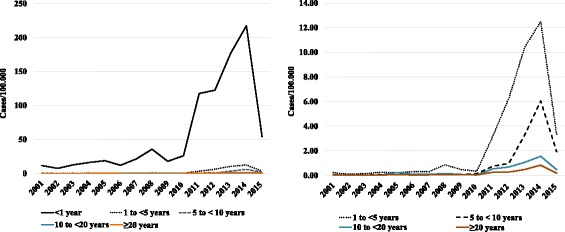
A significant increase in pertussis incidence occurred in Brazil, from 2011 to 2014, despite high coverage of childhood immunization with whole-cell-pertussis (wP) containing vaccines. This study presents pertussis surveillance data from São Paulo state and discusses the challenges to interpret them considering pertussis cyclic epidemic behavior, the introduction of new diagnostic techniques and new vaccination strategies, and enhanced disease awareness during epidemics.
Observational study including pertussis cases reported to the Surveillance System in São Paulo state, from January 2001 to December 2015. Pertussis cases data were retrieved from the National Notifiable Diseases Information System (SINAN) website and from São Paulo state Epidemiological Surveillance Center (CVE/SP) database. Vaccination coverage and homogeneity data were collected from the Unified Health System Department of Informatics (DATASUS). We presented cases distribution by year, age group and diagnostic criteria and calculated pertussis incidence rates. The proportions of cases among different age groups were compared using chi-square test for trend.
Infants less than 1 year of age were the most affected during the whole period, but the proportions of cases in this age group had a significant decreasing trend, with significant increase in the proportions of cases reported among older age groups (1-4, 5-10 and ≥20 years). Cases among infants aged less than 6 months represented ≥90% of all cases in children less than 1 year of age in all but 2 years (2012 and 2015). A non-significant decrease in the proportion of cases among infants aged < 2 months was observed in parallel to a significant increase in the proportion of cases in infants aged 6-11 months.
A pertussis outbreak has occurred in a state with universal use of wP vaccine. The disease cyclic behavior has probably had a major role in the increased incidence rates registered in São Paulo state, from 2011 to 2014, as well as in the decreased incidence in 2015. Maternal vaccination cannot explain the drop in the number of cases among all age groups, in 2015, as herd protection is not expected, but may have had an impact on the number of cases in infants aged < 2 months.
尽管全细胞百日咳(wP)疫苗对儿童的免疫覆盖率很高,但 2011 年至 2014 年期间,巴西百日咳发病率显著上升。本研究介绍了来自圣保罗州的百日咳监测数据,并讨论了考虑到百日咳周期性流行行为、新诊断技术和新疫苗接种策略的引入以及流行期间疾病意识增强等因素,对这些数据进行解释所面临的挑战。
这是一项观察性研究,纳入了 2001 年 1 月至 2015 年 12 月期间向圣保罗州监测系统报告的百日咳病例。从国家法定传染病信息系统(SINAN)网站和圣保罗州流行病学监测中心(CVE/SP)数据库中获取百日咳病例数据。从统一卫生系统信息司(DATASUS)收集疫苗接种覆盖率和同质性数据。我们按年份、年龄组和诊断标准展示病例分布情况,并计算百日咳发病率。使用趋势 χ2 检验比较不同年龄组病例的比例。
整个研究期间,1 岁以下婴儿受影响最大,但该年龄组病例的比例呈显著下降趋势,而年龄较大组(1-4 岁、5-10 岁和≥20 岁)报告的病例比例显著增加。除了 2012 年和 2015 年之外,所有 1 岁以下儿童中,<6 个月龄婴儿的病例占所有病例的≥90%。与此同时,我们观察到<2 月龄婴儿的病例比例呈非显著下降趋势,而 6-11 月龄婴儿的病例比例显著增加。
在普遍使用 wP 疫苗的情况下,该州发生了百日咳暴发。疾病周期性流行可能在 2011 年至 2014 年期间圣保罗州登记的发病率上升以及 2015 年发病率下降中发挥了重要作用。孕产妇疫苗接种不能解释 2015 年所有年龄组病例数量的下降,因为预计不会产生群体保护作用,但可能对<2 月龄婴儿的病例数量产生影响。