Laboratory of Neuroimaging, National Institute on Alcoholism and Alcohol Abuse, Bethesda, MD, USA.
College of Mechanical and Electronic Engineering, Northwest Agriculture and Forestry University, Yangling, Shaanxi, China.
Int J Obes (Lond). 2018 Nov;42(11):1890-1899. doi: 10.1038/s41366-018-0040-2. Epub 2018 Feb 23.
The control of food intake in environments with easy access to highly rewarding foods is challenging to most modern societies. The combination of sustained release (SR) naltrexone and SR bupropion (NB32) has been used in weight-loss and obesity management. However, the effects of NB32 on the brain circuits implicated in the regulation of food intake are unknown. Here we used functional connectivity density (FCD) mapping to evaluate the effects of NB32 on resting brain FC.
Thirty-six healthy women underwent magnetic resonance imaging (MRI) before and after 4-week treatment with NB32 (n = 16) or with placebo (n = 20). In each imaging visit, a 5-min resting-state functional MRI scan was conducted after 15 h of fasting. The FC of brain regions showing significant group effects on FCD were subsequently assessed using seed-voxel correlation analyses. We characterized the associations between FCD measures and craving control scores in the Control of Eating Questionnaire.
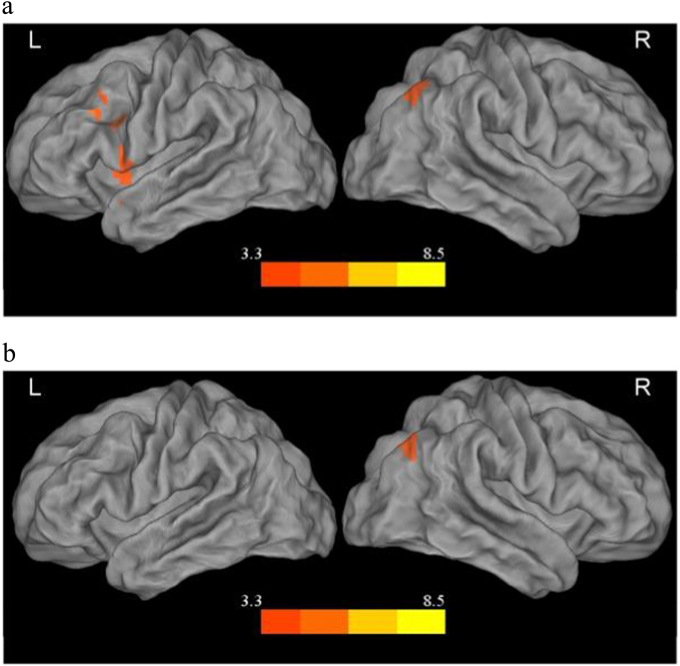
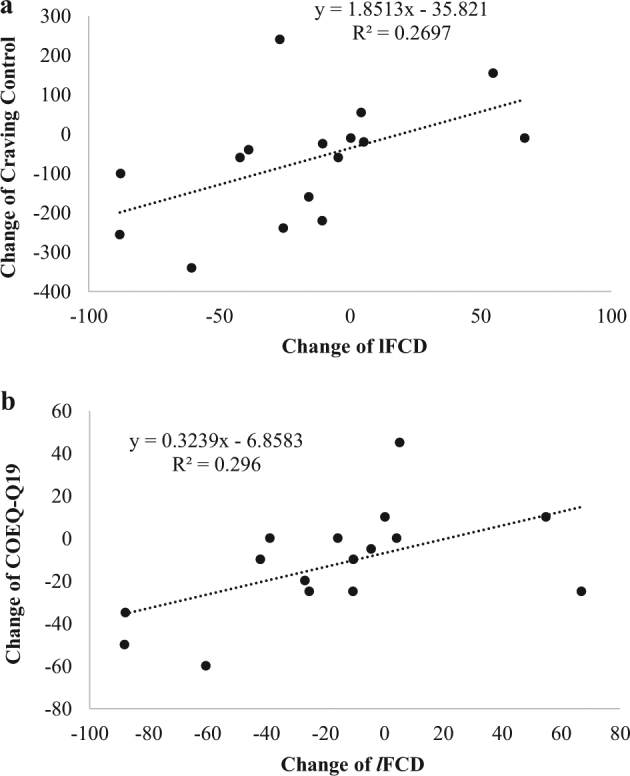
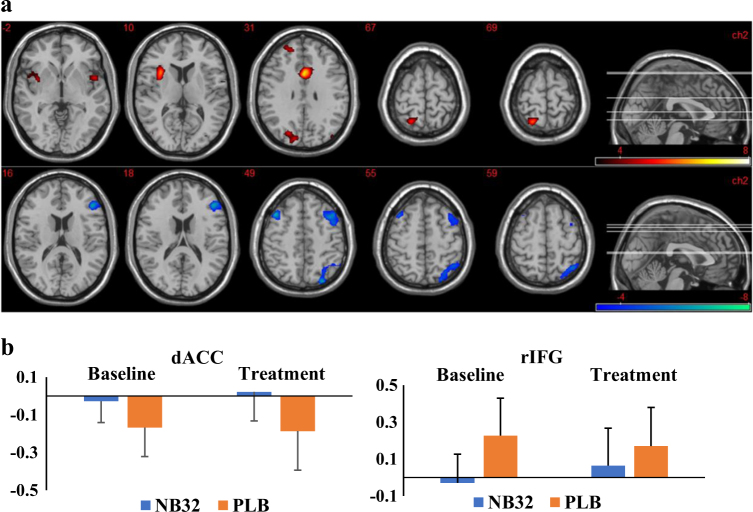
After NB32 treatment, the group showed lower local and global FCD than the placebo group in the right superior parietal cortex and lower local FCD in the left middle frontal gyrus. Seed-voxel correlation analysis for the right superior parietal cortex seed demonstrated higher positive FC with the dorsal anterior cingulate gyrus (ACC), bilateral insula, and left superior parietal gyrus and stronger negative FC with right inferior frontal gyrus and right superior parietal cortices for the NB32 than the placebo group. Further, the NB32 group showed a significant correlation between local FCD change after treatment in left middle frontal gyrus and craving control scores (r = 0.519, p = 0.039).
NB32 treatment decreased local and global FCD in superior parietal cortex and increased its connectivity with ACC (involved with saliency attribution), insula (interoception), and decreased local FCD in the medial prefrontal cortex (craving), which might underlie NB32 improved control over eating behaviors. ClinicalTrails.gov: NCT00711.
在容易获得高奖励食物的环境中控制食物摄入对大多数现代社会来说都是一项挑战。持续释放(SR)纳曲酮和 SR 安非他酮(NB32)的组合已被用于减肥和肥胖管理。然而,NB32 对调节食物摄入的大脑回路的影响尚不清楚。在这里,我们使用功能连接密度(FCD)映射来评估 NB32 对静息大脑 FC 的影响。
36 名健康女性在接受 NB32(n=16)或安慰剂(n=20)治疗 4 周前后接受了磁共振成像(MRI)检查。在每次成像检查中,在禁食 15 小时后进行 5 分钟的静息态功能 MRI 扫描。随后使用种子-体素相关分析评估显示 FCD 组间效应的脑区的 FC。我们描述了 FCD 测量值与饮食控制问卷(Control of Eating Questionnaire)中控制欲望评分之间的相关性。
NB32 治疗后,与安慰剂组相比,NB32 组右侧顶上回的局部和全局 FCD 降低,左侧额中回的局部 FCD 降低。对于右侧顶上回种子的种子-体素相关分析显示,NB32 组与背侧前扣带回(ACC)、双侧岛叶和左侧顶上回的正相关 FC 较高,与右侧额下回和右侧顶上回的负相关 FC 较强。此外,NB32 组治疗后左侧额中回的局部 FCD 变化与控制欲望评分呈显著相关性(r=0.519,p=0.039)。
NB32 治疗降低了顶上回的局部和全局 FCD,增加了与 ACC(涉及突显归因)、岛叶(内脏感觉)的连接,降低了内侧前额叶皮质(渴望)的局部 FCD,这可能是 NB32 改善饮食行为控制的基础。ClinicalTrails.gov:NCT00711。