Melamed Philippa, Haj Majd, Yosefzon Yahav, Rudnizky Sergei, Wijeweera Andrea, Pnueli Lilach, Kaplan Ariel
Faculty of Biology, Technion-Israel Institute of Technology, Haifa, Israel.
Front Endocrinol (Lausanne). 2018 Feb 27;9:58. doi: 10.3389/fendo.2018.00058. eCollection 2018.
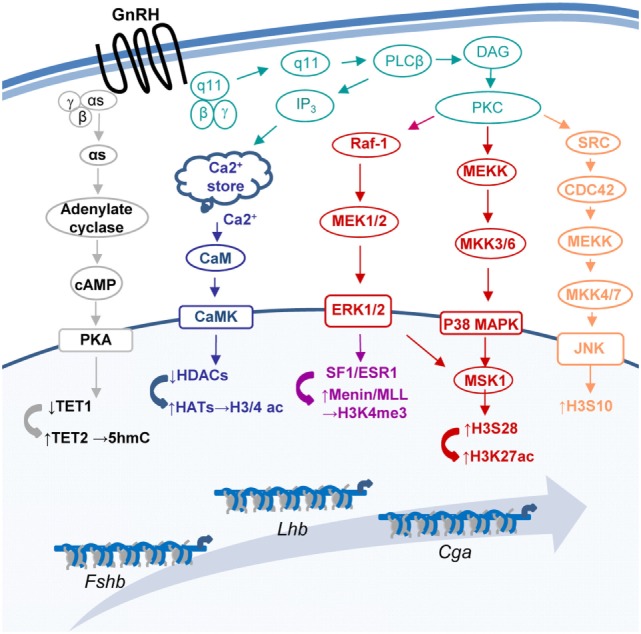
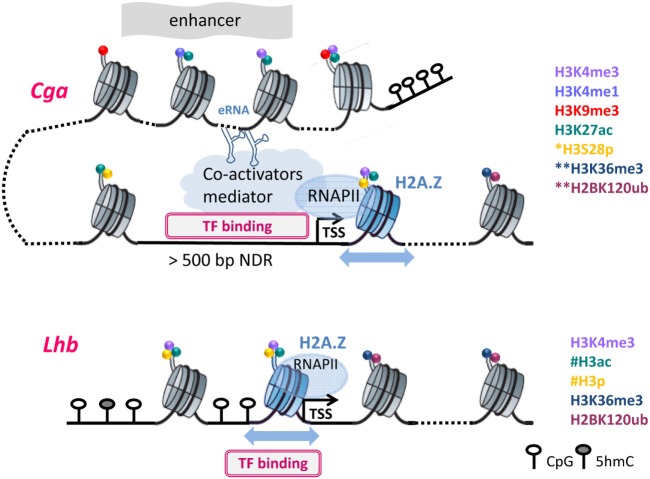
Gonadotropin-releasing hormone (GnRH) stimulates the expression of multiple genes in the pituitary gonadotropes, most notably to induce synthesis of the gonadotropins, luteinizing hormone (LH), and follicle-stimulating hormone (FSH), but also to ensure the appropriate functioning of these cells at the center of the mammalian reproductive endocrine axis. Aside from the activation of gene-specific transcription factors, GnRH stimulates through its membrane-bound receptor, alterations in the chromatin that facilitate transcription of its target genes. These include changes in the histone and DNA modifications, nucleosome positioning, and chromatin packaging at the regulatory regions of each gene. The requirements for each of these events vary according to the DNA sequence which determines the basal chromatin packaging at the regulatory regions. Despite considerable progress in this field in recent years, we are only beginning to understand some of the complexities involved in the role and regulation of this chromatin structure, including new modifications, extensive cross talk, histone variants, and the actions of distal enhancers and non-coding RNAs. This short review aims to integrate the latest findings on GnRH-induced alterations in the chromatin of its target genes, which indicate multiple and diverse actions. Understanding these processes is illuminating not only in the context of the activation of these hormones during the reproductive life span but may also reveal how aberrant epigenetic regulation of these genes leads to sub-fertility.
促性腺激素释放激素(GnRH)刺激垂体促性腺细胞中多种基因的表达,最显著的是诱导促性腺激素、黄体生成素(LH)和卵泡刺激素(FSH)的合成,同时也确保这些细胞在哺乳动物生殖内分泌轴中心发挥适当功能。除了激活基因特异性转录因子外,GnRH还通过其膜结合受体刺激染色质发生改变,从而促进其靶基因的转录。这些改变包括组蛋白和DNA修饰、核小体定位以及每个基因调控区域的染色质包装变化。这些事件中的每一个的要求因决定调控区域基础染色质包装的DNA序列而异。尽管近年来该领域取得了相当大的进展,但我们才刚刚开始了解这种染色质结构的作用和调控所涉及的一些复杂性,包括新的修饰、广泛的相互作用、组蛋白变体以及远端增强子和非编码RNA的作用。这篇简短的综述旨在整合关于GnRH诱导其靶基因染色质改变的最新发现,这些发现表明了多种不同的作用。了解这些过程不仅有助于理解在生殖寿命期间这些激素的激活情况,还可能揭示这些基因的异常表观遗传调控如何导致生育力下降。