Ahn Ki Bum, Baik Jung Eun, Yun Cheol-Heui, Han Seung Hyun
Department of Oral Microbiology and Immunology, DRI, and BK21 Plus Program, School of Dentistry, Seoul National University, Seoul, South Korea.
Research Division for Biotechnology, Korea Atomic Energy Research Institute, Jeongeup, South Korea.
Front Microbiol. 2018 Feb 27;9:327. doi: 10.3389/fmicb.2018.00327. eCollection 2018.
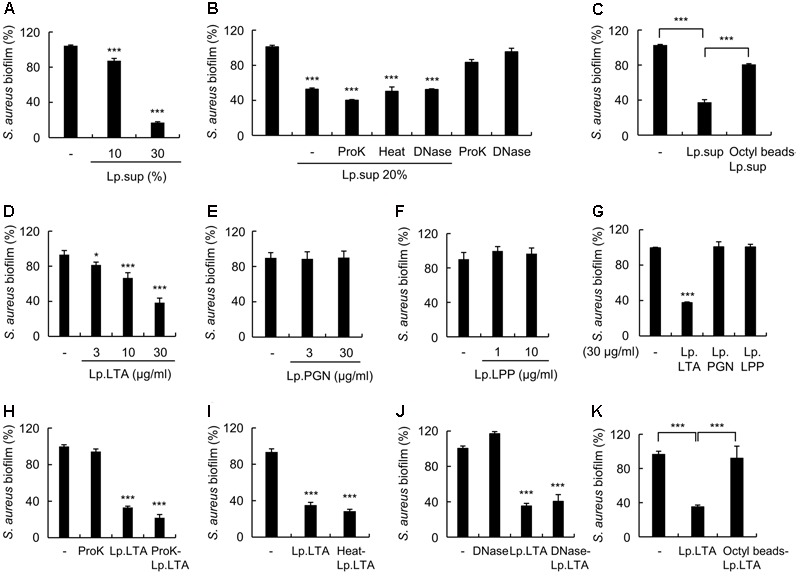
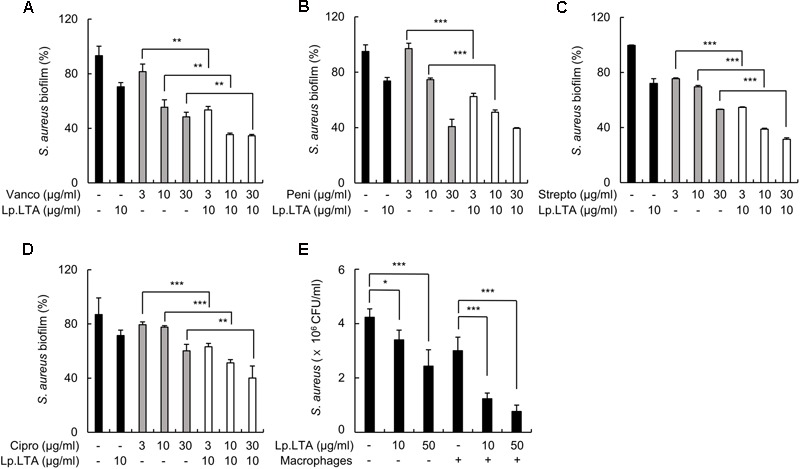
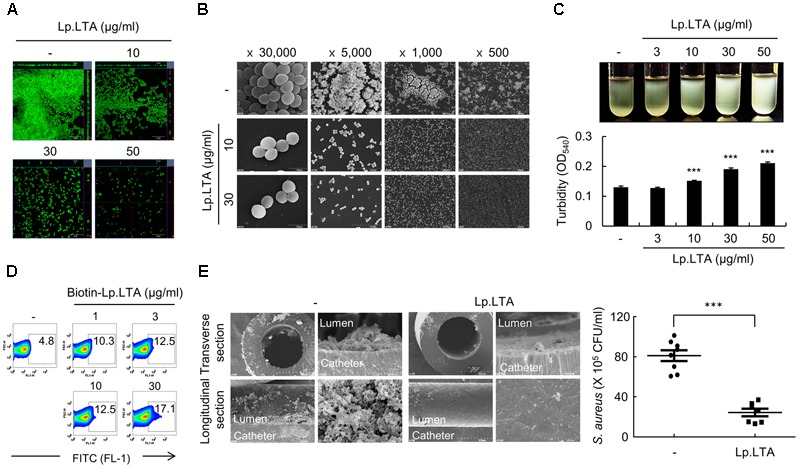
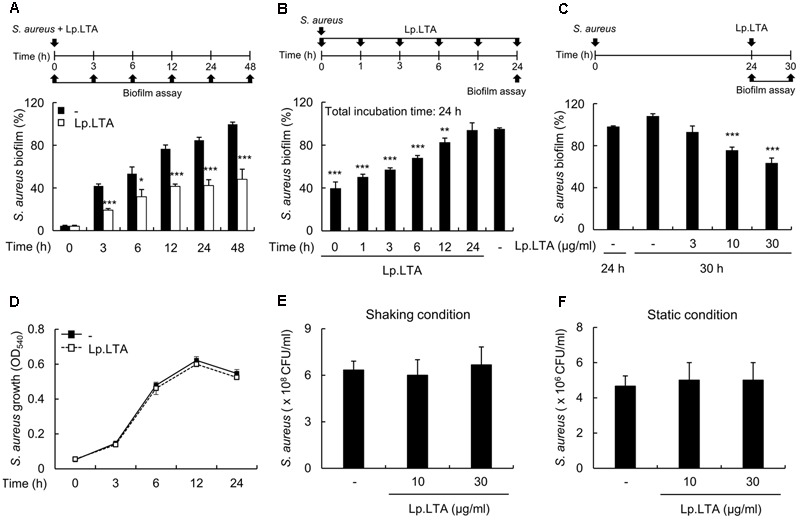
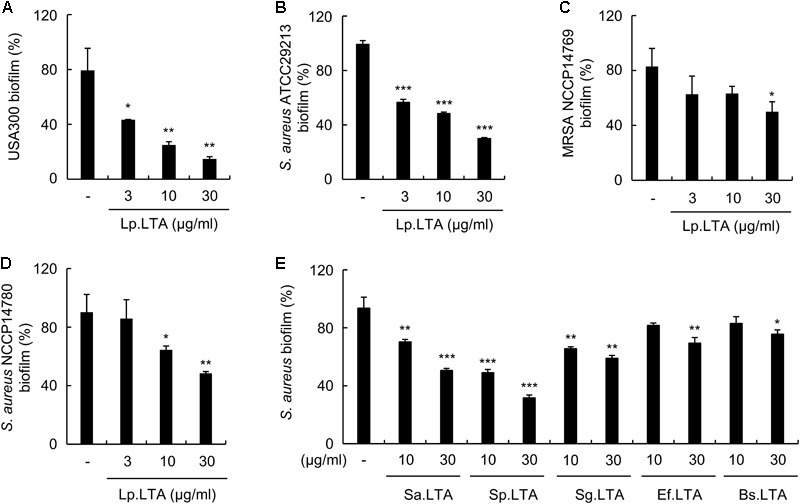
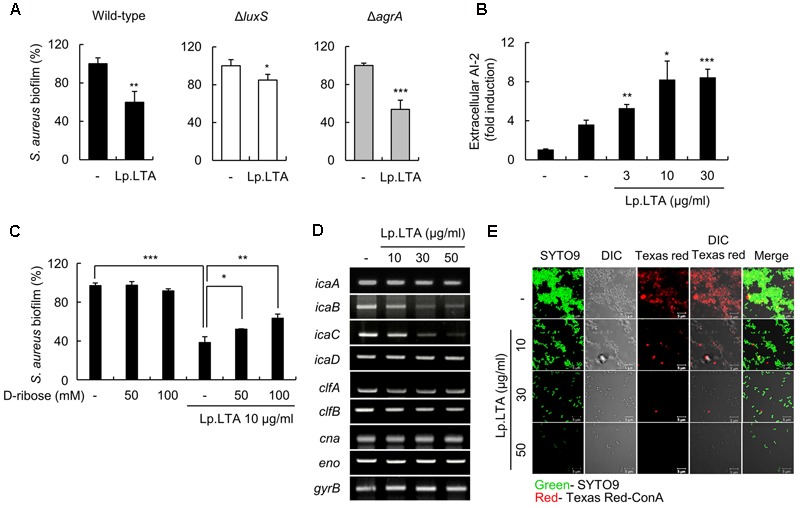
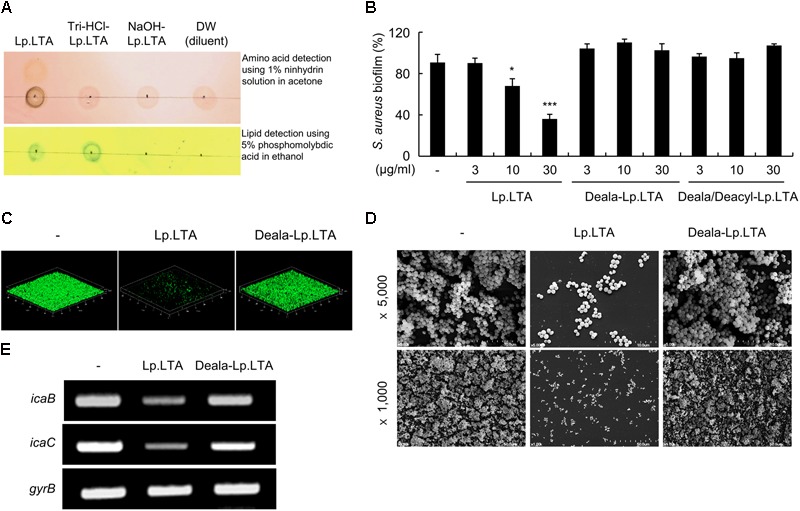
A biofilm is an aggregate of microorganisms in which cells adhere to biological or non-biological surfaces and is responsible for various infectious diseases. Infections caused by , including pneumonia, endocarditis, and osteomyelitis, are often associated with colonization and biofilm formation. Although lipoteichoic acid (LTA) is involved in biofilm formation, the specific role of LTA is not clearly understood. In this study, we demonstrated that LTA released from could inhibit biofilm formation and aggregation without affecting the growth of in various and models. LTA (Lp.LTA) also inhibited biofilm formation of clinical isolates, including a methicillin-resistant strain. Remarkably, Lp.LTA not only interfered with biofilm formation, but it also disrupted a pre-formed biofilm. Mechanism studies demonstrated that Lp.LTA inhibited expression of the -operon, which is responsible for the production of poly--acetylglucosamine, a key molecule required for biofilm development. Lp.LTA increased the release of autoinducer-2 from , which contributed to the inhibition of biofilm formation. Moreover, Lp.LTA treatment enhanced susceptibility of the biofilm to various antibiotics and to macrophages. Interestingly, Lp.LTA without D-alanine moieties was not able to inhibit biofilm formation by . In conclusion, the present study suggests that LTA can inhibit biofilm formation, and therefore could be applied for preventing and/or treating infectious diseases caused by biofilms.
生物膜是微生物的聚集体,其中细胞粘附于生物或非生物表面,并引发各种传染病。由[具体微生物名称未给出]引起的感染,包括肺炎、心内膜炎和骨髓炎,通常与定植和生物膜形成有关。尽管脂磷壁酸(LTA)参与生物膜形成,但其具体作用尚不清楚。在本研究中,我们证明从[具体微生物名称未给出]释放的LTA可抑制[具体微生物名称未给出]生物膜形成和聚集,而不影响其在各种[具体培养条件未给出]和[具体模型未给出]模型中的生长。[具体微生物名称未给出]的LTA(Lp.LTA)也抑制了包括耐甲氧西林菌株在内的[具体微生物名称未给出]临床分离株的生物膜形成。值得注意的是,Lp.LTA不仅干扰[具体微生物名称未给出]生物膜形成,还破坏预先形成的生物膜。机制研究表明,Lp.LTA抑制了[具体操纵子名称未给出]操纵子的表达,该操纵子负责多聚-N-乙酰葡糖胺的产生,而多聚-N-乙酰葡糖胺是[具体微生物名称未给出]生物膜发育所需的关键分子。Lp.LTA增加了[具体微生物名称未给出]中自诱导物-2的释放,这有助于抑制[具体微生物名称未给出]生物膜形成。此外,Lp.LTA处理增强了生物膜对各种抗生素和巨噬细胞的敏感性。有趣的是,没有D-丙氨酸部分的Lp.LTA不能抑制[具体微生物名称未给出]的生物膜形成。总之,本研究表明LTA可抑制[具体微生物名称未给出]生物膜形成,因此可用于预防和/或治疗由[具体微生物名称未给出]生物膜引起的传染病。