Eastley Nicholas C, Ottolini Barbara, Neumann Rita, Luo Jin-Li, Hastings Robert K, Khan Imran, Moore David A, Esler Claire P, Shaw Jacqueline A, Royle Nicola J, Ashford Robert U
University Hospitals of Leicester NHS Trust, Trauma and Orthopaedics, Leicester, UK.
University of Leicester Department of Genetics, Leicester, UK.
Oncotarget. 2018 Jan 19;9(12):10549-10560. doi: 10.18632/oncotarget.24278. eCollection 2018 Feb 13.
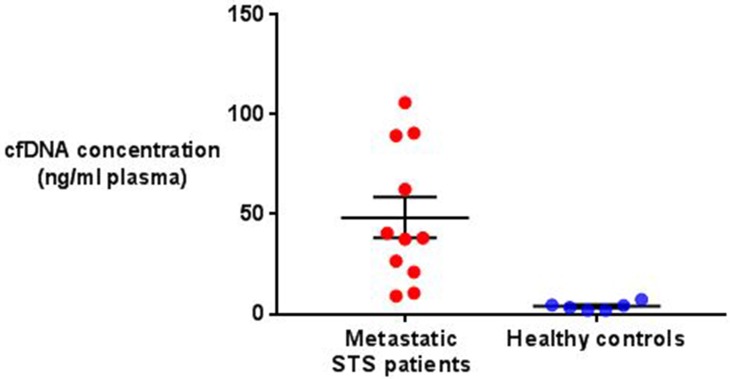
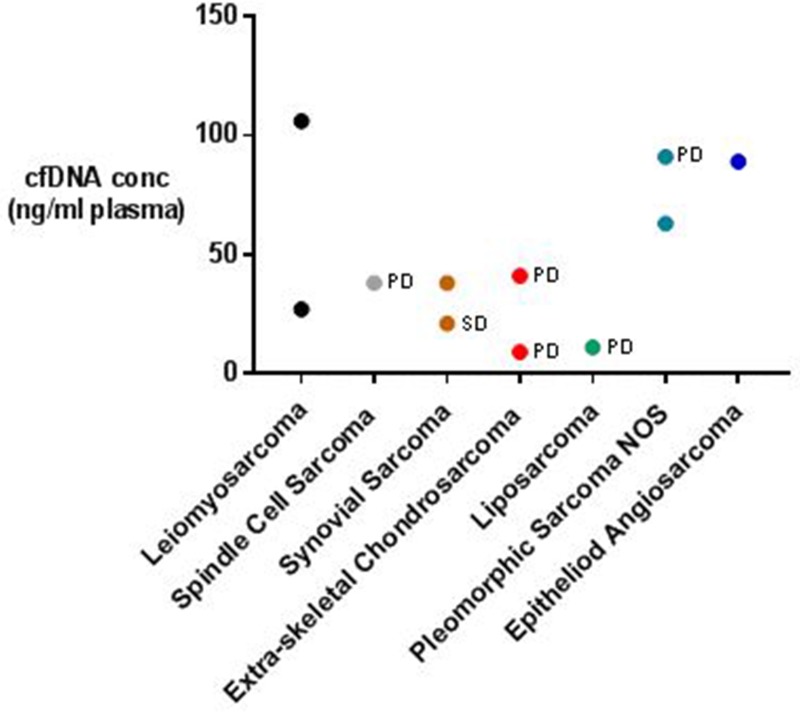
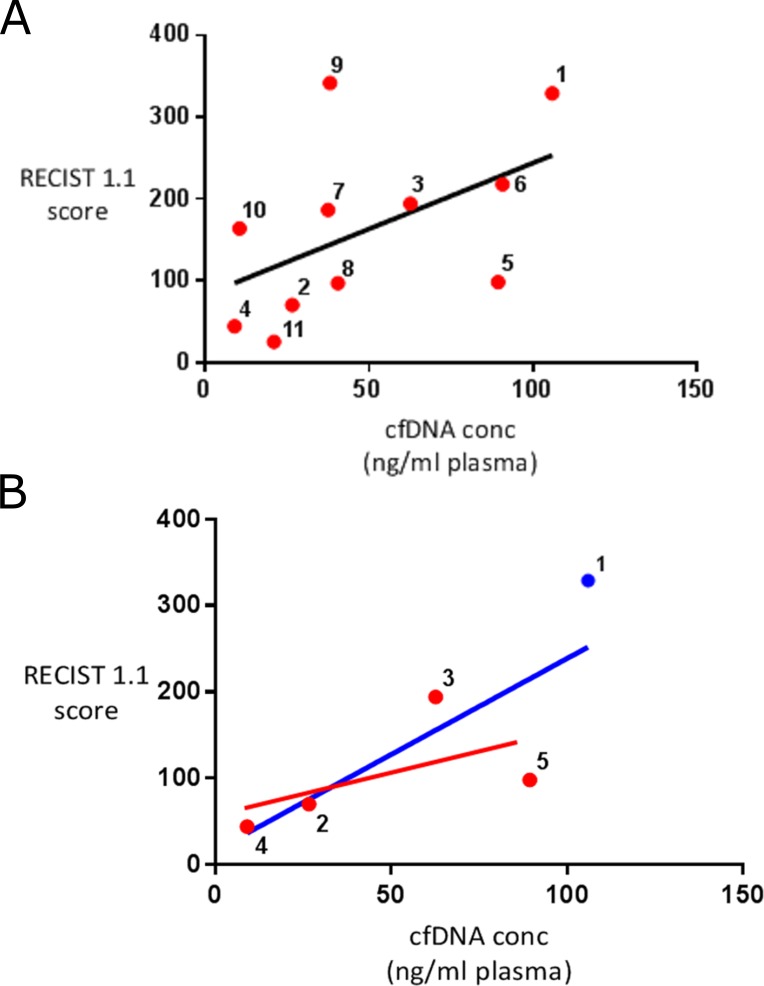
Following treatment 40% of soft tissue sarcoma (STS) patients suffer disease recurrence. In certain cancers circulating cell free DNA (cfDNA) and circulating tumour-derived DNA (ctDNA) characteristics correlate closely with disease burden, making them exciting potential sources of biomarkers. Despite this, the circulating nucleic acid characteristics of only 2 STS patients have been reported to date. To address this we used an Ion AmpliSeq™ panel custom specifically designed for STS patients to conduct a genetic characterisation of plasma cfDNA, buffy coat (germline) DNA and where available Formalin-Fixed Paraffin-Embedded (FFPE) primary STS tissue DNA in a cohort of 11 metastatic STS patients. We found that total cfDNA levels were significantly elevated in the STS patients analysed, and weakly correlated with disease burden. Using our Ion AmpliSeq™ panel we also successfully detected ctDNA in 4/11 (36%) patients analysed with a wide variety of STS subtypes and disease burdens. This evidence included the presence of cancer associated / mutations in 2 patients' plasma and matched primary STS tumour tissue, and in the plasma alone for 2 patients. We also identified 2 potential examples of allelic loss of heterozygosity in an additional patient's STS DNA and cfDNA. This is the largest study performed characterising STS patient cfDNA/ctDNA and confirms that the field remains an attractive potential source of novel STS biomarkers. Further work is required to investigate the circulating nucleic acid characteristics of individual STS subtypes, and the potential prognostic or therapeutic roles that cfDNA/ctDNA may hold for patients with these complex tumours.
治疗后,40%的软组织肉瘤(STS)患者会出现疾病复发。在某些癌症中,循环游离DNA(cfDNA)和循环肿瘤来源DNA(ctDNA)特征与疾病负担密切相关,使其成为令人兴奋的潜在生物标志物来源。尽管如此,迄今为止仅报道了2例STS患者的循环核酸特征。为了解决这一问题,我们使用了专门为STS患者定制设计的Ion AmpliSeq™ 检测板,对11例转移性STS患者队列中的血浆cfDNA、血沉棕黄层(种系)DNA以及可用的福尔马林固定石蜡包埋(FFPE)原发性STS组织DNA进行基因特征分析。我们发现,在分析的STS患者中,总cfDNA水平显著升高,且与疾病负担呈弱相关。使用我们的Ion AmpliSeq™ 检测板,我们还在4/11(36%)接受分析的患者中成功检测到ctDNA,这些患者具有多种STS亚型和疾病负担。这一证据包括2例患者的血浆和匹配的原发性STS肿瘤组织中存在癌症相关突变,以及2例患者仅在血浆中存在相关突变。我们还在另外1例患者的STS DNA和cfDNA中发现了2个杂合性等位基因缺失的潜在例子。这是对STS患者cfDNA/ctDNA进行特征分析的最大规模研究,并证实该领域仍然是新型STS生物标志物的一个有吸引力的潜在来源。需要进一步开展工作,以研究个体STS亚型的循环核酸特征,以及cfDNA/ctDNA对这些复杂肿瘤患者可能具有的潜在预后或治疗作用。