Li Tian, Song Jianwei, Zhao Xinpeng, Yang Zhi, Pastel Glenn, Xu Shaomao, Jia Chao, Dai Jiaqi, Chen Chaoji, Gong Amy, Jiang Feng, Yao Yonggang, Fan Tianzhu, Yang Bao, Wågberg Lars, Yang Ronggui, Hu Liangbing
Department of Materials Science and Engineering, University of Maryland, College Park, MD 20742, USA.
Department of Mechanical Engineering, University of Colorado, Boulder, CO 80309, USA.
Sci Adv. 2018 Mar 9;4(3):eaar3724. doi: 10.1126/sciadv.aar3724. eCollection 2018 Mar.
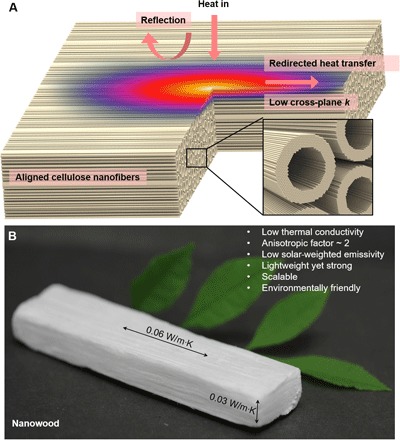
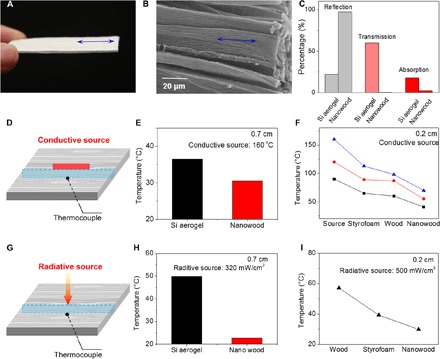
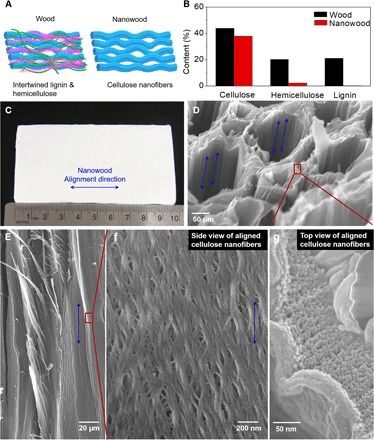
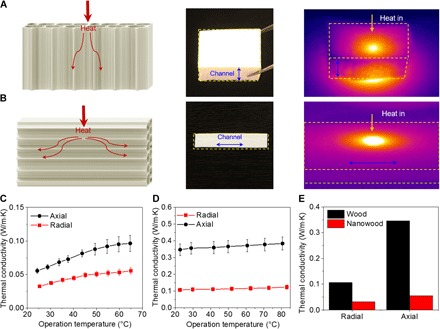
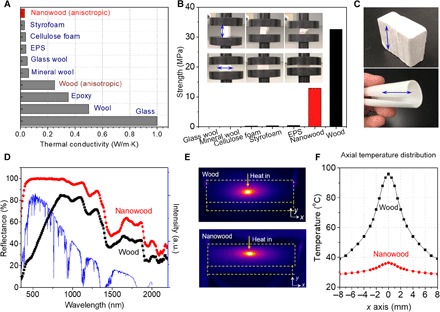
There has been a growing interest in thermal management materials due to the prevailing energy challenges and unfulfilled needs for thermal insulation applications. We demonstrate the exceptional thermal management capabilities of a large-scale, hierarchal alignment of cellulose nanofibrils directly fabricated from wood, hereafter referred to as nanowood. Nanowood exhibits anisotropic thermal properties with an extremely low thermal conductivity of 0.03 W/m·K in the transverse direction (perpendicular to the nanofibrils) and approximately two times higher thermal conductivity of 0.06 W/m·K in the axial direction due to the hierarchically aligned nanofibrils within the highly porous backbone. The anisotropy of the thermal conductivity enables efficient thermal dissipation along the axial direction, thereby preventing local overheating on the illuminated side while yielding improved thermal insulation along the backside that cannot be obtained with isotropic thermal insulators. The nanowood also shows a low emissivity of <5% over the solar spectrum with the ability to effectively reflect solar thermal energy. Moreover, the nanowood is lightweight yet strong, owing to the effective bonding between the aligned cellulose nanofibrils with a high compressive strength of 13 MPa in the axial direction and 20 MPa in the transverse direction at 75% strain, which exceeds other thermal insulation materials, such as silica and polymer aerogels, Styrofoam, and wool. The excellent thermal management, abundance, biodegradability, high mechanical strength, low mass density, and manufacturing scalability of the nanowood make this material highly attractive for practical thermal insulation applications.
由于普遍存在的能源挑战以及隔热应用方面未得到满足的需求,人们对热管理材料的兴趣与日俱增。我们展示了一种直接由木材制造的大规模、分级排列的纤维素纳米纤维(以下简称纳米木材)卓越的热管理能力。纳米木材呈现出各向异性的热性能,在横向(垂直于纳米纤维)方向上具有极低的热导率,仅为0.03W/m·K,而在轴向方向上,由于高度多孔骨架内分级排列的纳米纤维,热导率约为0.06W/m·K,是横向的两倍左右。热导率的各向异性使得热量能够沿轴向有效耗散,从而防止光照面局部过热,同时在背面提供更好的隔热效果,这是各向同性隔热材料所无法实现的。纳米木材在太阳光谱范围内还具有低于5%的低发射率,能够有效反射太阳能热量。此外,纳米木材重量轻但强度高,这得益于排列整齐的纤维素纳米纤维之间的有效结合,在75%应变下,其轴向抗压强度为13MPa,横向抗压强度为20MPa,超过了其他隔热材料,如二氧化硅和气凝胶聚合物、聚苯乙烯泡沫塑料和羊毛。纳米木材出色的热管理性能、丰富性、生物可降解性、高机械强度、低质量密度以及制造可扩展性,使其成为实际隔热应用中极具吸引力的材料。