School of Agricultural, Forest and Food Sciences, Bern University of Applied Sciences, 3052, Zollikofen, Switzerland.
Institute of Biology, University of Neuchâtel, 2000, Neuchâtel, Switzerland.
Parasit Vectors. 2018 Mar 15;11(1):164. doi: 10.1186/s13071-018-2712-0.
Ticks and tick-borne pathogens are a global problem for the health of humans and their livestock. Wood ants are important ecosystem engineers in forests worldwide. Although both taxa are well studied, little is known about their interactions under natural conditions. The purpose of the present field study was to test whether European red wood ants (Formica polyctena) influence the abundance of Ixodes tick populations in temperate forests.
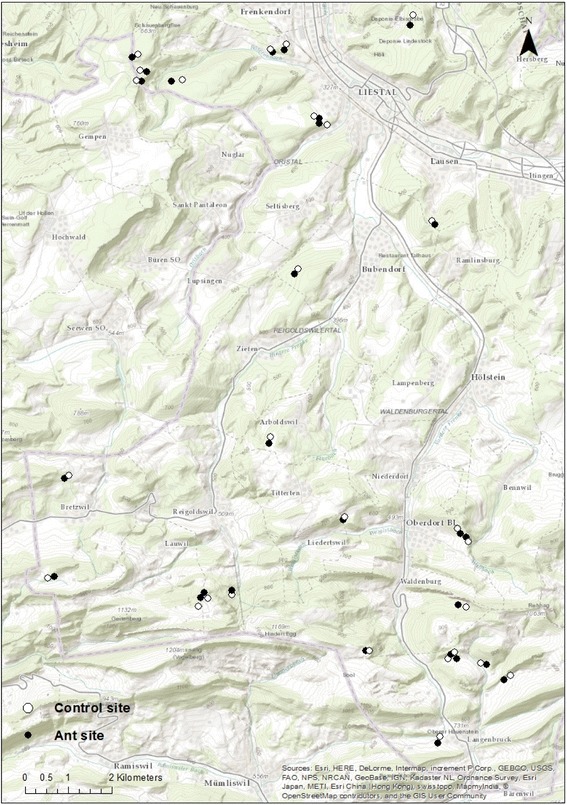
Data collection took place in 130 sampling plots located at 26 ant nest sites paired with 26 control sites in northwestern Switzerland. At each sampling plot, tick abundance, ant abundance, ant nest volume and habitat variables (describing litter, vegetation and microclimate) were measured. We used linear mixed-effect models to analyze the abundance of questing ticks as a function of ant abundance and habitat variables.
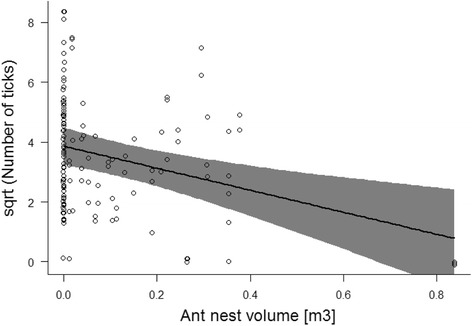
Ant nest volume, rather than the presence of ants, had a significant negative effect on tick abundance. The number of ticks decreased from 11.2 to 3.5 per 100 m if the volume of the adjacent ant nest increased from 0.1 m to 0.5 m. Additionally, high vegetation cover and litter depth had negative and positive relationships with tick abundance, respectively.
We showed that the number of questing ticks was negatively correlated with the size of red wood ant nests. Further studies are needed to identify the mechanisms that drive the relationship. Possible mechanisms include the repellent effect of ant formic acid, and the predatory behavior of wood ants. The present field study suggests that red wood ants provide a new ecosystem service by reducing the local abundance of Ixodes ticks.
蜱虫和蜱传病原体是一个全球性的问题,关系到人类和其牲畜的健康。木蚁是全世界森林中重要的生态系统工程师。尽管这两个类群都得到了很好的研究,但人们对它们在自然条件下的相互作用知之甚少。本野外研究的目的是检验欧洲红林蚁(Formica polyctena)是否会影响温带森林中游离蜱种群的丰度。
数据收集在瑞士西北部的 26 个蚁巢位点和 26 个对照位点的 130 个采样点进行。在每个采样点,测量了蜱虫丰度、蚂蚁丰度、蚁巢体积和描述枯枝落叶、植被和小气候的生境变量。我们使用线性混合效应模型分析游离蜱的丰度与蚂蚁丰度和生境变量的关系。
蚁巢体积而不是蚂蚁的存在对蜱虫丰度有显著的负向影响。如果相邻蚁巢的体积从 0.1 立方米增加到 0.5 立方米,蜱虫数量从每 100 平方米 11.2 只减少到 3.5 只。此外,高植被覆盖度和枯枝落叶深度分别与蜱虫丰度呈负相关和正相关关系。
我们表明,游离蜱的数量与红林蚁蚁巢的大小呈负相关。需要进一步的研究来确定驱动这种关系的机制。可能的机制包括蚁酸的驱避作用和木蚁的捕食行为。本野外研究表明,红林蚁通过减少局部游离蜱的数量提供了一种新的生态系统服务。