Czarnoleski Marcin, Labecka Anna Maria, Dragosz-Kluska Dominika, Pis Tomasz, Pawlik Katarzyna, Kapustka Filip, Kilarski Wincenty M, Kozłowski Jan
Institute of Environmental Sciences, Jagiellonian University, Gronostajowa 7, 30-387 Kraków, Poland
Institute of Environmental Sciences, Jagiellonian University, Gronostajowa 7, 30-387 Kraków, Poland.
Biol Open. 2018 Apr 9;7(4):bio029603. doi: 10.1242/bio.029603.
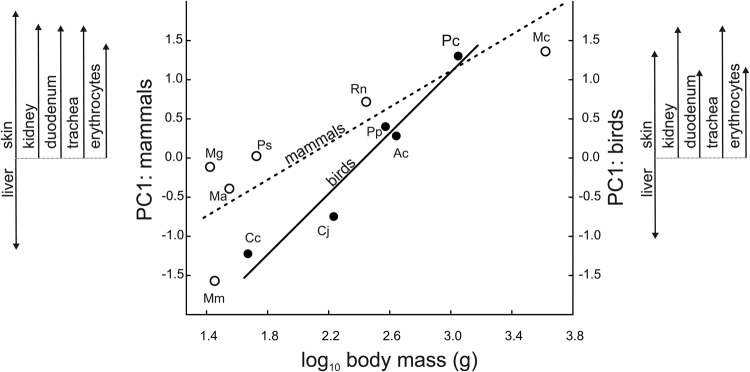
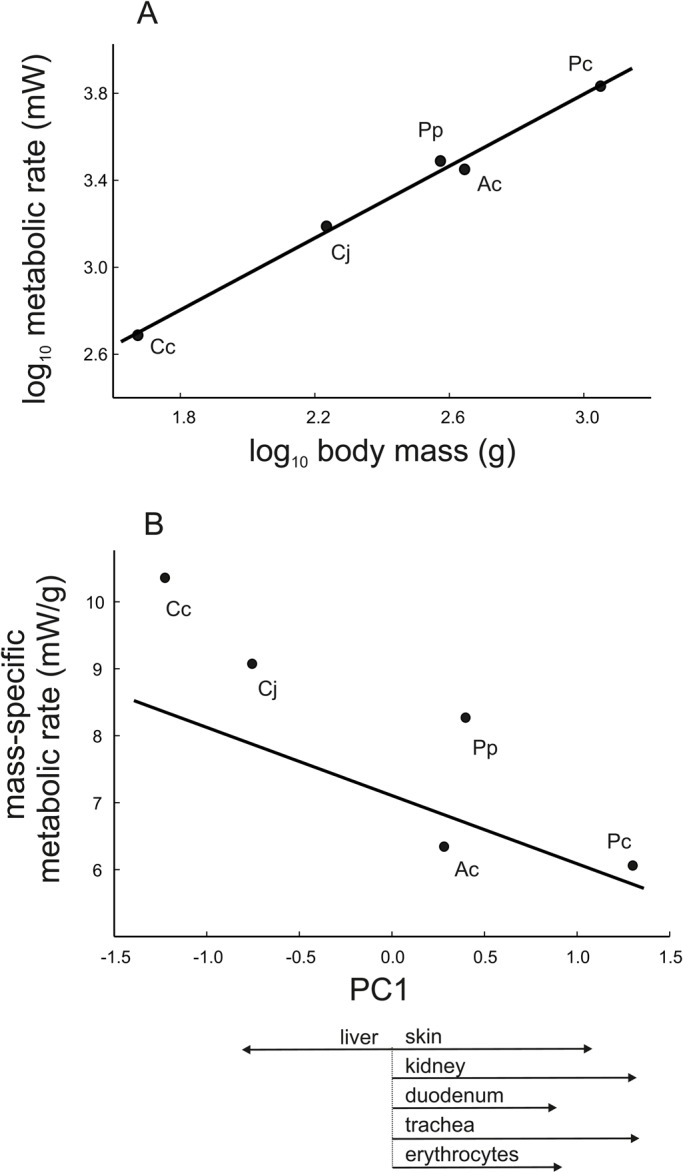
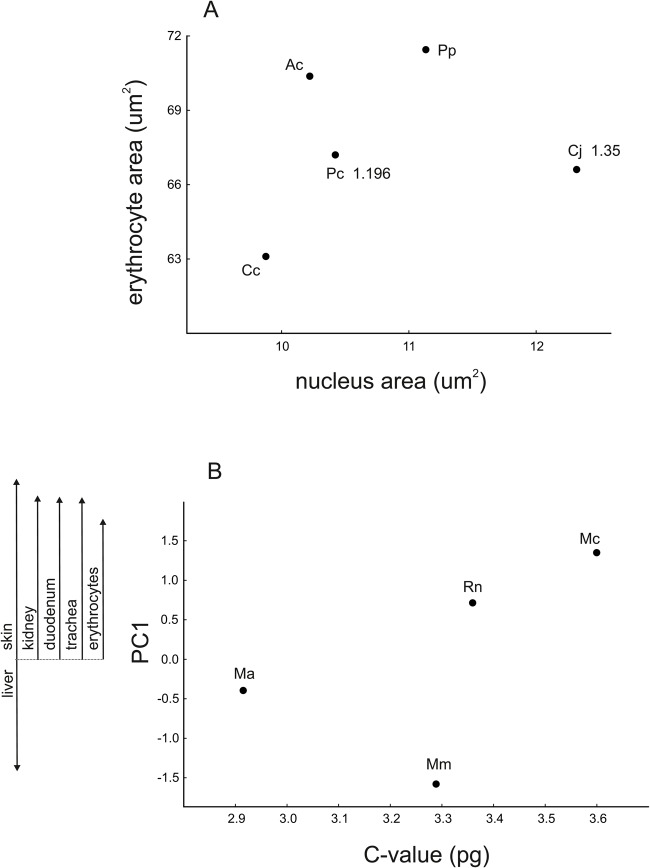
Cell size plays a role in body size evolution and environmental adaptations. Addressing these roles, we studied body mass and cell size in Galliformes birds and Rodentia mammals, and collected published data on their genome sizes. In birds, we measured erythrocyte nuclei and basal metabolic rates (BMRs). In birds and mammals, larger species consistently evolved larger cells for five cell types (erythrocytes, enterocytes, chondrocytes, skin epithelial cells, and kidney proximal tubule cells) and evolved smaller hepatocytes. We found no evidence that cell size differences originated through genome size changes. We conclude that the organism-wide coordination of cell size changes might be an evolutionarily conservative characteristic, and the convergent evolutionary body size and cell size changes in Galliformes and Rodentia suggest the adaptive significance of cell size. Recent theory predicts that species evolving larger cells waste less energy on tissue maintenance but have reduced capacities to deliver oxygen to mitochondria and metabolize resources. Indeed, birds with larger size of the abovementioned cell types and smaller hepatocytes have evolved lower mass-specific BMRs. We propose that the inconsistent pattern in hepatocytes derives from the efficient delivery system to hepatocytes, combined with their intense involvement in supracellular function and anabolic activity.
细胞大小在体型进化和环境适应中发挥着作用。为了探究这些作用,我们研究了鸡形目鸟类和啮齿目哺乳动物的体重和细胞大小,并收集了关于它们基因组大小的已发表数据。在鸟类中,我们测量了红细胞核和基础代谢率(BMR)。在鸟类和哺乳动物中,较大的物种在五种细胞类型(红细胞、肠上皮细胞、软骨细胞、皮肤上皮细胞和肾近端小管细胞)中一致地进化出更大的细胞,而肝细胞则进化得更小。我们没有发现细胞大小差异源于基因组大小变化的证据。我们得出结论,细胞大小变化在生物体范围内的协调可能是一种进化上保守的特征,鸡形目和啮齿目的趋同进化体型和细胞大小变化表明了细胞大小的适应性意义。最近的理论预测,进化出较大细胞的物种在组织维持上消耗的能量较少,但向线粒体输送氧气和代谢资源的能力降低。事实上,上述细胞类型较大且肝细胞较小的鸟类进化出了较低的质量特异性基础代谢率。我们认为,肝细胞中这种不一致的模式源于向肝细胞的高效输送系统,以及它们在超细胞功能和合成代谢活动中的强烈参与。