Adrian Gregory J, Czarnoleski Marcin, Angilletta Michael J
School of Life Sciences Arizona State University Tempe AZ USA.
Institute of Environmental Sciences Jagiellonian University Krakow Poland.
Ecol Evol. 2016 Oct 12;6(22):7991-7996. doi: 10.1002/ece3.2534. eCollection 2016 Nov.
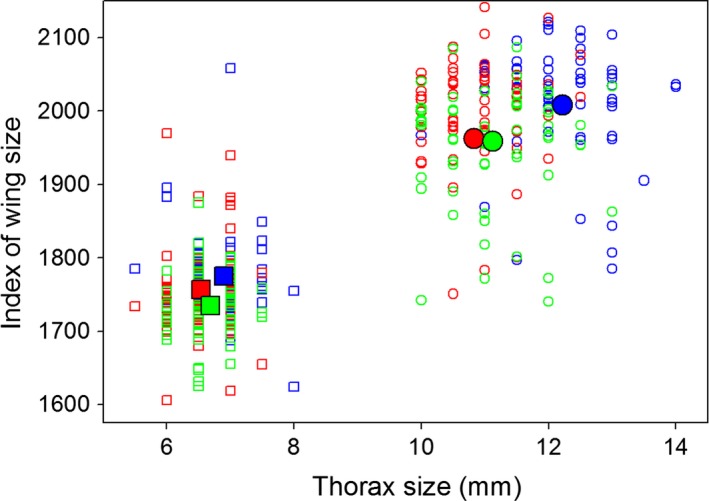
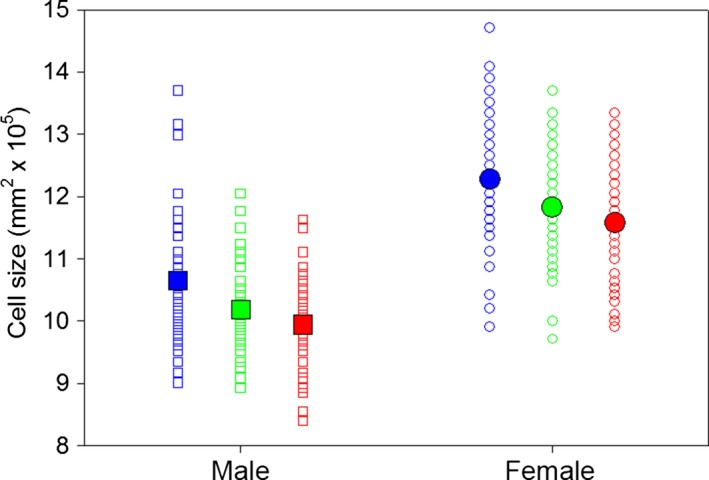
Recent theory predicts that the sizes of cells will evolve according to fluctuations in body temperature. Smaller cells speed metabolism during periods of warming but require more energy to maintain and repair. To evaluate this theory, we studied the evolution of cell size in populations of held at either a constant temperature (16°C or 25°C) or fluctuating temperatures (16 and 25°C). Populations that evolved at fluctuating temperatures or a constant 25°C developed smaller thoraxes, wings, and cells than did flies exposed to a constant 16°C. The cells of flies from fluctuating environments were intermediate in size to those of flies from constant environments. Most genetic variation in cell size was independent of variation in wing size, suggesting that cell size was a target of selection. These evolutionary patterns accord with patterns of developmental plasticity documented previously. Future studies should focus on the mechanisms that underlie the selective advantage of small cells at high or fluctuating temperatures.
最近的理论预测,细胞大小将根据体温波动而进化。较小的细胞在升温期间会加速新陈代谢,但维持和修复需要更多能量。为了评估这一理论,我们研究了在恒定温度(16°C或25°C)或波动温度(16°C和25°C)下饲养的果蝇种群中细胞大小的进化。在波动温度或恒定25°C下进化的种群,其胸部、翅膀和细胞比暴露在恒定16°C下的果蝇更小。来自波动环境的果蝇的细胞大小介于来自恒定环境的果蝇的细胞大小之间。细胞大小的大多数遗传变异与翅膀大小的变异无关,这表明细胞大小是选择的目标。这些进化模式与先前记录的发育可塑性模式一致。未来的研究应聚焦于高温或波动温度下小细胞选择性优势背后的机制。