Institute of Environmental Sciences, Jagiellonian University, Gronostajowa, 7, 30-387, Kraków, Poland.
Institute of Biology, University of Białystok, Ciołkowskiego 1J, 15-245, Białystok, Poland.
Biol Rev Camb Philos Soc. 2020 Oct;95(5):1393-1417. doi: 10.1111/brv.12615. Epub 2020 Jun 10.
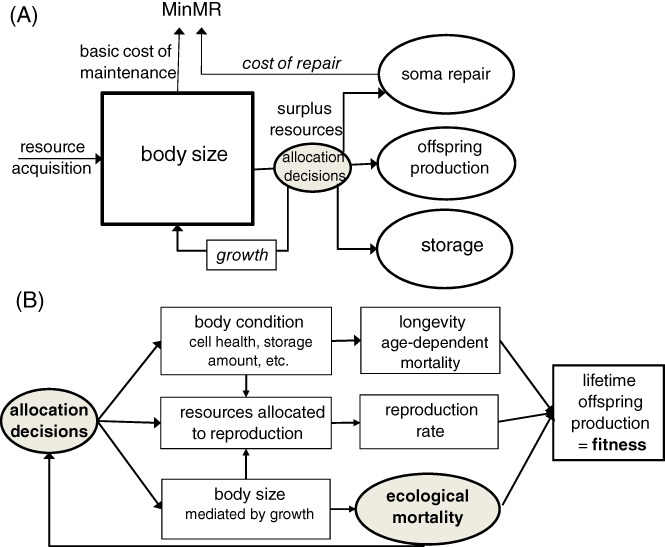
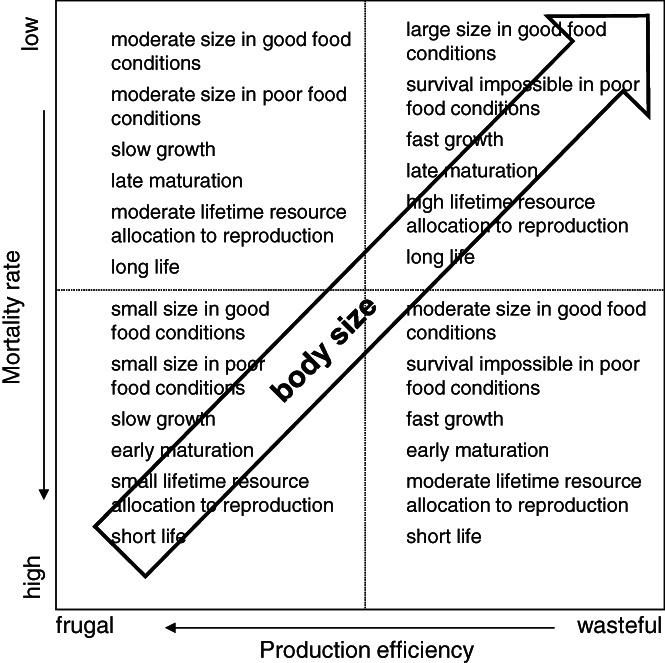
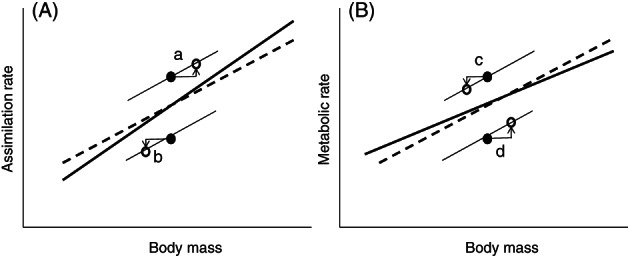
Despite many decades of research, the allometric scaling of metabolic rates (MRs) remains poorly understood. Here, we argue that scaling exponents of these allometries do not themselves mirror one universal law of nature but instead statistically approximate the non-linearity of the relationship between MR and body mass. This 'statistical' view must be replaced with the life-history perspective that 'allows' organisms to evolve myriad different life strategies with distinct physiological features. We posit that the hypoallometric allometry of MRs (mass scaling with an exponent smaller than 1) is an indirect outcome of the selective pressure of ecological mortality on allocation 'decisions' that divide resources among growth, reproduction, and the basic metabolic costs of repair and maintenance reflected in the standard or basal metabolic rate (SMR or BMR), which are customarily subjected to allometric analyses. Those 'decisions' form a wealth of life-history variation that can be defined based on the axis dictated by ecological mortality and the axis governed by the efficiency of energy use. We link this variation as well as hypoallometric scaling to the mechanistic determinants of MR, such as metabolically inert component proportions, internal organ relative size and activity, cell size and cell membrane composition, and muscle contributions to dramatic metabolic shifts between the resting and active states. The multitude of mechanisms determining MR leads us to conclude that the quest for a single-cause explanation of the mass scaling of MRs is futile. We argue that an explanation based on the theory of life-history evolution is the best way forward.
尽管已经进行了几十年的研究,但代谢率(MR)的异速缩放仍然知之甚少。在这里,我们认为这些异速关系的缩放指数本身并不反映自然的普遍规律,而是统计上近似于 MR 与体重之间关系的非线性。这种“统计”观点必须被取代,取而代之的是生命史观点,即“允许”生物体进化出具有不同生理特征的无数不同的生活策略。我们假设,MR 的低等异速缩放(质量缩放指数小于 1)是生态死亡率对分配“决策”的选择性压力的间接结果,这些“决策”将资源分配到生长、繁殖和反映在标准或基础代谢率(SMR 或 BMR)中的基本代谢成本之间,这些“决策”通常受到异速分析的影响。这些“决策”形成了大量的生命史变化,可以根据生态死亡率决定的轴和能量使用效率决定的轴来定义。我们将这种变化以及低等异速缩放与 MR 的机制决定因素联系起来,例如代谢惰性成分比例、内脏器官相对大小和活性、细胞大小和细胞膜组成,以及肌肉对休息和活跃状态之间剧烈代谢变化的贡献。决定 MR 的多种机制使我们得出结论,寻求单一原因来解释 MR 的质量缩放是徒劳的。我们认为,基于生命史进化理论的解释是前进的最佳途径。